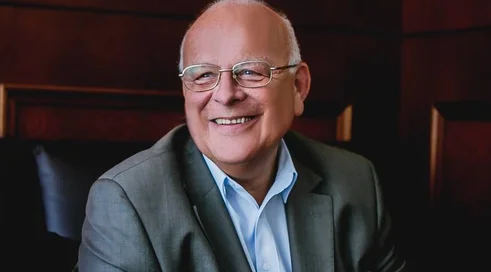
As I read about the salaries of some doctors, I feel like an idiot, because with all my titles about these amounts I can only dream. On the other hand, I'm undoubtedly not a poor man, and I probably wouldn't have the time to manage such a mountain of money, since every property needs to be handled later.
Feature
Prof. Wieslaw W. Jedrzejczak
Doctor's checkout

Published Dec. 15, 2025 07:13

FOT. ADAM STEPIEN / AGENCJA GAZETA
On the other hand, I have a sense of enormous information hype, because while the discussion is only about the public sector (in the private sector, no one has anything to do with how much anyone earns?), there is a huge confusion of concepts. After all, one thing is the salaries of contracted employees, another is on-call payments, another is discretionary bonuses, and finally, another is income from B2B, or contracts. What's different is regular monthly income, and what's different is performing certain tasks on a piecework basis in some particular month. Finally, since we don't know to whom these gigantic earnings apply, we don't know whether they are undeserved. From all of this, there are different amounts, but also different burdens. The higher the amount of income, the higher the tax, too, that is, the return of the money paid out of the public coffers to that coffers. In addition, the more revolving (e.g., me) independently pay three different health premiums as if they were three people.
I'm not complaining. There must be some kind of payment on my part for wanting and being able to work hard at my age. Rather, it is a biological privilege that 1/3 of my fellow students have not lived to see.
Exactly 50 years ago I started working as a civilian employee of the US Navy, and there the pay scale was an 18 x 10 rectangle: there were 18 salary grades (I had 11) each in 10 ranks depending on seniority (I had 1). I never encountered a simpler pay system later on, and I don't know if it persisted, but it shows that sometimes in the public sector, too, the issue of salaries can be straightforwardly regulated.
The current confusion in salaries is not the work of doctors but of politicians and other health care administrators, and this is unfortunately their problem.
Wieslaw Wiktor Jedrzejczak