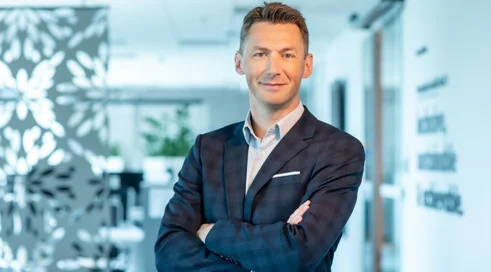
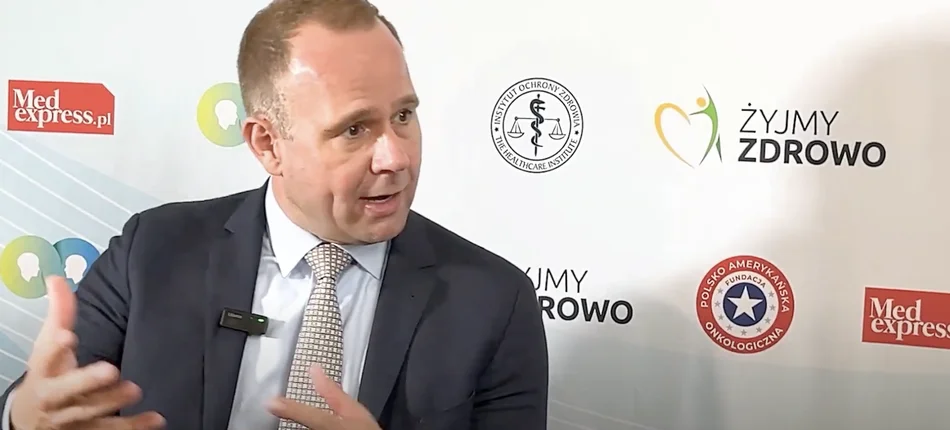
Holger Pfeiffer, president of Bayer in Poland, the Czech Republic, Slovakia and Hungary, and head of the Pharmaceuticals division in the region, talks about innovation, artificial intelligence, and EU law reform.
Holger Pfeiffer: We are at a very important moment for the pharmaceutical industry in Europe

Published Sept. 24, 2024 10:11
How often do you do research?
I try to do the most important tests as recommended-especially when it comes to male diseases, cardiovascular diseases. Although I sometimes skip appointments, I monitor the issue of research. I also try to eat consciously.
So by your example, you confirm that awareness is the most important issue in taking care of health.
Yes.
Turning to the topic of pharmaceutical companies: it seems to me that the most interesting topic is the creation of innovation. The main challenge is no longer rather the production of drugs that have been used for years in therapies, but innovation. What innovations is Bayer currently working on?
This is a very broad spectrum of solutions. We can look at them from both the technology and therapy side. Our goal is to increase health awareness as well as treatment innovation.
An example of the latter area is cell and gene therapy. These are very cutting-edge treatments for diseases and an area that is being intensively explored. There are thousands of ongoing clinical trials, conducted by companies. It is also an area with great potential, sometimes called the medicine of the future. The essence of these therapies is to target diseases at the cellular and genetic level, the root cause of some diseases. These methods have the potential to stop or even reverse disease progression. Thus, we are talking about new therapeutic modalities and approaches, a move away from classic methods such as pills and injections as we know them, to more comprehensive therapies.
What projects are you currently developing in this area?
We have several areas where we are exploring these opportunities. In recent years, we have invested nearly €3.5 billion in platforms to discover and develop new cell and gene therapies. We have two subsidiaries - under the names AskBio and BlueRock - that are exploring and developing these opportunities.
They are currently embarking on the clinical development of new solutions - a stage that precedes the marketing of drugs.
What specific solutions could help patients in the near future? What can be proposed to treat, for example, cardiovascular diseases?
There are many solutions available. Take the example of Poland, which I have been observing closely since I arrived in Warsaw one year ago. Compared to the rest of Europe, I was impressed by the coordinated health care programs, as well as the cardiovascular strategy.
Many solutions are already available, and I believe that when using existing tests to detect diseases early in at-risk groups, according to the guidelines, much can already be done. It's important to make sure that existing options are widely available before disease symptoms even appear - it's a very important step to act at this early stage.
What breakthrough therapies is Bayer currently working on?
Among the most important is the area of cell and gene therapy, involving a completely new approach to treatment. In parallel, a great many classic drugs will be brought to market.
On the New York Stock Exchange, we have seen a decline in the listings of companies working in the field of artificial intelligence. However, this does not mean that AI is no longer relevant. Are you taking advantage of it? Does artificial intelligence support you in developing innovations?
Of course. Artificial intelligence has developed with unprecedented speed, especially in the last two years.
Data-driven technologies, engineering and data analysis, which are the basis of predictive analytics, machine learning, are elements that we use in many areas in our value chain. This includes drug development, as well as clinical trials, clinical evaluation, pharmacotherapy safety: here we use artificial intelligence to, on the one hand, increase efficiency and, on the other, innovation.
In the field of health care, there are two groups of people who should have the most influence on it. They are the politicians, who make the decisions, and the patients. Are you working with both of these groups? Are regulatory institutions willing to support innovation in pharmaceutical technology? Do you cooperate with patients and support their initiatives?
In both cases - yes. We try to maintain contact with patient organizations as much as possible. As you know, the pharmaceutical sector is a highly regulated industry, and within this framework we maintain relations with patient organizations and, at the same time, with state authorities. We discuss a great many issues with them, whether in connection with registering a drug or obtaining reimbursement for it.
In terms of policy, I think we are at a very important moment for our entire industry in Europe, as pharmaceutical regulatory reform is currently being discussed at the EU level.
It will be of momentous importance. Poland has a key role to play here as part of its upcoming presidency of the EU Council. It comes at an extremely important time, as the last time this legislation was modified was 20 years ago.
The priority is to ensure that all patients have a chance at health and access to medicines. At the same time, future innovations must be taken into account and anticipated in regulations today. This is a once-in-a-generation opportunity, because if we want to come back to this in another 20 years, the medical industry will probably already look quite different.
Health care revolves all the time around money: the expenses that governments incur and those incurred by people. A German pharmacist said: "Medicine is for the people, not for profit. The better we understand this, the more benefits medicine will bring us." What is your opinion?
I agree that patients must be at the center of medicine. At the same time, we should take into account the fact that the pharmaceutical industry and, more broadly, life science is the industry that, of all, reinvests the largest share of revenues in research and development. This is what drives innovation.
Of course, a balance must be struck in which the patient will always be the most important actor.
The company is a partner of the material: