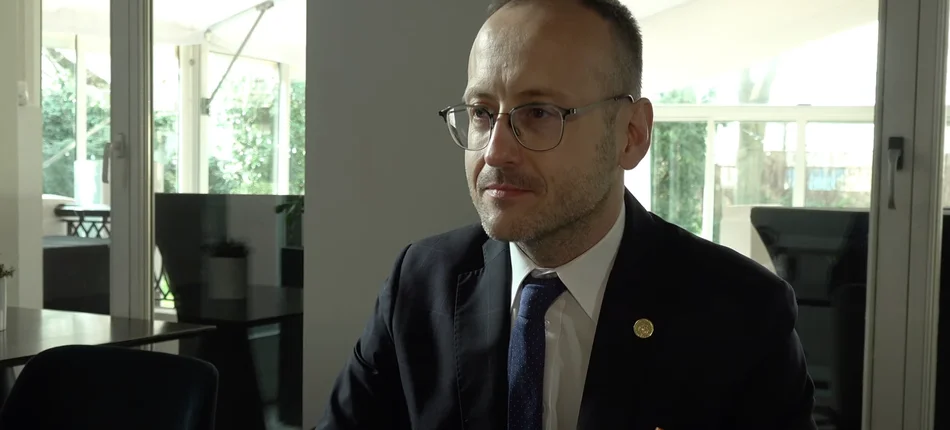
Prof. Lukasz Krzych, head of the Department of Anesthesiology and Intensive Care, Prof. K. Gibinski University Clinical Center of the Silesian Medical University in Katowice, tells us about modern anesthesiology.
Modern anesthesiology: safety and efficacy

Published April 9, 2024 08:00
What distinguishes modern sedation drugs from older generation ones?
Modern sedation drugs are supposed to guarantee patient safety and efficacy. Current designed clinical trials are conducted with numerous strictures. As a result, it takes a long time before a drug that has been created as a chemical molecule somewhere enters the market for clinical use. The priorities that are taken into account in clinical trials are the drug's effectiveness and its safety. And balancing these two factors as a benefit to the patient.
And what benefit do they bring to the doctor?
First and foremost, the ability to safely perform the procedure in question. Because, after all, we are talking about surgical procedures here. But let's not forget that at the center of our interest is the patient. It is for the patient that these drugs are created, not for doctors.
In which procedures is sedation advisable or a good option for the patient?
Sedation, combining many effects, including the one related to eliminating the patient's anxiety, is actually possible to implement in most procedures. It depends a little bit on the patient, how afraid he or she is of the procedure and how his or her body reacts with a stress reaction to the procedure in question. That is, it could be from such very popular and seemingly trivial procedures, for example, biopsies, endoscopic procedures, both upper and lower gastrointestinal, or numerous cardiac procedures. And we could also find such procedures in pulmonology such as bronchoscopies. In the conditions of orthopedics, traumatology, for example, setting fractures. Any procedure that for the patient is associated with anxiety can be secured with a sedative drug.
So could we improve prevention? For example, some people avoid colonoscopy because they are afraid of pain....
Of course, here we are talking about modern medicine. If we are talking about modern medicine then it should be so in each of the planes we are talking about. Not only about the equipment, not only about the preparation of the doctor, but also about pharmacotherapy. And, as much as possible, colonoscopies or gastroscopy should be performed with sedation drugs, because this gives a mutual benefit both to the patient, who can go through the whole procedure painlessly and without fear, but also to the doctor-operator, because such a procedure is then easier and faster to carry out. So this also translates measurably into the entire health care system, because these procedures can be carried out more in a limited time.
And what is septic shock? Why is it so life-threatening for patients?
Sepsis is a silent killer. We doctors have known about it for very many years. The public still doesn't. It wasn't until the action of the Great Orchestra of Christmas Charity that a little bit showed the public what sepsis is. This word began to be conjugated by all cases, sometimes good, sometimes bad. But the most dangerous life-threatening condition of sepsis is septic shock. The mortality rate of patients who develop sepsis and septic shock exceeds 50 percent. Thus, one in two patients may die. Hence, all diagnostic and therapeutic measures are designed to save the lives of the public.
How does anesthesiology today deal with patients in more difficult situations, for example, patients in septic shock?
A battle has been waged for many years. New scientific studies are being designed to reduce the mortality rate in sepsis. I have to worry you, but we are not succeeding very well. Despite the implementation of international recommendations, the creation of modern recommendations, we still have to look for new solutions, both in the diagnostic and therapeutic context. And here, for us, the basis is physiological and pathophysiological knowledge, combating the symptoms of septic shock, that is, proper fluid therapy, the so-called "drip", and the use of drugs to restore cardiovascular function, that is, to improve cardiac function and to maintain proper blood pressure.