Urologists from the Świętokrzyskie Oncology Center have performed the first percutaneous cryoablation of kidney tumors in patients with cancer of this organ in the Świętokrzyskie region. There are only a few centers in Poland performing such procedures.
Needle and frost in kidney cancer. Urologists at the ŚCO have implemented cryoablation of kidney tumors

Published Nov. 29, 2024 11:55
fot. ŚCO
- We are committed to operating on kidney cancer patients radically, with the least possible invasiveness. With the traditional method, one would have to cut the shells, while now we can perform the surgery percutaneously and perform radical treatment of the kidney tumor," explains Prof. Stanisław Góźdź, director of the Świętokrzyskie Oncology Center.
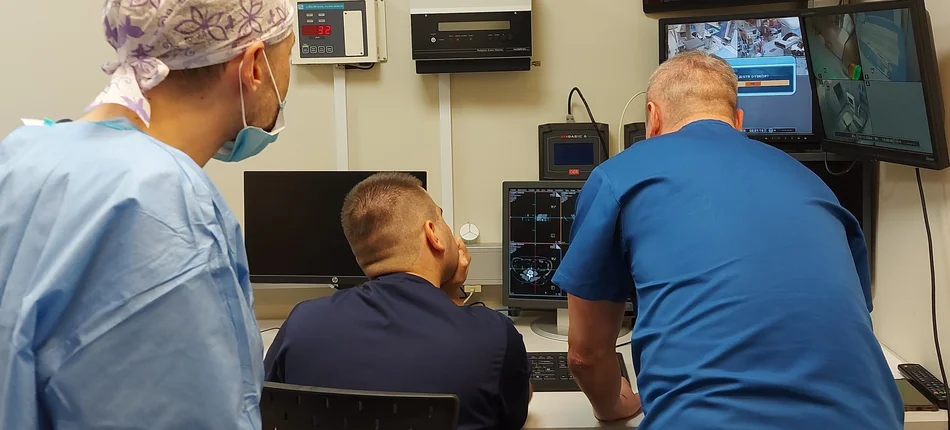
Transcatheter cryoablations of renal tumors were performed on November 5 and 19, 2024, by interdisciplinary teams consisting of urologists, radiologists, a surgical nurse and ŚCO electroradiology technicians. Dr. Andrzej Niewczas and Dr. Łukasz Niedziela from the ŚCO Urology Department were assisted by Dr. Dawid Dopierała and Dr. Damian Kopycki, radiologists from the ŚCO Imaging Diagnostics Department.
The cryoablation procedure is performed under local anesthesia and under CT scan guidance. It takes about 1-2 hours, depending on the size of the tumor. It involves freezing the tumor tissue to minus 40 degrees C using argon gas, delivered through needles (probes) inserted through the patient's skin into the tumor. Freezing and passive thawing of the tumor is carried out twice during the procedure. This low temperature ensures complete freezing and necrosis of the tumor tissue with sparing the healthy kidney parenchyma to preserve the patient's renal function. After the procedure, the body absorbs the necrotic tissue and only scar tissue remains in the kidney.
- During the procedure, the patient is conscious. The pain sensation is that of an injection during the administration of local anesthesia. Our patients report that the sensation of pain is momentary, at a level of 4-5 on a scale of 0-10, during the insertion of the needles. The next day, the patient goes home," says Dr. Andrzej Niewczas, a urology specialist at the ŚCO Urology Clinic.
After returning home, the patient should avoid exertion for a while to minimize the risk of bleeding or complications at the site that was frozen.
- After 2-3 months after the procedure, an imaging study is carried out to evaluate the effectiveness of our treatment. We establish a whole follow-up regimen, the basis is imaging studies: CT or MRI at appropriate intervals," adds Dr. Andrzej Niewczas.
For whom percutaneous cryoablation
Patients with histopathologically confirmed renal cancer are qualified for percutaneous cryoablation. For this purpose, a percutaneous biopsy of kidney tumors under CT guidance is performed before the procedure.
As emphasized by Matthew Obarzanowski, MD, urology specialist and deputy head of the ŚCO Urology Department, the world standard of treatment in kidney cancer remains surgical treatment, i.e. removal of the tumor or removal of the kidney together with the tumor.
- In selected cases, when a patient has multiple burdens that make surgery or anesthesia impossible, due to age, or due to having the only kidney we want to preserve, cryoablation of the kidney tumor may be an alternative. In terms of oncological effectiveness, such treatment is comparable to surgery. However, it is not for all kidney tumor patients, but only for a select group," says Dr. Obarzanowski.
A very important group are patients who have the only kidney and the risk of losing a kidney involves condemning them to dialysis. This also applies to patients whose kidney function is already baseline before surgery, the urologist points out. - With this new treatment method, we can preserve most of the kidney parenchyma and thus its function.
As urologists explain, the larger the tumor, the more complicated the procedure is, and it also requires the use of more needles, since the range of freezing focus that a given needle can produce is limited. The method itself is used for lesions that are relatively small, measuring about 4 cm.
About 5,000 new cases of kidney cancer are diagnosed annually in Poland.
Source: ŚCO