A program to treat spinal muscular atrophy (SMA) with nusinersen has been in place in Poland for seven years. Observational studies show that patients, including those with advanced disease, benefit in real ways - not only stabilization, but also gradual improvement in function. The Polish program is distinguished by rapid screening of newborns, availability of therapy across the full age spectrum and support for pregnant women. - From the beginning, we have had the availability of therapy for patients across the full age spectrum, regardless of the severity of symptoms, and our experience shows what an excellent reimbursement decision this was," stressed Prof. Anna Kostera-Pruszczyk, at the SMA Foundation conference.
Polish SMA treatment program as a model for the world. Prof. Anna Kostera-Pruszczyk on seven years of therapy with nusinersen

Published Nov. 13, 2025 06:45
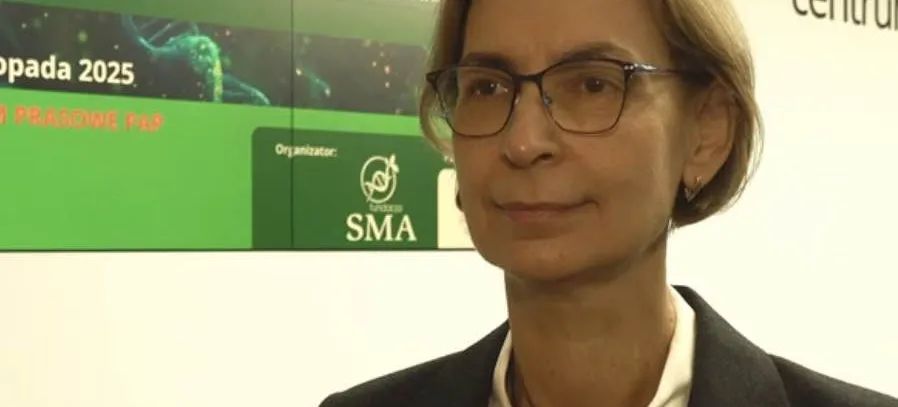
Professor, today at the SMA Foundation press conference, the long-term results of observational studies for nusinersen in a broad spectrum of treatment were presented. Can we ask you to summarize them? What are the differences between our data and those from other European countries?
Indeed, we are in an excellent place - we are summarizing 7 years of the drug program for the treatment of spinal muscular atrophy in Poland. We now have all three therapies registered in Europe available in the program. Of course, the availability of these therapies varies. We can certainly boast, not only in our Polish conditions, but also before the world, of the results of a very long follow-up of adult patients who, from the beginning in our drug program, have gained access to the first therapy registered in Europe with a drug called nusinersen.
All evaluations are performed in the appropriate physiotherapy scales. They show that our patients, including those with very advanced disease at the time of starting therapy, benefit, which is not only marked in the first several months of therapy. If we had achieved self-stabilization of the disease, this would already be a very clear improvement in terms of the expected course of this progressive neurological disease, but we see that each successive dose is associated with another effect, even a small one, but one that adds up nicely in the following months or years of therapy.
A large meta-analysis was also published recently, in which data from our and Krakow's centers were included. First of all, our results are, in general, consistent with what has been reported by doctors from other parts of the world. Particularly noteworthy is the fact that our Polish patients gain more. How is this possible? Thanks to the great determination of our patients and their relatives, because we realize what a great added value to pharmacotherapy is, for example, regular rehabilitation, physiotherapy. We dream of better access to reimbursed physiotherapy for our patients.
Unfortunately, part of the cost of this fight for their health, in terms of at least just rehabilitation, is borne by the patients themselves. And this is certainly the great commitment of Polish neurologists and pediatric neurologists. The moment the therapy was reimbursed, we were able to launch the drug program together very quickly. We treat almost 100% of SMA patients in Poland, and indeed our solutions and results are an excellent model also for Western European countries or the United States.
In this case, can the Polish drug program be a model for other European countries, and if so, what, in addition to the aspects you mentioned earlier, Professor, can still distinguish it?
I think there are several such very important distinctions. The first, it seems to me particularly important, is the combination of an excellent neonatal screening program for SMA, which means that since its implementation, the vast majority of children begin treatment before the end of the first month of life, which is when there are as many salvageable motoneurons as possible.
We have a unique solution that allows us to combine very rapid diagnosis with a very good pathway to access treatment for the disease. Of course, according to the registration indications, there is the possibility of reaching for single gene therapy, and where the child has four times as many copies of the SMN2 gene there is the possibility of using one of the other two drugs.
Another unique solution is the decision last spring, which allowed us to continue reimbursable therapy with just nusinersen, for women with spinal muscular atrophy who are pregnant at this point. This is not a break in therapy, which could bring often irreversible, potentially worsening, results.
Finally, the fact that from the beginning we have the availability of therapy for patients of a full cross-section of ages, regardless of the severity of symptoms, and our experience, but also those coming from the world, show how excellent in terms of content and justification this reimbursement decision was, and how much our patients benefit from it.
However, there are more and more SMA patients in drug programs. What challenges are and will doctors and hospitals face as a result?
Of course, a challenge that has already been talked about in the public space for some time is the issue of access to drug programs through certain contractual restrictions, especially for centers treating adult patients.
The issue is the ratio between the number of centers treating children and adults. Why? First of all, children are being born less and less, so the wards of pediatric neurology will decrease. Children are treated with gene therapy. The vast majority of them will most likely function very well and will not require regular care.
Meanwhile, however, adult patients are those who, by definition, started therapy symptomatically, so it is in them that we cannot expect full reversal of the effects of the disease, and besides, neurology departments also have to face an increasing number of patients with civilization diseases. We are living longer and longer, and unfortunately these last years of life are not years of life spent in health. This is a situation when, unfortunately, there are more and more needs when it comes to specialized care, so here we definitely need more centers treating adult patients, better financial support also for treatment centers in this and other drug programs, improvement of the price of the so-called "service."
And something else that seems to me to be a demand we have been repeating for a long time - a careful review of what is involved in administering drug programs and an attempt to reduce this administrative burden, which, on the one hand, we understand and respect, because these are innovative therapies and here every tablet or ampoule reported must be properly reported to the National Health Fund. On the other hand, we would like to have more time for patients and spend a little less of it at our computer systems.
Is the valuation of benefits adequate for treatment needs?
We have presented such analyses many times in previous years as well, and the last similar summary we presented to the NFZ was for last year.
The valuation of this program was estimated in various centers at about 40-50% of the actual costs incurred. And therefore, on the one hand, once again - a low bow to the teams, departments that treat patients with great commitment, understanding how important this is for our patients, but on the other hand, we would like to be able to, for example, hire another person to work in order to make the queues shorter, to make it easier for patients to access this and other therapies. I think a lot has already been said on this subject, but we will certainly remind you of it. We are not doing it for ourselves, we are doing it in the interest of our patients.