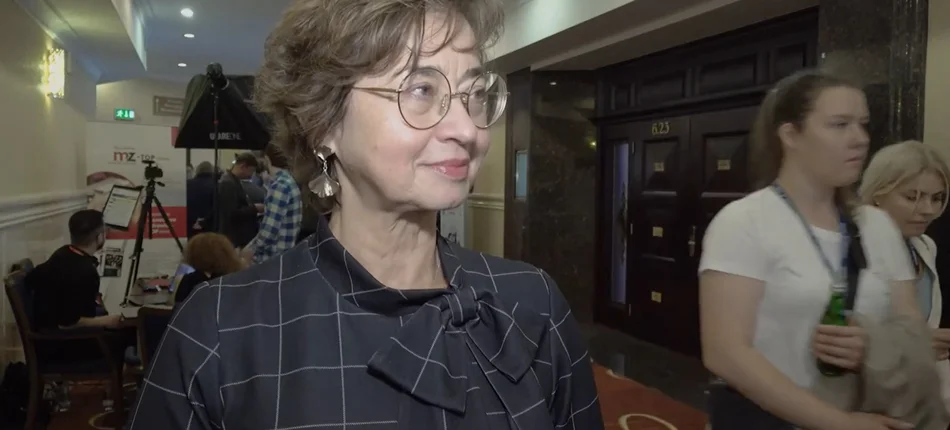
Interview with Prof. Barbara Radecka, head of the Department of Oncology at the Prof. Tadeusz Koszarowski Oncology Center in Opole and Opole University.
Prof. Barbara Radecka on treatment needs for early breast cancer and disseminated intestinal cancer

Published Sept. 21, 2023 08:00
What are the current needs of clinicians and their patients in relation to early breast cancer?
The best defined need at the moment is to introduce reimbursement for treatments that would be dedicated to patients with early, hormone-dependent breast cancer who have a high risk of recurrence. We in oncology define this risk based on the initial stage, so the size of the primary tumor, metastasis to the axillary lymph nodes, the degree of malignancy, a parameter related to cell proliferation. These are some characteristics based on which we can say that even in a patient with a small tumor, the risk of recurrence is high. In different cohorts, it is estimated even at about 30 percent. This is not a small number, because out of 10 women treated radically, three will experience failure. We would like to reduce this risk of recurrence by various possible means. Such ways include the use of postoperative hormone therapy, in selected groups the use of chemotherapy as well, but what has emerged recently is the use of ciclib, which is an additional treatment that, when used in parallel with hormone therapy, increases its effectiveness. This allows us to reduce this risk of recurrence. In radical treatment, the goal is a cure, so if we can protect some patients from recurrence, we increase their chances of a permanent cure. Our goal is that cancer does not shorten people's lives, so that patients can live to an average population age despite being diagnosed with early breast cancer.
And what needs are associated with disseminated colorectal cancer? We are already talking about the last lines of treatment.
In colorectal cancer, new therapies have recently emerged, also covered by reimbursement, including immunotherapy. It is dedicated to a very narrow group of patients. That's a mere 4-5 percent of patients with a particular molecular disorder. For these patients, the introduction of immunotherapy makes it possible to use this treatment in different lines, starting with the first, but also in subsequent lines. This is a very big advance, especially since immunotherapy is a treatment with very high efficacy. There are, of course, still unmet areas. These include patients with BRAF mutations - a difficult group for whom there is also molecularly targeted treatment. This is about 8-10 percent of patients with aggressive disease. As far as I know, the reimbursement process for this treatment is underway. We also have treatment based on classical chemotherapy, which in combination with anti-angiogenic biological therapy is proving to be a much more effective treatment than chemotherapy alone. This treatment is also dedicated to subsequent lines of treatment. Its value numerically is not very great, but in the treatment of chronic disease, small steps, which can be applied sequentially, ultimately add up to a significant extension of human life.
Thank you for the interview.