Will the Ministry of Health meet the demand of the pediatric neurology medical community and extend the availability of gene therapy to children whose screening tests found four copies of the SMN2 gene?
SMA: One drug administration makes it possible for patients and their families to forget about the disease

Published Sept. 27, 2024 16:16

During a meeting of the Parliamentary Group on SMA, experts presented data on the benefits that gene therapy has brought to patients. Children who received it as part of the drug program, even before the onset or severity of the disease's symptoms, they stressed, are now developing virtually as well as their healthy peers.
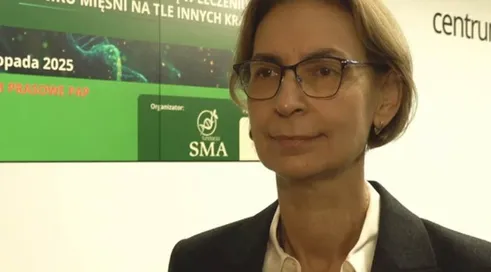
More than 4,000 children with spinal muscular atrophy worldwide are being treated with gene therapy. - The longest follow-up published is 7.5 years. The results of ongoing long-term observations in patients with pre-symptomatic and symptomatic SMA indicate that a single intravenous administration of the therapy provides sustained high efficacy and, importantly, with no new safety signals," said Prof. Mazurkiewicz-Beldzinska, and noted the success of implementing a screening program and treatment for SMA. - I absolutely did not expect that in 2024 we will be talking about spinal muscular atrophy as a chronic disease that requires patient control and coordinated care.
Prof. Katarzyna Kotulska-Jóźwiak, chairwoman of the Coordinating Team for the Treatment of Spinal Muscular Atrophy, stressed that gene therapy has become a permanent part of the SMA treatment landscape.
However, not all children confirmed to have SMA at screening have access to gene therapy. Children with four copies of the gene receive treatment, but with the other drugs in the program. - It is in these children that the administration of gene therapy would make the most sense - their disease progresses, in the vast majority of cases, more slowly and later, and one administration of the drug can virtually eliminate it. The patient and his family can "forget" about the disease for life," said Prof. Mazurkiewicz-Beldzinska. She also stresses that a patient with four copies of the SMN2 gene who receives gene therapy will be completely healthy - the probability is 99%. This patient of working age will forget that he or she has been taking medication. This is a patient whose symptoms may not appear. Hence was our appeal. Consequently, this patient will be cheaper for the system. - A patient with four copies has almost a 100% chance of being cost-effective," she explained.
With four copies of the SMN2 gene, one in four children is born in whom screening confirms SMA. At the moment, experts estimate, there are no more than ten such children each year. But will the Health Ministry decide to expand reimbursement? For the time being, such plans do not seem to exist. Matthew Oczkowski, deputy director of the Department of Drug Policy and Pharmacy, spoke directly about financial constraints. He recalled that 17 percent of the National Health Fund's budget for services is allocated to reimbursement (in fact, this is the maximum limit, reimbursement expenditures haven't really approached it for years, currently hovering around 13-14 percent, while Deputy Minister Marek Kos, responsible for drug policy, has recently said publicly that there is no chance in the near term for more money for drugs, because there are other pressing needs), and since it is difficult to assume a very rapid increase in health expenditures, the reimbursement budget won't grow quickly either.
Experts also responded to concerns about the sufficiency of gene therapy. These are children who have received gene therapy through public collections and some of whom are continuing treatment under the drug program. Experts made no secret of the fact that these are children who were given gene therapy after the onset of symptoms (this is true of virtually all children benefiting from public collections), and had no chance for the drug to produce spectacular results. Nevertheless, half of them do not benefit from other available medications and all of them, experts stressed, benefited measurably from gene therapy. However, they cannot be contrasted with those of the children treated pre-symptomatic. In their case, as Prof. Mazurkiewicz-Beldzinska emphasized, there is no reason to assume that it will be necessary to include another drug. Indeed, what determines the effectiveness of treatment is first of all the moment when the therapy is switched on, not even what drug it is, but when it is switched on. Children reach milestones. The basis is early diagnosis.