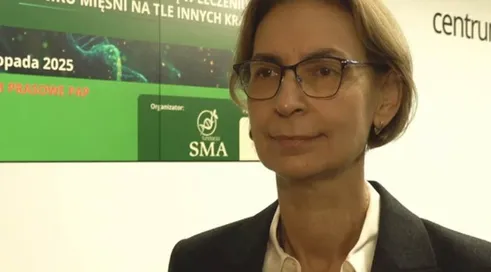
We talk about the model treatment of SMA and the future of spinal muscular atrophy treatment with Prof. Katarzyna Kotulska-Jóźwiak from the Department of Neurology and Epileptology at the Children's Memorial Health Institute.
SMA: Success of treatment in Poland

Published Nov. 27, 2025 10:28
Professor, what is the long-term impact of universal access to nusinersen therapy in spinal muscular atrophy in Poland based on 6-year follow-up?
Actually, we have had access to nusinersen for even longer and longer follow-up in a certain small group of patients. Under the drug program, we have actually had access to this treatment for six years, whereas more than a year before, thanks to the launch of the so-called early access program. It was a very limited program - for thirty children with spinal muscular atrophy type I. But in this group of patients, we have those who have been treated for even longer, about eight years.
In the drug program, it is worth reminding, we not only have dispensing of the drug, but also evaluation of its effectiveness and safety based on scales used to assess muscle strength and range of motion in patients, so we can show the effectiveness of the treatment in numbers: not only how many patients respond, but also what that response looks like.
What is most significant arising from our analysis is first of all that in most patients, in more than 80%, we succeed in a long treatment effect that is not only a stabilization of the disease, but is a significant improvement, that is, patients regain or acquire functions they did not have before. Such a response, which we consider to be already visible to the observer, important for the daily functioning of the patient and his family, is a change of at least 4 points on one of the scales we use in younger children, or at least 3 points on the scale we use in older patients or in less advanced stages of the disease. This is achieved in more than 80% of patients. 99%, almost 100% of patients are those in whom we manage to achieve at least stabilization of the neurological condition. This is important because spinal muscular atrophy, like most neurodegenerative diseases, is a progressive disease and our first goal is to stop the disease process.
Professor, you mentioned clinical improvement. What does that mean, clinically relevant improvement, and what is reflected in the observational data you presented in SMA?
This significant improvement is the possibility of regaining or gaining, depending on whether we are talking about a patient who has developed some function, such as walking, or in a patient whose disease began earlier, before that function was mastered by the patient, some function, but also some movement essential for daily functioning.
Of course, expectations for therapy and also the definition of this clinical success depend on what kind of patient we are dealing with and at what age, but most importantly, at what stage of disease progression. Patients who start therapy in the pre-symptomatic period have completely different expectations. Now we are dealing with this more and more often because of newborn screening, and of course in such a patient - a newborn we diagnose before the first symptoms of the disease are even apparent - our goal is to maintain this asymptomatic course of the disease, that is, to maintain such a state in which the patient has no symptoms of spinal muscular atrophy.
It is difficult to talk about improvement in such a situation. Stabilization, i.e. absence of symptoms of the disease, is what we want to achieve and actually the best possible result of treatment. And thanks to the treatment with nusinersen in those patients who had the treatment switched on in the pre-symptomatic period, in all of them, literally all of them, we have achieved just such an effect, that is, the patients do not develop symptoms of SMA.
As for patients who started therapy after the onset of symptoms of the disease, their expectations are also different. In those whose symptoms were initial, very minor, as for example we have a group of teenagers who started treatment at a time when they noticed only the first symptoms of loss of motor capabilities, for example, difficulty getting up from a squat, or difficulty climbing stairs, these expectations are quite different from those of patients who have been ill for a very long time and already require mechanical ventilation and are bedridden patients.
For the latter group, features that allow them to stay in touch with the world, and often enable them to work professionally, such as the ability to maintain hand movement, which allows them to operate a phone, joystick, tablet, are very important for patients. An improvement for them could be to extend the time they can use such equipment.
For different patients, this definition of success will vary. We measure it for the drug program in points, which, of course, does not always reflect the patient's expectations. And as I said, this improvement in points is achieved in more than 80% of patients.
In the B.102 drug program, since October there has been a clarification of the provisions regarding changes in therapy for SMA patients. What does this clarification of provisions consist of and have patients been given the option to return to the first drug, nusinersen?
Yes, I think the program was conceived from the very beginning to be very broad, to allow all patients to receive treatment that is supposed to be not only effective, but also safe. Initially there was only one drug available, the first one registered - nusinersen, then two more drugs appeared, that is, the orally administered drug, risdiplam and gene therapy, and some patients for whom the canalicular administration of nusinersen was difficult, requiring general anesthesia, administration of the drug under radiological control, decided to switch to oral therapy.
In this oral therapy, however, there is a provision that it is contraindicated during pregnancy or when planning pregnancy, and this was the first group of patients in whom we began to think about whether to describe this possibility of returning to intrathecal therapy, among other reasons, in order to allow treatment during pregnancy, which the drug program has also allowed for some time. Also, our intention to indicate as precisely as possible what the options are for changing therapy from intrathecal to oral, but also from oral to intrathecal, even in a situation where we already had this change from intrathecal to oral, I think we've managed to describe it well, and at the moment we have these guidelines from the coordination team, which indicate how this should look. Also, the monitoring system for therapeutic programs, that is, the SMTP system, where patient data is entered, also already makes this change possible.
As you said, for more than seven years in Poland you have had experience in treating with this drug. It was the first drug registered and reimbursed, as far as SMA is concerned. The data on the effectiveness of this therapy is very optimistic. Why does this drug show such high efficacy?
The mechanism of action of nusinersen, like all three drugs used in spinal muscular atrophy, is that the drug delivers a protein that is missing as a result of the disease-causing mutation, a mutation in the SMN gene.
How this protein is delivered is different. Nusinersen and risdiplam bypass this mutation in that they affect the production of the protein based on a second sister gene, which normally, that is, without pharmacological intervention, produces only a small amount of this normal protein, and a sizable amount of non-functional protein. By altering its translational transcription process, we can achieve a significantly higher production of this normal protein. Gene therapy provides a normal copy of the SMN gene. Importantly, none of these therapies are regenerative therapies, none of these therapies repair irreversibly damaged spinal cord motoneurons, those cells whose damage causes the symptoms of spinal muscular atrophy. Nusinersen, because of its route of administration - intrathecally, that is, near the motoneurons - has two distinguishing features from gene therapy and from this therapy administered orally.
First, when administered closer to the motoneurons, it achieves high concentrations for obvious reasons in the cerebrospinal fluid, which is where we want it delivered to the central nervous system. But this at the same time has risks associated with the route of administration, hence the difficulties in some patients especially those with very severe disease symptoms and advanced scoliosis. Also, it's a bit of a choice between being able to administer it systemically, that is, not by the lumbar puncture route, and achieving a high concentration of the drug in the cerebrospinal fluid and acting only into the cerebrospinal fluid.
Of course, this topical administration, that is, such targeted administration, is also associated with the fact that the drug has no side effects. In fact, there are no such effects that have been described that affect the whole body, that is, the risk of the drug causing any side effects on the liver, kidneys or other organs is minimal, but there is also this peripheral effect. We still don't know yet, we are working on whether this peripheral action, i.e. delivery of SMN protein to other sites, is relevant. It seems, given that patients who receive the drug pre-symptomatically persist as pre-symptomatic patients, that this action with nusinersen is not so significant, at least in the pre-symptomatic patient group.
Just a dozen years ago, probably few imagined that this is how SMA patients would be treated, and few thought that Poland would even be a model example of patient treatment. And what's new on the horizon for SMA patients?
I will still go back to what you mentioned, that in our case it is systemic coverage of patients, because it is extremely important that the drug program from the very beginning requires patients to be covered by multispecialty care, including an individual rehabilitation plan tailored for each patient. This plan must be reviewed annually, at least once a year. As a result, we really have such a model situation for achieving optimal benefits from therapies that are not inexpensive therapies. Thanks to the fact that we include multidisciplinary care including rehabilitation, we can make the best use of these therapies.
And as for the future, we have several different things on the horizon. Some of it will probably happen in the very near future, and some of it will still have to wait. There are ongoing clinical trials of drugs that are drugs that work very differently. We have clinical trials for new completely symptom-acting therapies, that is, therapies that increase muscle strength, not necessarily just for patients with spinal muscular atrophy, also for patients with other diseases. It seems from preliminary results that such treatments for patients with symptomatic spinal muscular atrophy may make sense. These drugs include primarily myostatin inhibitors, these studies are quite advanced. We also have studies that look at a completely new molecule that is structured similarly to nusinersen, but differs primarily in its duration of action, which means that the drug will be possible to administer even once a year, which will significantly improve both the comfort of treatment and the burden on treatment centers. We also have a clinical trial of nusinersen administered at a higher dose already completed. Nusinersen, which is registered, was studied a long time ago, already more than 10 years ago, in the highest dose of just this registered 12 mg, it was not known whether the higher dose of the drug was effective and safe. This study, which has just ended, has provided such evidence that there is a point in using the higher dose and we are therefore waiting for its registration.
We have also registered a new form of administration of risdiplam. This will be risdiplam in tablets, this drug is not yet reimbursed in Poland. Studies of gene therapy administered via the intrathecal route are also underway, so there is a lot going on, and we will probably have other treatment options for spinal muscular atrophy in the next few years.