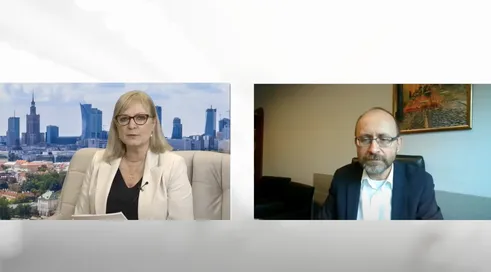
Interview with Prof. Zbigniew Żuber, pediatrician, rheumatologist, head of the Department of Pediatrics and Rheumatology at St. Louis Hospital in Krakow.
Specifics of clinical trials in rare diseases

Published July 10, 2024 10:00

Today we are going to talk about clinical trials in rare diseases. We have 7,000 rare diseases described and only 140 registered orphan drugs (please correct me if these figures are a little different). And rare diseases in clinical trials have their own difficult specificity, so let's tell you what it is.
The specificity is that we have rare or ultra-rare diseases, that is, diseases that are rare in the population. That is, we have such disease entities that we are even treating at the moment, such as Charcot-Marie disease in five patients. In the population, the incidence of just such disease entities is once in several million - one birth in several million births. And I want to emphasize that in order to do a clinical trial, we should have at least a few dozen to a few hundred or a few thousand patients. We can imagine that if we have in the Polish population, which is very roughly 10 percent of the population of the European Union (actually about 7.5 percent), we should have in European countries - a few hundred such patients at most. That is, we need to have a large worldwide study, if we have a few or a few hundred patients in general, to organize and conduct this study reliably.
But this research is going on in rare diseases.
Of course, only these are generally multicenter, international studies, that is, many countries have to participate. It is a matter of coordination and the right approach. But we must remember that we have different regulations, different insurance systems. That is, it is not easy. It is much easier to conduct a study with similar conditions, because clinical trials must be safe. This is the first essential element absolutely observed. That is, first the safety of the patients and only then can there be further phases of the study, so it's an arduous process.
Are these procedures, which are mandatory to just ensure safety, the same in research for rare diseases as for other diseases? Because it seems that in the case of rare diseases, this time is crucial. It is very important to be able to get a molecule into treatment as soon as possible. So what does this look like? What changes should take place so that patients in rare diseases have more of these molecules, so that this treatment could be broader?
We have a huge problem, because first of all the most important thing is the safety of the patient. That is, all the safety rules that apply to clinical trials must be followed. It is impossible to register a study either with the EMA or the FDI that would not comply with the GCP rules, with the Chinese Convention, which are the absolute basic canvass of research. If the appropriate safety systems are not in place, there is no way to conduct such a study. There is no room here for over-reaching licenses to allow testing of dangerous drugs. This is simply impossible. An unsafe drug will be doomed to failure anyway, because complications will generate too much risk for patients and they will end up unhappy. On the other hand, the issue of the size of the patient groups in which the trials will be conducted is up for discussion. That is, limiting the number of patients in terms of statistical requirements. And here, of course, there is room for discussion and tailoring of research capabilities to a given promising drug that is expected to bring improvement in a particular group of patients.
Is it possible to change the scenario of these studies conducted in rare diseases and why is this important?
It's already a matter of fitting into a specific protocol.
Evaluation criteria should be different for clinical trials in rare diseases.
Of course! We are dealing with genetically determined diseases, where we absolutely know what the mode of inheritance is and what the symptoms are. And here we have at the moment a great hope for interventions, that is, genetic modifications, that is, gene therapies, such as we have in MS, for example, which can be a hope and a determinant for further management. But it cannot be research, as I emphasize in many discussions and as we all talk about in the environment, that would pose any risk to the patient's life and health.
Do you see any particular ethical considerations in conducting clinical trials in rare diseases?
Here we are dealing with a serious problem. These are diseases that directly threaten the normal development of children (some disease entities are also detected in adults). If we are dealing with a medical technology, a drug technology that will bring hope to improve the patient's fate, then we count on the fact that, according to safety rules, conducting such a trial will have a positive effect. Of course, then there is the question of cost, financing of the treatment and availability of this treatment to patients. But any new therapy that improves a patient's fate seems to me to be something absolutely positive and expected. And it is a hope for more groups of patients. If we have several thousand disease entities defined as rare diseases, ultra-rare diseases, that is, it is between 7,000 and 8,000 entities, and out of this 100-something therapeutic options, we see what a huge hole for millions of patients there is to fill. This gap is a huge health need. And we can't condemn these patients to non-existence, because we have no hope for them. There is another aspect, extremely important. If there is research in an area it creates a huge opportunity for further development, that is, improvement in one group brings hope for further groups of patients. Because certain drugs that we can use in enzyme replacement therapy raise hope that in the next disease entity will also be taken care of. Patients will have a better prognosis, because diagnosis improves, drug treatment broadly, and comprehensive care for patients affected by such a disease entity also improves. That is, particular groups of patients gain tremendously. There is also increased interest due to the fact that we have the opportunity to help patients, this help is expressed in various ways. And around this a field of action is created for many fields. This is undeniable, one of the best examples of improvement and multispecialty care, better prognosis of the sense of action for the needs of patients who need our help.
You mentioned international cooperation. Looking at the ECRIN Network data, conducting 70 international studies, 25 of these studies are specifically about rare diseases. Is that a lot or a little? Maybe it shows that these studies are more and more willing to be conducted, that there is better and better instrumentation to conduct such research?
Yes, this is definitely a huge progress. If we have 140, 150 therapies available at the moment, and there are about 25 being researched, this is gigantic progress, because it is, after all, a huge percentage. So this is excellent progress and an opportunity to increase therapeutic options. You can also see that this progress is pulling in more laboratories and research teams. Because the implementation of new therapies represents an ever-widening breakout for growing progress. And this is definitely positive. Besides, I can say as already a doyen in this field, where once no one wanted to talk about rare diseases at all, because it was thought to be a hopeless case and a pity to deal with it, a pity to invest in research for treatment, because the fate of patients is a foregone conclusion anyway, that now we see how tremendous progress raises hope for more groups of patients. This is definitely a fantastic stage, where more groups of patients are getting new hope and new opportunities. And you can see this progress, which also improves both the public perception, the financial possibilities, the next steps of new therapies, but also the interest of broad public opinion. This is extremely important. And here I give a nod to the Editor, because we have been working together for many years. And your role is fantastic in promoting the problem of rare diseases, many areas that seemed to be neglected and somehow forgotten. Thanks to good popularization, these disease entities, patients in general, care of patients with rare diseases, have become something fully understood and normal. And it used to be much less well understood.
Thank you that Medexpress.co.uk can also contribute to the popularization of knowledge on this subject. Professor, thank you for the interview and for the meeting.