- We can repair genes and restore sight to people who were born blind. This is something absolutely amazing," says Professor Maciej Wojtkowski, director of the International Center for Eye Research in Warsaw (ICTER). The unit, in cooperation with the world's leading eye research centers, is creating technologies that are revolutionizing the diagnosis and treatment of the most difficult eye diseases.
Treating blindness is no longer considered a miracle

Published May 12, 2023 10:55
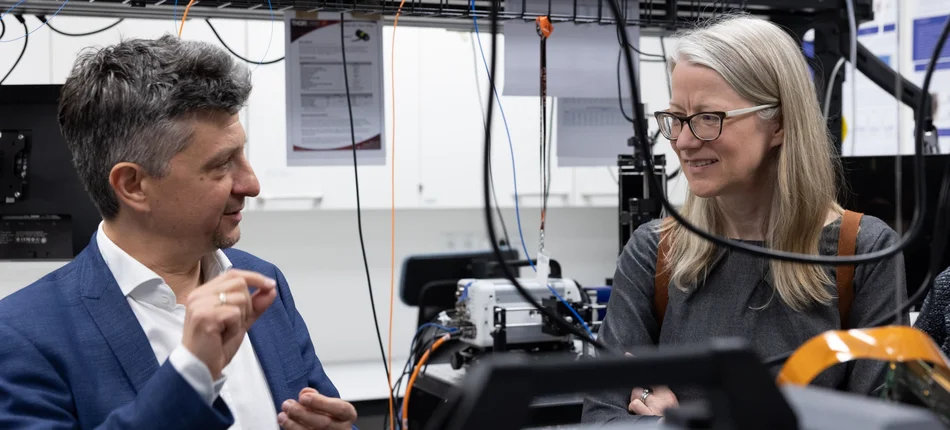
The International Center for Eye Research (ICTER) was established thanks to European funds from the Program for Intelligent Development (POIR) awarded by the Foundation for Polish Science (FNP) under the International Research Agendas (MAB) program. The research carried out at MAB is interdisciplinary in nature and the results will enable the development of new technologies to serve society in the future.
- ICTER is one of 14 International Research Agencies. It is the only such program in Poland, which enables the creation of new research units led by outstanding scientists," explains FNP Vice President Dr. Tomasz Perkowski.
Researchers at the center are working on breakthrough technologies for imaging eye processes and facilitating treatments to save or restore vision.
- The eye is very sensitive. It used to be that in order to see what was going on in it, it had to be cut out of a dead body, cooked and sectioned. Today, we have precision surgical tools that can be robotically controlled and are able to assist the surgeon in everyday activities," stresses Professor Maciej Wojtkowski.
Some of the technologies developed at ICTER are at the implementation stage. One of them is an innovative method that allows imaging of the retina using so-called fluorescence with two-photon excitation. It allows, on the smallest, chemical scale, to check whether the cells responsible for the vision process are working properly. Another method is optoretinography, which allows precise measurement of the response of photoreceptors present in the retina to light. Both techniques can be used to diagnose visual disorders, but they also make it possible to analyze whether implemented therapies are having the intended effect. In the case of optoretinography, the technique requires previously unimaginable precision - measuring devices must detect the elongation of light-sensitive eye cells by 1 nanometer, despite the movement of the entire organ.
ICTER is collaborating with leading eye research centers around the world, including University College London, the center's strategic partner, as well as London's Moorfields Eye Hospital and the University of California, Irvine.
- Scientific cooperation across the divide makes it possible to expand knowledge with additional elements, exchange experience and competence, access to research infrastructure and transfer technology. The UK is an active partner of Poland in the field of scientific research. I am pleased that British centers and ICTER maintain close cooperation in research on the eye and its diseases. This is an important area for improving the quality of life for millions of people around the world. I hope that this cooperation will grow and benefit all countries," says Anna Clunes, Ambassador of the United Kingdom of Great Britain and Northern Ireland to Poland.