Fear, pains and muscle spasms kept her awake. She began a long trek to the doctors in search of a diagnosis. - I can't count how many visits there were, probably dozens. Finally, when I heard it was ALS, my hands were shaking so badly that I couldn't dial my husband's phone number. I thought I had been given a sentence. - Monika Partyka, a patient with SOD1-ALS, said. She was afraid that she would stop walking, talking, swallowing and breathing. However, the black scenario did not come true.
New perspective and chance of life for amyotrophic lateral sclerosis patients

Published Dec. 9, 2024 12:19
You probably know the most famous man in the world who suffered from ALS. That's astrophysicist Stephen Hawking - the one "from black holes," whose amyotrophic lateral sclerosis confined him to a wheelchair for most of his life and caused the scientist to communicate with loved ones and colleagues exclusively through a speech synthesizer.
ALS (for amyotrophic lateral sclerosis) is a rare, debilitating and rapidly progressive disease. Like Alzheimer's and Parkinson's, it belongs to the group of neurodegenerative diseases. Damage and loss of motor neurons, known as motoneurons, occur in the brain and spinal cord of those affected.
The average life expectancy with ALS is 3 to 5 years from the first symptoms of the disease. The main cause of death is respiratory failure.
- This is one of the most difficult diseases for a person. It takes away the ability to communicate, express one's needs and stand up for oneself. The patient cannot move his arms and legs, but has no sensory or memory impairment. He remains himself and is intellectually functional. Such people often struggle with the so-called locked-in syndrome. Trapped in their own body, they can only communicate with the environment using eye movements," says Professor Magdalena Kuźma-Kozakiewicz of the Neurodegenerative Diseases Research Team of the Department of Neurology at the Medical University of Warsaw.
This black scenario has a chance of not coming true in some cases. For patients with mutations in the SOD1 gene, a chance to stop the disease has emerged. It is tofersen - the first molecularly targeted therapy for the treatment of SOD1-ALS registered in the EU, on May 29, 2024. - This is a real breakthrough," says Prof. Magdalena Kuzma-Kozakiewicz.
The onset of ALS is insidious
The first symptoms sometimes vary. One person can't hit the lock with a key and has trouble unscrewing a bottle, while another can't hold a phone or mug in his hands and becomes "awkward." Someone else begins to speak more slowly, unintelligible to those around him. He finds it increasingly difficult to swallow food, and sometimes even saliva, and can choke on it. In the case of Monika Partyka, an insurance consultant, the disease began with trouble walking.
Vacation 2019. Monica walks in flip-flops, her husband notices that she "somehow puts her feet strangely." He tells her about it.
- I brushed him off. I concluded that he was exaggerating and it only seemed to him, but I felt that there was something wrong with my left leg," Monica recalls. Then there was a friend's wedding. She danced, and on her feet this time she had stilettos. - At one point my left leg literally "flew", I did not control it," she recounts.
- Shortly thereafter, I was with my son at the pediatrician for a so-called balance sheet of a three-year-old. I asked the doctor why this foot was drooping when I tried to stand on my toes. He advised a visit to an orthopedist," she recalls.
This time she no longer downplayed the symptoms, as she did when she was on vacation. She struggled with fear, muscle pain, and the soaring cramps kept her awake. She began a long trek in search of a diagnosis.
- I circulated between an orthopedist and a rheumatologist. I can't count how many visits there were, probably dozens. And when I finally learned from the neurologist that it was ALS, I was devastated and terrified. My hands were shaking so badly that I couldn't dial my husband's phone number. I thought I had been given a verdict. That it would only get worse with each passing day. Had I inherited the disease? I analyzed the family history and it was probably already there, but no one diagnosed it that way," recalls Monica, who recently turned forty.
Affects even 20-year-olds
- Amyotrophic lateral sclerosis is a highly variable disease, and symptoms and survival times can vary from person to person. In 70 percent of ALS patients, it begins with arm or leg weakness. A third of patients first have trouble speaking. However, it is not said that patients who have trouble with speech will have limb weakness. Also, it is not always the case that those who walk badly will have worse speech, swallowing or breathing. There are cases, more often in middle-aged and elderly women, when the disease mainly occupies the facial muscles and spares the arms and legs. Then we are dealing with the so-called pad onset," explains Prof. Kuzma-Kozakiewicz.
The specialist adds that the disease usually begins around the age of 50-60, and sometimes later.
- There are also younger patients who are diagnosed with ALS even around the age of 20. Statistically, men are more often affected. However, it is not gender that determines the incidence of the disease, he points out.
The familial background of ALS accounts for only 10 percent of cases.
Among patients with amyotrophic lateral sclerosis, about 90 percent are sporadic cases, while the remaining 10 percent have a familial basis. Researchers have managed to identify about 40 genes whose mutations are closely linked to the disease. The most common are four: C9orf72, TARDBP, FUS, and SOD1, called suboxide dismutase. There are cases of SOD1-ALS in each of the two groups, so genetic diagnosis to determine the underlying cause of the disease should be carried out in all patients, regardless of the patient's history, age and health status.
It is estimated that about 3,000 people in Poland in general suffer from ALS, while ALS with a mutation in the SOD1 gene affects about 100 people.
It is this last mutation that 68-year-old Mieczyslaw Dynaka faces. For years he was a specimen of health, nothing ever hurt him. He worked in managerial positions, and when he retired, his account didn't have a single day on L4! However, three years ago his difficulty walking began, and running and jumping became virtually impossible. He quickly became suspicious that it might be ALS, as the disease had run in his family before.
- The sister stopped walking, and so did her son. The sister's disease was not formally diagnosed, but in his nephew's case it took a violent course, Mieczyslaw recalls. His nephew died less than two years after the diagnosis. - He died young, before the age of fifty," says Mieczyslaw. He adds that his brother was also ill and died at 72.
The year 2022, Mieczyslaw Dynaka decides to face the brutal reality. He takes a genetic test. A thorough analysis of his blood leaves no illusions, it shows the presence of the mutation in the SOD1 gene responsible for amyotrophic lateral sclerosis.
Stop amyotrophic lateral sclerosis
- The visit was short and specific, and the diagnosis was unequivocal," Mieczyslaw recalls the first meeting with Professor Magdalena Kuzma-Kozakiewicz, under whose care he came after the diagnosis. - She looked at the results, conducted neurological examinations, checked motor skills. The worst thing I endured was the realization that this was an incurable, unpredictable disease, quickly leading to death," says Mr. Dynaka. - I consoled myself by telling myself that in my case it would progress slowly and gently, and I would live a few more years, he adds. He started taking riluzole, a drug he knew extended his life by only a few months. It turned out that his intuition did not fail him. Fate smiled on him when he qualified for the early access program for tofersen treatment in Poland.
- Tofersen is a drug administered intrathecally via lumbar puncture. Its action targets the reduction of SOD1 gene expression. And reducing the level of toxic SOD1 protein in motor neurons slows or stops the progression of the disease, explains the effect of the therapy, Prof. Kuzma-Kozakiewicz. - The patients' condition stabilizes, in some it improves muscle strength, so the quality of life improves unquestionably, he says. He stipulates, however, that while the effects of the therapy may be spectacular, they are not immediately apparent. - And the earlier treatment with tofersen begins, the better the effect of therapy can be, he adds.
ALS symptoms under control
Mieczyslaw has been taking tofersen regularly for a year, every four weeks. He has already had 15 doses.
- I see that the disease has clearly slowed down, the symptoms are not getting worse. I still have mobility problems, especially when climbing stairs, but functions such as speech and swallowing are intact," he stresses.
Monika Partyka also notices positive effects of the drug in herself. The therapy is producing visible results. - The symptoms so far remain under control. The level of neurofilaments, or markers of neurodegeneration, has decreased. Repeatedly, "My ALS has gone to my legs. And let it stay there!" - he says.
What is her daily life like now? - It's a challenge, but I'm managing. At home I get around without a problem, for longer walks I take trekking poles. With them I feel more stable, they give me confidence that I won't fall over, as it would be difficult for me to get up," Monika says.
Risk of familial ALS
People with amyotrophic lateral sclerosis worry that ALS is hereditary and will be passed from generation to generation.
- We identify a genetic background in a few percent of sporadic cases and in almost two-thirds of familial cases," explains Dr. Maria Jedrzejowska, a specialist in clinical genetics and neurology. Most of the mutations responsible for ALS are inherited autosomal dominantly. This means that damage to one of the two copies of the gene is enough for the symptoms of the disease to appear.
- Genes occur in duplicate: one copy is inherited from mom, the other from dad. In turn, a person with the disease can pass either a normal or defective copy of the gene to his or her child. Hence, there is a 50 percent risk of passing the disease to offspring. Although there are exceptions: sometimes, for example, there is so-called incomplete penetrance, when not every person with a given mutation will get sick. Some mutations, on the other hand, are inherited recessively, which means that both copies of a given gene must be damaged - from both mom and dad - for ALS symptoms to occur, explains Dr. Maria Jedrzejowska.
Mr. Mieczyslaw's adult children have decided to have their health checked for ALS. - They say the tests showed nothing. However, they don't want to show the results, and I don't dare ask them to do so," says Mieczyslaw Dynaka.
For her part, Monika Partyka has been advised by her doctor to hold off for now on genetic testing for her son, who is only three years old. Monica does not rule out that she will do it someday, however. - Maybe we'll decide sometime in the future, when he's already grown up? - she wonders.
Genetic testing for ALS
- The decision to perform family genetic testing must be a conscious and well-considered one, Dr. Jedrzejowska stresses. - Even if a patient suffers from a genetic form of ALS, this does not mean that his or her relatives: siblings or children have to take a genetic, so-called predictive, test. Not everyone is ready for that," she adds. And she says that for some people, especially the very young, information about a threatening neurodegenerative disease is, after all, a huge emotional challenge.
- Awareness of potential disease can be completely devastating. All the more reason not to do predictive testing in children. However, there are those who say, "Doctor, I need to know this, I want to plan my life, put it together." They hope to take advantage of the available therapies before they experience symptoms. It is always a good idea to consult a psychologist, geneticist, neurologist. Talk and think together about whether and when to perform the appropriate tests," emphasizes Dr. Maria Jedrzejowska.
In ALS, time is of the essence
Currently, the diagnosis of ALS is made with a long delay - from the onset of symptoms to diagnosis takes an average of 9.5 months to 2.5 years.
Katarzyna Kozłowska, a member of the board of directors of the Polish Neuromuscular Diseases Society, is primarily concerned with ensuring that patients who have already developed symptoms of the disease have access to early diagnosis in order to implement effective treatment as soon as possible.
- In Poland, a small group of patients with SOD1-ALS have been receiving tofersen as part of early access for a year now. Time is of the essence in their treatment, as the disease progresses very quickly and is fatal. Here, diagnosis cannot be delayed," stresses Katarzyna Kozlowska.
- Currently, there is an average wait of about a year for genetic testing under the National Health Fund, while the average life expectancy of such a patient is about two years! The Polish Neuromuscular Disease Society, the oldest organization in Poland for people with neuromuscular disease experience, has, through its efforts, obtained a discount at private genetic facilities for genetic testing for ALS. - But this is still not enough," adds Katarzyna Kozlowska.
Tofersen gives hope to patients and doctors
Thanks to her treatment with tofersen, Monika Partyka has not had to give up her career or radically change her lifestyle. She still goes on vacation with her family and on trips with friends who know she is ill, so hiking is not too tiring. Since she's been taking tofersen, she no longer has to take painkillers. - Only sometimes, when I walk a lot, my spine gives out, but that's because my gait is different today than it used to be, clumsy. I have a drooping foot, my toes hit the ground, sometimes I don't keep my balance," Monika calculates. She also doesn't carry heavier things as she did years ago. - The most important thing is that the symptoms, so far, remain under control," she concludes.
- I don't have dizziness and nausea," calculates Mieczyslaw Dynaka. And he takes care of himself. He keeps an eye on 2,700 calories a day and a Mediterranean diet, rich in fish. He tries to spend time actively every day. And he calculates: - I ride my bike, swim, get massages. Every day I enjoy life, tofersen gives me hope. And I prefer not to think what will happen when the program ends.
Ministry of Health declares openness to making positive changes for patients with SOD1-ALS
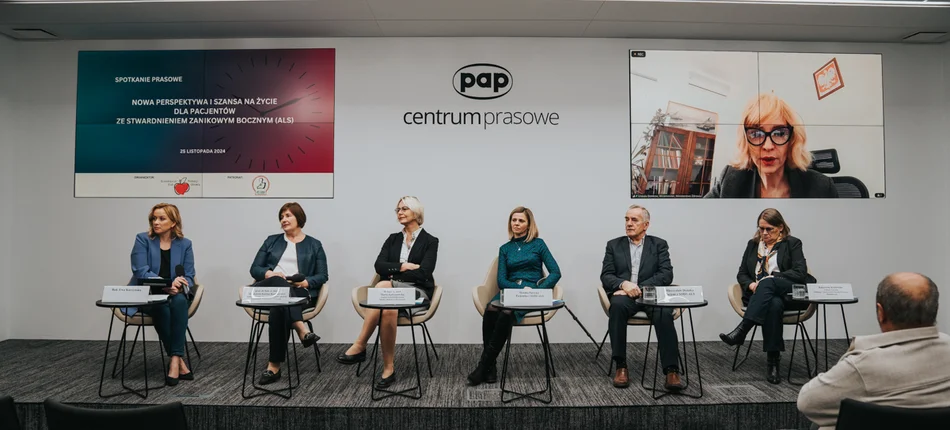
- I am responsible for rare diseases, and amyotrophic lateral sclerosis is one of them, and as a result, this disease is within my sphere of interest. We are creating such conditions so that ALS patients have access to appropriate diagnostics and are cared for in appropriate centers. There is now hope for these patients, this is an amazing step forward. That's because this disease was called the world's most serious disease, because there was no cure for it. - said Professor Urszula Demkow, Undersecretary of State at the Ministry of Health, during the press briefing "New perspective and chance for life for patients with amyotrophic lateral sclerosis (ALS)." - The Health Ministry is open to the introduction of new therapies, especially if they are effective and the only option for patients. Such drugs enter the reimbursement list, faster or slower, but they enter because here not only economic criteria are taken into account, but also non-economic factors. If we can turn a death sentence into a long-lasting life and halting the progression of the disease, this is a huge value for these patients. If there is a willingness for dialogue on the part of the drug manufacturer, then everything is on the right track for reimbursement," Prof. Demkow added.
Not only the Ministry of Health sees the needs of ALS patients, the Parliamentary Group for Rare Diseases, which was represented at the meeting by Prof. Alicja Chybicka, also sees them.
- The Parliamentary Group on Rare Diseases is ready to help all patients. ALS with a mutation in the SOD1gene givespatients a chance for a better life, because there is tofersen, registered in Europe, so Polish patients also have a chance to be treated with this drug. - Prof. Chybicka added. At the same time, she stressed that the Parliamentary Group on Rare Diseases, which she chairs, invites patients, the medical community and policymakers to dialogue about the need for rapid diagnosis of ALS, which would allow faster introduction of therapy in newly diagnosed patients.
Source: press mat.