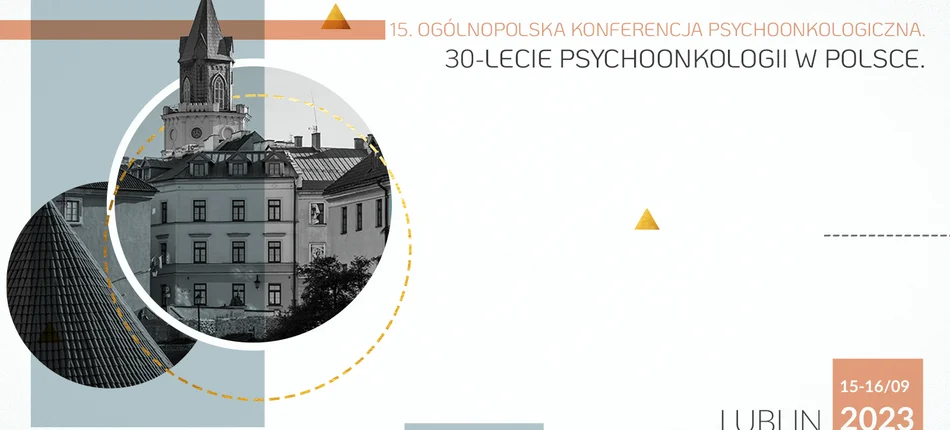
Prominent experts in psychooncology, palliative care, pain management will discuss the role of the psychooncologist in oncological treatment and modern methods of supporting cancer patients and their loved ones. The 15th anniversary National Psychooncology Conference, summarizing the 30th anniversary of psychooncology in Poland, will be held on September 15-16, 2023 in Lublin. A number of practical workshops have also been planned, including communication with patients and medical personnel.
Anniversary Conference and 30th Anniversary of the Polish Psychooncology Society: Challenges of psychooncology in hematooncology, oncology, palliative medicine

Published Sept. 4, 2023 08:29
The psyche plays an important role in oncological treatment, so it is increasingly emphasized that psycho-oncology should be an integral part of it, and the psycho-oncologist should be a member of the treatment team caring for the cancer patient. - The psycho-oncologist should accompany the oncology patient from the diagnosis, and later also at every stage of treatment, especially in difficult moments. Above all, however, it is necessary to assess for which patients and their families it is necessary to provide professional support, says Professor Marzena Samardakiewicz, president of the Polish Psychooncology Society.
Psychooncology is a young field - in 1984, IPOS (The International Psycho-Oncology Society) was founded - the first scientific society in the world to bring together specialists in this field. The Polish Psycho-Oncology Society (PTPO), founded in 1993 by Professor Krystyna de Walden-Galuszko, was one of the first psycho-oncology societies in Europe. PTPO's 30 years of activity and the 15th Anniversary National Psychooncology Conference is a time to take stock, but also to look at the challenges of the present and future.
Psycho-oncology yesterday, today and tomorrow
The conference will open with a lecture by Prof. Krystyna de Walden-Galuszko: "Man in the modern world - considerations of a psychiatrist". In the session "Psychooncology Yesterday, Today, Tomorrow," Gil Goldzweig of the Academic College in Tel Aviv-Jaffa, a member of the IPOS Board of Directors, will talk about the specifics of geriatric psychooncology. We will also hear speeches from people working in psychooncology in Sweden, Austria, the UK and the US. Also scheduled are sessions with prominent experts on the role of psychooncology in oncology, hematooncology, palliative care, a session on the care of children and adolescents and recovering patients who have moved from pediatric to adult care, among others. There will also be lectures on modern pain management, nursing spiritual care, controlling emotions, and the sexuality of cancer patients.
An important part of the conference is a workshop on, among other things, conveying difficult information to the patient and learning about the patient's perspective in the treatment process: it will be held at the UM Medical Simulation Center in Lublin, using, among other things, a simulated patient. - We are also planning, among other things, workshops on enhancing the dignity of the patient, directed at people at the end of life. Psychooncology is an interdisciplinary field, hence the interdisciplinary nature of our conference, to which we invite not only psychooncologists, but also all those who in their work meet patients at various stages of cancer treatment. We want to activate and unite the community, encourage students to take an interest in this field," says Prof. Marzena Samardakiewicz. - The conferences we organize have always been an opportunity to expand their knowledge from invited experts. We also want to give young psycho-oncologists a chance, to encourage them to be active," notes Prof. Krystyna de Walden-Gałuszko.
Supporting a patient is not saying "it's going to be okay"
- ESMO (European Society of Medical Oncology) recently issued recommendations that every patient should be screened for depression and anxiety after a cancer diagnosis. The recommendations include very precise tools to be used when conducting the tests. The medical consortium should include a psychologist or psycho-oncologist, and we want to suggest that they give the patient the option of using the ESMO-developed psycho-oncology scales for the examination. The examination itself takes about 20 minutes; if the patient's anxiety and depression levels were found to be high, he or she would be taken under the care of a psycho-oncologist," stresses Prof. Krystyna de Walden-Galuszko.
It is very important that the psycho-oncologist is able to match the help offered with the real needs of the patient and his relatives, who also often need support. - Psycho-oncology is an interdisciplinary approach to a person who has cancer. Some patients are task-oriented, and guidance on how to proceed is enough; others also need emotional support, as they feel that after the diagnosis their whole previous world collapsed, and still others need very intensive psychological and psychiatric help," says Professor Marzena Samardakiewicz.
An important role of the psycho-oncologist is also to teach loved ones how to support the patient. - We can't just say that "everything will be fine." Of course, the patient would like this to happen, but we cannot guarantee it. The most important thing is to accompany him, to be attentive to his needs. Many people think that support is when the patient does not think about his illness, so they try to "puzzle" him, distract him. However, this often has the opposite effect, the patient feels tired of this, it does not respond to his needs, " stresses Prof. Samardakiewicz. Reading patients' needs is not easy, so it is worth taking advantage of the workshop offer during the conference.
Experts emphasize that to practice as a psycho-oncologist it is not enough to complete a degree in psychology and one year of post-graduate studies, it is necessary to constantly educate oneself, to educate oneself. - There is a lot of interest in psychooncology among psychology students and graduates; this is a very good thing, because there are still not enough specialists in this field in the health care system to professionally provide assistance to all patients who need it, especially in oncology clinics. However, a continuous process of education is necessary; hence the workshops and conferences we organize," adds Prof. Samardakiewicz.
The Polish Psychooncological Society also participates in the development of standards of psycho-oncological care. - For years we have been concerned with the quality of education, and we also award certificates. One of the conditions for obtaining a certificate is completion of postgraduate studies in psychooncology and at least 5 years of experience working with oncology patients, as well as writing an article, speaking at a conference, discussing a case. We are all about nurturing a high level of psychooncology," Professor Krystyna de Walden-Galuszko points out.
However, working with cancer patients is demanding, so professional burnout is a big problem: the stress level of a young nurse in the first year of working with a cancer patient can be comparable to the stress accompanying a divorce. Therefore, the topic of preventing professional burnout will also be addressed at the conference.
Psycho-oncology education of medical personnel
The way in which the diagnosis of oncological disease is communicated largely determines how the patient will approach his situation, so it is very important to educate medical personnel (doctors, nurses, radiation therapists, physiotherapists) about psycho-oncology.
- I believe that everyone working with cancer patients should learn basic knowledge of psycho-oncology so that they know how to talk to patients and recognize their needs. A person who gets cancer changes a lot in terms of value system, needs, sensitization. Oncologists and nurses should know about these basic things. That's why we try to train medical personnel," stresses Prof. Krystyna de Walden-Galuszko
Psycho-oncology in cancer prevention
"Psycho-oncology today" is mainly concerned with helping cancer patients and their loved ones, but "psycho-oncology of tomorrow" should be more concerned with prevention as well: motivating healthy people to lead active lifestyles, get screenings and check-ups. - Most people are aware that cancer is a serious disease, but they think that nothing will happen to them. If we did a street survey, to the question, "Is cancer a serious disease?" everyone would answer "Yes." However, if we ask another question, "Do you feel directly threatened by cancer?" most will answer: "No, I feel fine," recognizing that they are fine, because if they were sick, the body would hint to them that something worrying is going on. Unfortunately, the body prompts us too late, so it would be very important to organize oncology awareness workshops for healthy people, motivating them, for example, to self-examine their breasts, perform check-ups, teach them pro-health behaviors, how to deal with stress, and how to take care of themselves in a positive way," adds Prof. Krystyna de Walden-Galuszko.
Psychooncology is a profession with a future, as will be seen at the anniversary conference of the Polish Psychooncology Society, with the participation of prominent experts in psychology, psychooncology, palliative care, pain management, among others.
Source: press mat.
Topics
psychoonkologia