An increasing number of oncology patients in Poland are not only facing a disease diagnosis, but also face inequalities in access to modern diagnostic and, consequently, therapeutic methods. Despite tremendous advances in the field of molecular diagnostics, comprehensive genomic profiling (CGP) and molecular testing from blood in an outpatient setting remain unattainable for many patients.
Oncology patients in Poland await reimbursement for comprehensive genomic profiling

Published April 10, 2024 10:19

Thinkstock/GettyImages
While the possibility of extending patients' lives through targeted and personalized cancer therapies is a reality, still not every patient has access to them. Complicated reimbursement procedures and drug programs mean that patients not only face a disease like cancer, but also struggle with the challenges posed by the system.
One of the changes most anticipated by oncology patients was to be brought about by a new healthcare benefit proposed by the Polish Cancer Society - "Comprehensive genomic profiling (CGP) testing performed by high-throughput next-generation sequencing (NGS) for molecular diagnosis of patients with malignant tumors," which received a positive recommendation from the President of AOTMiT in October 2023.
- There can be no modern treatment without proper diagnostics. If we want oncology patients to be able to benefit from innovative targeted therapies to the optimum extent, we urgently need the decision of the Ministry of Health and changes in the reimbursement of molecular tests," argues Dorota Korycinska, president of the Board of Directors of the National Federation of Oncology and the Association of Neurofibromatosis Poland.
- Modern diagnostic solutions such as molecular testing, based on comprehensive genomic profiling, make it possible to determine up to several hundred mutations simultaneously. What's more, they can be performed from peripheral blood (so-called liquid biopsy - editor's note) and not just from tumor tissue. Let's also not forget that molecular testing is an important source of information, e.g. for the patient's family when thinking about germline/inherited mutations such as BRCA 1 or 2, but also for scientists and health policy makers," argues Dorota Korycinska, president of the Board of Directors of the All-Poland Oncology Federation and the Neurofibromatosis Poland Association, which has been fighting for years to improve treatment conditions for patients.
In October 2023, the document on making a new healthcare benefit, the Comprehensive Genomic Profiling (CPG) test, available to patients was submitted to the Ministry of Health after receiving a positive evaluation from the Agency for Health Technology Assessment and Tarification. Six months have passed since then, and the decision is still in limbo. This is despite repeated appeals from doctors as well as patients and their families. For patients, each additional day of waiting means fewer chances to benefit from innovative treatments.
- Developments in medicine and the advent of new diagnostic and treatment methods have fundamentally changed the approach to cancer. Cancer is increasingly viewed in terms of a chronic disease, and traditional chemotherapy is used when other, more effective personalized medicine options are not available to the patient. Efficient diagnosis gives a real chance to quickly implement the most clinically effective therapy and determine the optimal treatment path -- notes Anna Kupiecka, president of the Onkocafe Foundation "Together Better."
In Poland, the National Health Fund has been funding selected molecular tests since 2017. Although there has been a steady increase in the number of cancers and genetic markers requiring analysis in specific patient groups, the benefit basket offers limited diagnostic options and does not include large-scale molecular testing. These limitations not only unnecessarily prolong the diagnostic process, but may lead to the complete use of a patient's tissue material, before the required diagnostic process is completed, and may exclude patients for whom it is not possible to collect tissue for testing, who could benefit from comprehensive genomic profiling as part of a so-called liquid biopsy, i.e. from the patient's blood.
- Approximately PLN 61 million is spent annually on molecular diagnostics in our country, which is only 0.5 percent of the total oncology budget. This, along with the number of tests performed - 150,000 tests in 5 years - is the best evidence that the potential of molecular diagnostics is not used sufficiently and, consequently, the possibilities of targeted therapy in patients and the possibilities of prevention in families with hereditary (germline) mutations are not used. It is high time to change this," urges Dorota Korycinska.
According to statistics from the World Health Organization, by 2050 the number of cancer patients worldwide will exceed 35 million. This is 75 percent more than in 2022.
***
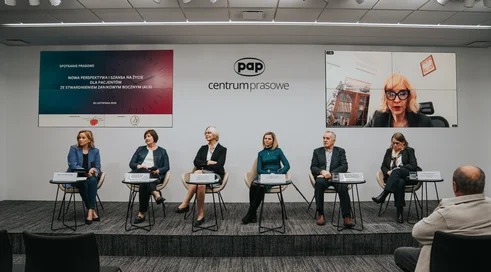
The Roundtable for Molecular Diagnostics, organized by the Alliance for Diagnostics, was dedicated to this problem. Participants included Prof. Anna Latos-Bieleńska, national consultant in clinical genetics, Prof. Maciej Krzakowski, national consultant in clinical oncology, and Dr. Andrzej Tysarowski of the National Cancer Institute in Warsaw. With the participation of experts, the following recommendations were developed:
- Linking the conduct of a drug program to the center's contract to perform molecular testing. As Prof. Piotr Rutkowski, chairman of the Polish Oncology Society, stressed, there are currently funded drug programs for indications such as lung, colorectal and ovarian malignancies. However, the lack of performing molecular diagnostics prevents their implementation. Particularly in patients with lung cancer, moreover, comprehensive genomic profiling in the form of liquid biopsy is essential.
- Improving the quality and financing system for genetic testing. Prof. Maciej Krzakowski, national consultant in clinical oncology and president of the Polish Society of Clinical Oncology, noted that patients expect efficient and correct diagnostics, i.e. the best possible quality. However, this one in Poland is not controlled by anyone. In order to change this, changes are needed in the complicated system of financing genetic tests, filling the shortage of personnel and equipment, and building awareness of the importance of these tests among doctors.
- Taking efficient and effective action. Prof. Anna Latos-Bieleńska, national consultant in clinical genetics, assessed that there is a lot of talk about what needs to be done, but everything usually begins and ends at the same time with the talk. Training is to be organized for nurses to obtain a specialization related to genetic testing. The Health Ministry also announces a move away from flat-rate funding for genetic testing in AOS to pricing of services.
- Giving decision-making power back to the person performing the tests. As stressed by Dr. Andrzej Tysarowski of the Laboratory of Genetic and Molecular Cancer Diagnostics at the Maria Sklodowska-Curie National Cancer Institute in Warsaw, coordinator of the National Cancer Strategy's molecular diagnostic guidelines, it should be the person performing the test who decides on the best method.