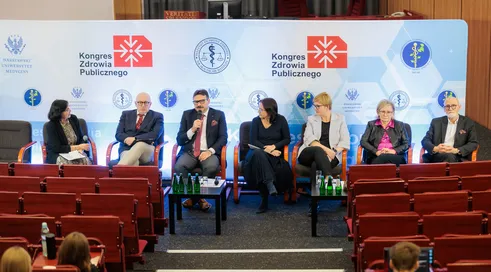
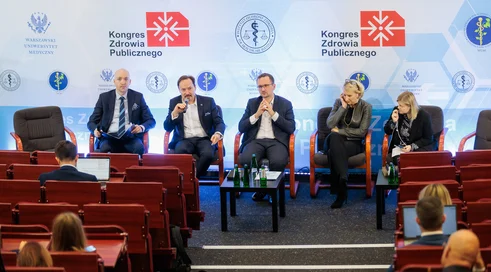
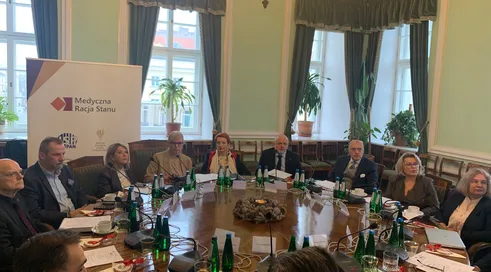
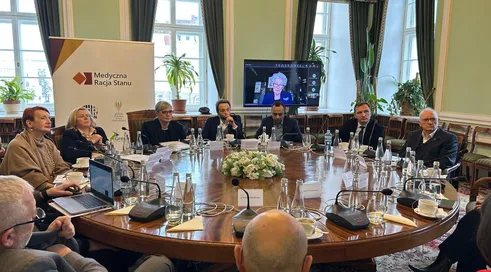
Are we making good use of medical staff? What can be done to ensure that each medical professional can realize his or her competencies one hundred percent? How to effectively move away from the hierarchization of medical professions? The opening panel of the 11th Public Health Congress was devoted entirely to the issue of cadres, in the context not so much of a crisis as - challenges.
KZP 2024
Human resources in public health: deficits, challenges and strategies for the future

Published Dec. 11, 2024 12:20
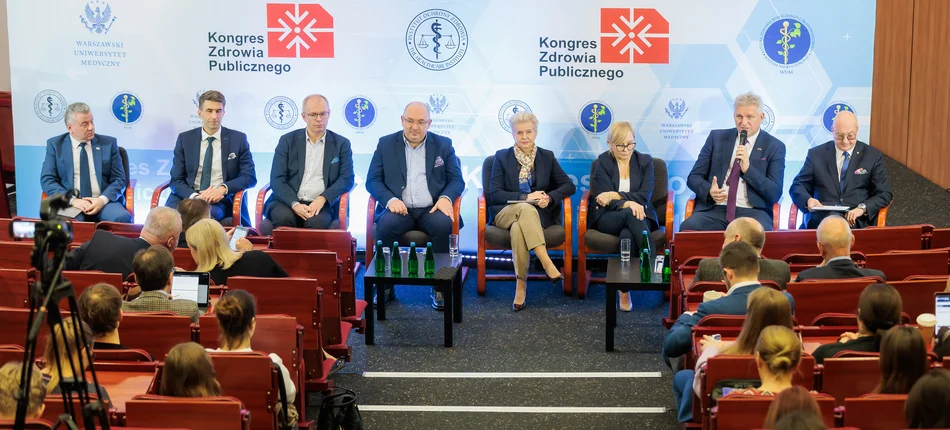
At medical universities, public health specialists have been trained for years. Recently, the catalog of medical professions has been expanded to include a new position: preventionist. However, at the moment, as Beata Małecka-Libera, chairwoman of the Senate Health Committee, said, the system "does not see" the potential of these cadres. - There are two emphatic examples of this. The law on coordinated care in primary care explicitly stipulates that preventive health care is handled by a doctor and a nurse. As much as possible, this could be the task of prevention," she stressed. Health education, which will wrap up in schools in September, is another example. The Ministry of Education's plans, at least for now, do not include the use of health specialists; the axis is to be retrained teaching staff.
It seems that the health ministry also recognizes the problem. - There is a question of who are we going to teach this subject? It seems that the presence of public health specialists in schools is the basis for success, although it is not necessarily a question of them being employed on a full-time basis, said Deputy Health Minister Wojciech Konieczny. - Introducing health knowledge into schools is a fantastic idea. Doctors see on a daily basis how little patients know both about their health and their illness, about their bodies," echoed Mariusz Klencki, director of the Department of Medical Personnel Development at the Ministry of Health. What will change in September 2025? - We will have teachers and a core curriculum. The snag is that it can be implemented in a hundred different ways," he stressed. It would be a mistake if health education became one more "school" subject. Implementation of the program should be based on lessons with health professionals. Prof. Boleslaw Samolinski of WUM went even further: "It's not just about involvement in the subject itself, in how it is implemented, but about building a pro-health atmosphere at school, for example, by organizing happenings, actions promoting pro-health behavior," he pointed out.
However, there are more reasons why so much emphasis has been placed on health education. Experts agreed that a change in the attitude of at least part of the public towards primary prevention depends on its success. This is the most sensitive public health problem at the moment, which translates - directly - into the burden of ailing patients on the system, and therefore on medical staff. Without a change in health attitudes, attitudes to, for example, physical activity, diet, stimulants or, on the other hand, vaccinations, the onslaught of those in need of remedial medicine will become an increasing problem.
There can be no discussion of human resources in health care without the conundrum that we don't have enough of them (it's not just and even not primarily about doctors), so the key to success, or at least to minimizing staffing problems, is to make good use of those professionals the system has. There are good practices, although they must be sought primarily in the private sector. Monika Tomaszewska, director of the Department of Clinical Management and Medical Projects at the LUX MED Group, admitted that in a private entity it is easier to create solutions "outside the framework defined by the public payer," thanks to which LUX MED Group facilities can make better use of the competencies of, among others, nurses, physiotherapists or paramedics. - For many years we have been working on a competency map, describing what representatives of each profession are allowed to do. There is no medical profession that remains one hundred percent underutilized within our group, whether it is optometrists, prophylaxis or physiotherapists," she added. Sensible staff management translates into high quality services, improves accessibility but also facilitates satisfactory performance indicators. - The key is to get the competencies of each profession well described in the system, she said.
As Prof. Mariusz Gujski, head of the Department of Public Health at WUM, who led the discussion, stressed, the preparation of such a map requires - among other things - saying goodbye to the established notion of "auxiliary professions." - At the moment, in the system we are building, there is no room for such hierarchization," he concluded.
Topics
KZP 2024