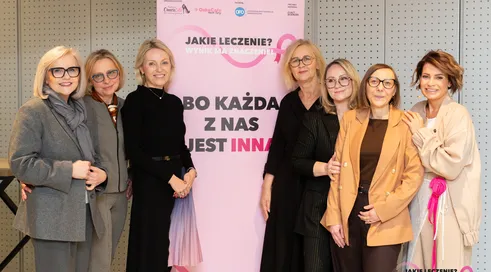
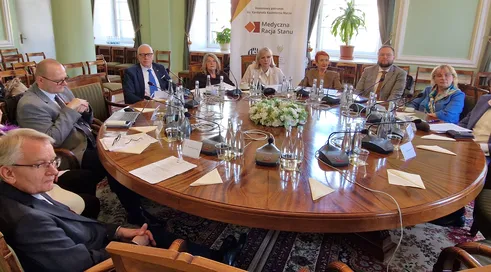
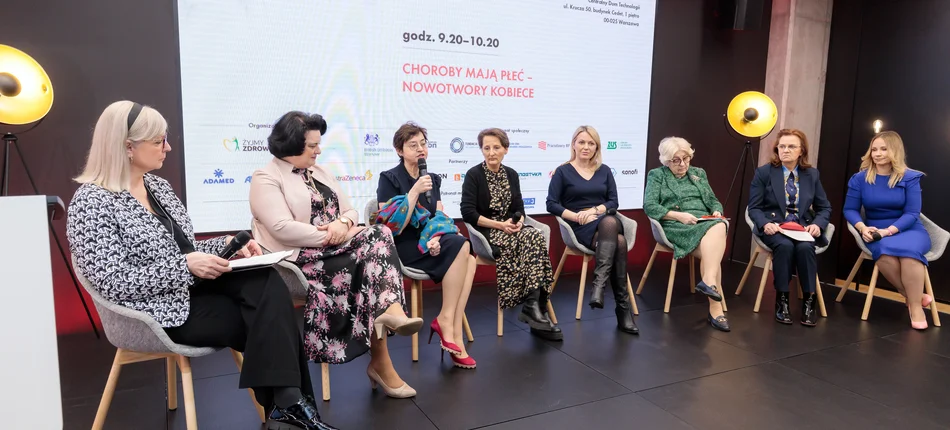
Few diseases are perceived as "feminine" to the extent that breast cancer is. That's why breast cancer was the theme of the opening panel of the 2nd Women's Health Congress, held in Warsaw on March 8, 2023.
Women's Health Congress
Diseases have a gender - female cancers

Published April 13, 2023 11:01
Fot. Rafał Gronecki
- All the time there is a belief that breast cancer is a sentence. This is also why women do not go for examinations. Cancer is the plague of the 21st century," said MP Barbara Dziuk. In her opinion, although we have an increasing number of good systemic solutions, in order for them to translate into results, it is necessary to raise health awareness on the one hand, and on the other - greater involvement of medical staff, doctors and nurses.
Prof. Barbara Radecka argued that it is necessary to focus on health education, which in a perspective of several or more years will translate into a significant increase in the percentage of people who actively care about their health, also in the dimension of using preventive examinations. In her opinion, however, systemic changes are also necessary, because not only prophylaxis (low percentage of beneficiaries), but also diagnostics (bureaucracy, bottlenecks due to organizational errors or low financing) translate into the fact that cancer is detected in Poland late, often - too late. Meanwhile, medicine has more and more and better solutions to offer. - We are at the stage of determining gene mutation status. If drugs dedicated to specific mutations appear in reimbursement it will be important for diagnostics to work efficiently so that patients can benefit from these drugs, the expert said. Meanwhile, there are too few genetic clinics, and at the moment too few women - relative to the needs - can benefit from such tests at all. In addition, the whole process takes time, because it has to take time. - Genetic diagnosis is counted in weeks, and it is impossible to speed it up, which is due on the one hand to considerations of the technologies used, on the other hand to the equipment and personnel resources we have," she admitted. In her opinion, however, everything must be done to ensure that diagnostics does not in any case hold up the treatment process. - It is necessary to increase the level of testing, she urged.
On the other hand, there is no doubt that in recent years there has been tremendous progress in the area of reimbursement, and modern oncological therapies have become, also for Polish women, in the area of typically female cancers, more accessible. Here, too, however, one cannot rest, not even for a moment, because, as Prof. Radecka stressed, practically every year brings new molecules that in some oncological diseases improve the quality of a patient's life, and in some represent a real breakthrough, if before there was practically no treatment. - Then even a small gain in the form of longer survival is worth it to introduce reimbursement," she argued. The drugs that should be reimbursed first are indicated to the Minister of Health by the experts of the Polish Society of Clinical Oncology themselves, preparing their own TOP10 lists from among dozens of proposals presented. - Each item is scored, and of course you have to justify your choice. We can indicate ten drugs from the entire field of oncology," said Prof. Radecka. This is a strong suggestion to the Minister of Health - although "only" a suggestion.
Referring to the TOP10 list, Katarzyna Pogoda, MD, from the Maria Sklodowska-Curie NIO-PIB, cited drugs with which oncologists have recently been pinning very high hopes. - An actively developed group of drugs are the so-called conjugates. These are modern drugs, "Trojan horses," such targeted chemotherapy. Conjugates are a big leap, it's a revolution, because they improve survival time not by a few, but by up to 20 months. Conjugates will be used not only in breast cancer, there are already further registration indications. You can see that this group of drugs will "rule" in oncology," said Dr. Pogoda.
Although the reimbursement lists show tremendous progress in the number of molecules, this does not mean that all groups of patients, female patients, can benefit equally from this progress. The first disadvantaged group is - in the case of breast cancer - women who are diagnosed late. - In the case of advanced cancers, reimbursement decisions are deferred," lamented Dr. Pogoda, while acknowledging that this group of patients is also now being provided with better treatment, which means that even with distant metastases, women - actively - can survive five or even more years. - We are talking about a full-time professional, private life, not focused on treatment and disease," she stressed. The problem she pointed out - including in the context of prevention - is the 65-year age barrier, after which women, especially once they reach 70, virtually stop getting screened. - The European Union recommends raising the age limit for preventive examinations, she recalled.
The second disadvantaged group in access to modern particles are patients suffering from the most common types of cancer. The reason? Finance, of course. - When registering any drug, indications are listed. For reimbursement, as practice shows, sometimes one, sometimes two of several are included," admitted Irena Rej, president of the Economic Chamber of Pharmacy Poland. The justification for omitting part of the indications that manufacturers or experts sometimes hear from ministry representatives is "too large a population group."
Finances are also taking a negative toll on the key field of oncology, which is pathomorphology. - Requirements and expectations are growing exponentially, while outlays remain disproportionately low. Pathomorphologists are ten times too few in relation to the needs," stressed Dr. Agnieszka Kunecka-Nawrocka, head of the Department of Pathomorphology at Diagnostyka Consillio. There are provinces where there are - for the entire region - three pathomorphologists. Just like two decades ago, when it was enough, after examining a slice, to confirm breast cancer, possibly determining its type. - Now, in a basic examination, for example, it is necessary to determine the presence of receptors," the expert reminded. - Huge investments are needed for the development of pathomorphology, for infrastructure, equipment. Pathomorphology, looking systemically, at some point we got "stuck," she pointed out. The result? Only in selected centers, primarily in oncology centers and leading hospitals, pathomorphology departments are at a sufficiently good level, in other institutions - if they are at all, because very often pathomorphology research remains in the area of outsourcing - they are underinvested. Why? There is no separate pricing, so pathomorphology examinations remain an expense for hospitals, as they have to be funded by the money the facility receives for medical procedures performed. - Like laundry or parking lot maintenance, hospitals save money on pathomorphology examinations," Prof. Radecka echoed, stressing that the pathomorphologist is, and certainly should be, a partner of the oncologist in the treatment process.
The fact that everything should be done to optimize the treatment of breast cancer (and of course, not only) is evidenced by statistics presented by Prof. Gertrude Uścińska, president of the Social Security Administration. Breast cancer in recent years has generated 1.3 million days of sickness absence annually. While the average sick leave absence for women is 35 days (and is "pumped up" due to long-term pregnancy-related leaves), leaves due to cancer diagnoses are already 74 days. The percentage of exemptions, issued for cancer, is growing, and for some age groups - 45 to 54 - cancer causes absenteeism from work for almost one in four women using exemptions. The Social Insurance Institution spends about PLN 300 million annually on benefits for women with breast cancer, of which PLN 122 million is consumed by sickness benefits.
Will the chance to improve the quality of care - and better health outcomes - be, as the Health Ministry promises, the National Oncology Network? And experts, and perhaps above all patients, do not hide their hopes, but also - doubts, and certainly - questions. Magdalena Cardinal from the Omealife Foundation, for example, asked what guarantee there was that doctors from centers at the first level of the network (SOLO1) would be willing to take responsibility for the therapy they would not be dissecting (as decisions are to be made at higher levels of the network, after consiliums). - Patients hoped that the NSO would fill the white spots in diagnosis, treatment, rehabilitation, Magdalena Cardinal said. What they have learned about the shape of the network does not quite, she said, meet those expectations.