Poznan in the large cities category and Sopot in the smaller cities category are the winners of the 3rd edition of the Healthy Cities Index. It presents living conditions in 66 Polish cities with county rights. What are the further places on the podium and which cities became leaders in the eight sector categories?
Healthy Cities Index - we know the results of the third edition

Published Oct. 1, 2024 09:54
The Healthy Cities Index is a nationwide initiative that presents the approach of Polish cities to issues related not only to health, but to the well-being of their residents in general. The publication is a collection of information about the investments and activities undertaken by local governments that create an increasingly sustainable urban space. Thanks to the analysis, local governments can verify the practices they are implementing and see their real impact on residents' quality of life. The cities were reassessed in eight categories: health, population, municipal and social services, education, housing, environment, infrastructure and space.
Main category broken down into smaller and larger cities
A novelty, introduced to the list in this year's edition, is the division in the main category into cities below 300,000 residents and those above that number. Among cities with a population of less than 300,000, the laurel of the winner went to Sopot. Tri-City Gdynia came in second place, and Subcarpathian Rzeszow was third. Among the large agglomerations, a surprise - it is Poznan that is the city with the best life. On the podium, next to the capital of Greater Poland, was Warsaw, which stood on the first place of the podium a year ago. Gdansk came in third place.
We are committed to making the Healthy Cities Index a point of reference and inspiration for local governments, residents and researchers. It was created to change cities, to support their development so that we all simply live better in them. I hope that the data we cite in the report will be a kind of inspiration for local governments as to how and in which direction to improve in order to take care of the well-being of residents.
Anna Rulkiewicz, initiator of the Index, member of the program council of the Healthy Cities Congress and CEO of LUX MED Group
Who became the leader? These cities are leading in their categories
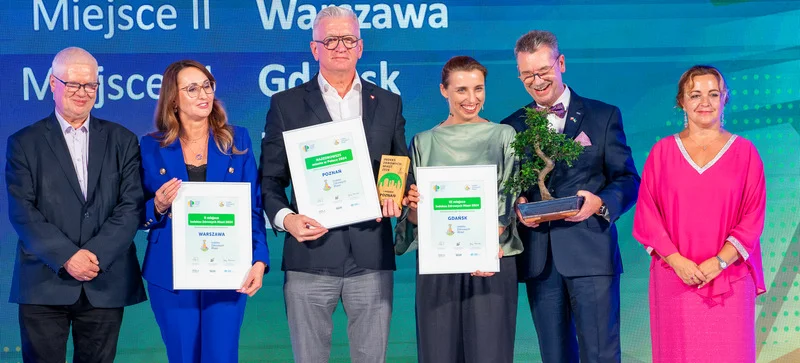
In each of the eight sector categories, as in previous years, leaders were also selected. During the Gala, on September 23, 2024, presidents and representatives of the awarded cities received special awards prepared by the organizers of the Healthy Cities Congress. They were awarded to the following cities:
Master statement above 300,000 inhabitants:
- I place - Poznań
- II place - Warsaw
- III place Gdańsk
Master statement under 300,000 population:
- I place - Sopot
- II place - Gdynia
- Third place - Rzeszow
Health:
- I place - Rybnik
- II place - Poznań
- Third place - Gdynia
Population and Generations:
- I place - Rzeszow
- II place - Cracow
- Third place - Gdańsk
Utilities and Social Services:
- I place - Przemyśl
- II place - Plock
- Third place - Leszno
Education:
- I place - Cracow
- II place - Warsaw
- Third place - Wroclaw
Housing:
- I place - Sopot
- II place - Katowice
- Third place - Chorzow
Environment:
- I place - Sopot
- II place - Olsztyn
- Third place - Poznań
Infrastructure:
- I place - Ostroleka
- II place - Tychy
- Third place - Walbrzych
Space:
- I place - Chorzow
- II place - Zielona Góra
- Third place - Swinoujscie
Responsibility for the future of the planet rests with all of us, and the actions we take today have a direct impact on the health of the environment and the health of future generations. Today's challenges, such as climate change and irrational resource management, require the involvement of both local governments and residents. The Healthy Cities Index is a valuable tool that not only helps assess where we are, but also points the way forward for improving the quality of life and protecting the environment.
Dr. Piotr Wachowiak, Prof. of SGH, Rector of the Warsaw School of Economics, co-organizer of the Healthy Cities Congress
What do Polish cities face?
Today, Polish cities are facing major challenges: from aging populations, to an influx of new residents (due, among other things, to economic emigration), to increasingly higher expectations regarding the quality of education or health services offered. Residents of Polish cities want a clean environment, access to recreational areas, care for their health and mental well-being, but also support in realizing their own lifestyles.
We encourage thinking about health as a key resource that drives innovation and productivity. To ensure a stable and sustainable future for cities, it is essential to include the health of residents in long-term strategies. This is because it affects labor force participation, social engagement and quality of life, which ultimately translates into the development of the entire local economy.
Prof. Jerzy Hausner, Chairman of the Program Council of the Open Eyes Economy Summit, GAP Foundation, co-organizer of the Healthy Cities Congress
More changes every year
The Healthy Cities Index is a signposting tool for local governments, which, when analyzing it, can draw conclusions about necessary changes in the areas they manage, but also compare themselves to other cities in the country. The originators have already confirmed the continuation of the project in future years.
We are seeing big changes in the various areas of the Healthy Cities Index, which shows the dynamism of the cities. This proves that efforts to improve the living conditions of residents are bearing fruit. Local governments are becoming more responsive to the changing needs of their communities, which can be seen in the improved performance of many cities.
Agnieszka Chłoń-Domińczak, Ph.D., Professor of the Warsaw School of Economics, Vice-Chancellor of the Warsaw School of Economics
A team of experts led by Agnieszka Chłoń-Domińczak, PhD, Vice Chancellor for Science at the Warsaw School of Economics, worked on the preparation of this year's edition of the Healthy Cities Index. Dr. Jakub Głowacki of the Cracow University of Economics (UEK) was responsible for the methodology and the area of municipal and social services. The area of health was handled by a team consisting of Barbara Więckowska, PhD, Violetta Korporowicz-Zmichowska, PhD, Monika Raulinajtys-Grzybek, PhD, and Melania Raczek-Zeromska, MA. The area of population and generations and education was coordinated by Agnieszka Chłoń-Domińczak, PhD. The categories of housing and environment were supervised by Adam Czerniak, PhD. Infrastructure was supervised by MA Michal Taracha and Eng. Jakub Kaczorowski, and the area of space was supervised by Dr. Michal Kudłacz. In addition, surveys to residents and city authorities were developed by Jacek Sierak, PhD, and Małgorzata Krytak, a student at the Warsaw School of Economics.
New research direction. Mental well-being a priority for cities
This year's publication of the Healthy Cities Index included a new area - the mental well-being of residents. Kantar Poland, on behalf of the LUX MED Group, conducted a study to understand how city residents experience loneliness and how urban space affects their mental health.
According to the Kantar Sustainability Sector Index 2023, in the ranking of Poles' greatest concerns, the issue of mental health ranks high, with as many as 36 percent of respondents indicating it as a key concern, while 25 percent believe that mental health problems should be addressed as soon as possible. According to the survey "Mental well-being and the chosen offer of cities," which Kantar conducted on behalf of the LUX MED Group - as many as 65 percent of residents believe that it is the city's responsibility to take care of the mental well-being of its residents. Unfortunately, only 24 percent of residents are convinced that their city cares about the mental well-being of its residents. This is therefore a special area for local governments to take care of.
The Healthy Cities Index report is available at the link: Healthy Cities Index - LUX MED Group
Topics
Indeks Zdrowych Miast