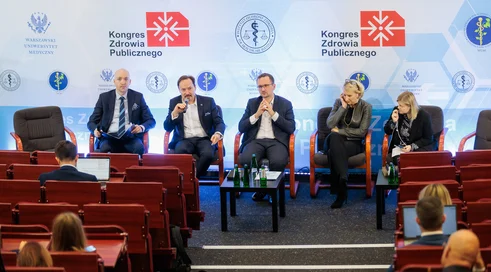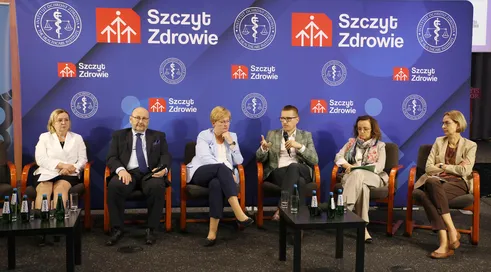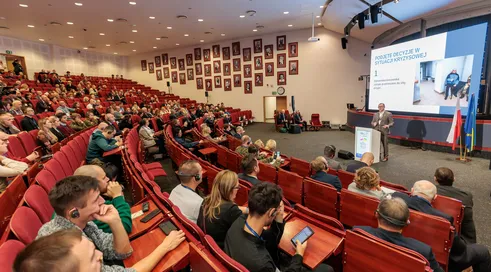
An innovation that saves a patient's life could be an artificial heart, but it could also be a solution that guarantees transportation for tests or treatment, they said during a panel on innovations and technologies of the future in healthcare.
KZP 2024
Innovations and technologies of the future in healthcare

Published Dec. 27, 2024 08:01

Prof. Beata Jagielska, director of the Maria Sklodowska-Curie National Institute of Oncology - National Research Institute in Warsaw, reminded that hospitals qualified for the National Oncology Network have been preparing for the innovation of cooperation for some time. In a system designed to compete for the patient, it is necessary to prepare pathways to optimize cooperation for the benefit of the patient, so that the patient can get the best possible treatment close to his place of residence (although this does not necessarily mean the nearest hospital). - Communication exclusion is still a very big problem. We are running a project, a program to support the treatment of residents of Plock County, and there some patients have a problem even getting to their PCP," admitted Prof. Jagielska, pointing out that solving this problem would be an important innovation in the health care system.
The discussion of innovation could not miss the topic of drug therapies as well. Agnieszka Grzybowska-Zalewska, chairman of the board of the Association of Employers of Innovative Pharmaceutical Companies INFARMA, spoke about good and bad news in this area. The good is related to the hopes that artificial intelligence brings. Scientists estimate that harnessing it to research new therapies could significantly reduce the time it takes for research to reach implementation, which currently averages ten years. The good news is also the tremendous increase in the number of studies. - It has increased 38 percent worldwide in ten years," she stressed. The bad news is that there has been a decline in the number of studies in Europe, which is primarily related to the multiplicity of markets, entailing different regulations. - The United States, China are the winners," the expert stressed. Against the background of Europe (a decline of 6 percent), however, Poland is doing not badly, as the decline is apparently smaller, 2 percent. Improving the conditions for conducting research can help stop the decline and thus ensure that thousands of patients can benefit from the tested therapies.
Participants of the Public Health Congress could also find out how much of an innovation and how much of a technology of the future they are:
Artificial heart. - We still have to wait for a fully perfected artificial heart, but the technology is developing all the time, assured Prof. Mariusz Kuśmierczyk, national consultant in cardiac surgery and head of the Department of Heart, Thoracic and Transplant Surgery at the UCK WUM Central Clinical Hospital, recalling that the first artificial heart was developed in the 1960s in Texas. - There still isn't one we want.
One of the unsolvable problems for the time being is the need to charge the battery - this cannot be done through the skin. The cable that makes charging possible (patients put it simply: "the cable of life"), at the same time poses a danger, because a huge proportion of patients with such a device develop infections. However, there is no doubt that the search for the perfect solution will continue, because an artificial heart - even an imperfect one - allows patients to function for years while waiting for a transplant, and extends life for those who will not be able to benefit from a heart transplant.
3D Implants. Endoprostheses are the standard. Personalized implants may also become the standard - for selected groups of patients. Dr. Pawel Legosz, coordinator of the Department of Orthopedics and Endoprosthetics in the Department of Orthopedics and Traumatology of the Musculoskeletal System of the Faculty of Medicine, deputy director for treatment at the Infant Jesus Clinical Hospital UCK WUM, stressed that a decade ago he implanted a 3D implant specially designed for him in a "difficult" patient suffering from rheumatoid arthritis. The patient, he added, has already undergone several other joint replacement surgeries. - Personalization of implants will have, and in fact already has, applications for patients with primary joint destruction as well, he stressed.
Mixed reality (augmented reality) glasses. They were discussed - in the context of orthopedic and oncological surgeries - and by Dr. Legosz and Dr. Tomasz Maciejewski, director of the Mother and Child Institute in Warsaw. - Oncologists greatly appreciate the possibilities offered by these devices," the IMiD director stressed.
Expansion of radiology. - Radiology has left the darkroom and entered operating rooms. It is no longer just diagnostics. We have the ability to replace surgeons with less invasive techniques," emphasized Magdalena Januszewicz, MD, head of the Second Department of Radiology, Warsaw Medical University. Radiologists have the ability to insert stents, remove aneurysms and even destroy some unresectable tumors.
Topics
KZP 2024