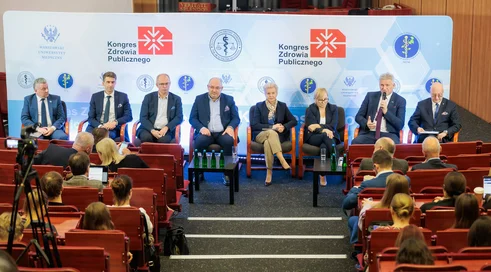
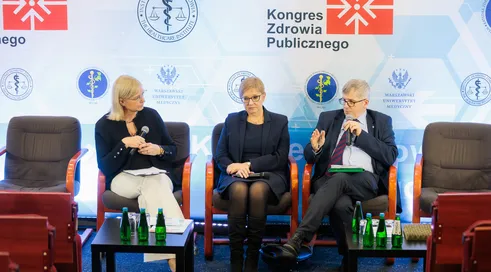
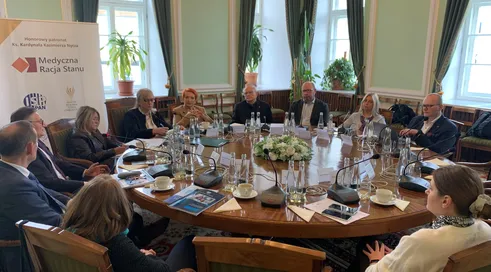
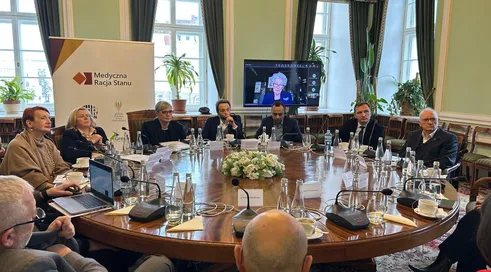
- We are still chasing the best in Europe, 30 years ago the average cure rate for cancer in Poland was 30%, and at the moment it exceeds 50% regardless of the stage, informed Dr. Janusz Meder during the Medical Rationale of State debate organized on the occasion of World Cancer Day on January 30, 2026. The experts discussed challenges in oncology, the importance of medical progress and systemic solutions to improve patients' access to modern diagnostics and therapy.
Medical Rationale: Progress that transforms human destiny

Published Feb. 9, 2026 12:57
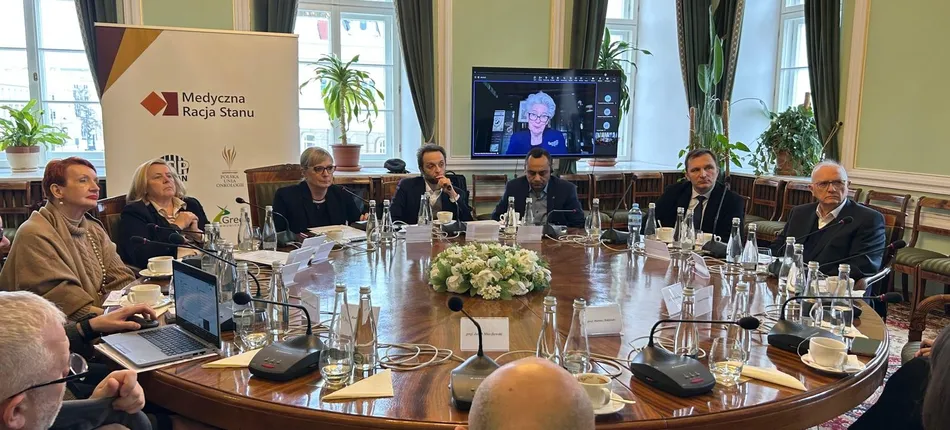
One of the founders of the Medical Rationale of State Dr. Janusz Meder, president of the Polish Union of Oncology, chairman of the NIO-PIB Bioethics Committee, recalled that the World Cancer Day 2025-2027 slogan "United by uniqueness" puts people at the center of care. - This means that we are all united in one goal. Hence, this roundtable of the Medical Rationale of State is very significant," he stressed.
The creators of the Medical Rationale of State Anna Jasinska and Grazyna Mierzejewska reminded that the think tank has been in existence for 10 years and is the most systematically organized platform for dialogue between experts and patients and with decision-makers. - Given that globally a quarter of cancers are in Europe, although Europeans make up less than 10% of the world's population, there is much to fight for, Anna Jasinska pointed out. - We are acting to improve the situation for patients. It depends on the decision-makers, but without the support of experts, politicians, patient organizations, this cannot be achieved," added Grazyna Mierzejewska.
Managing progress
WHO representative Rifat Hossain, head of the work to develop an artificial intelligence-based knowledge platform and the first Health Equity Report, spoke about equality in access to innovation. - Innovation without equality is a political risk, and oncology is something of a stress-test for the system, because in oncology we need early detection, rapid referral and continuity of care, he pointed out.
- Equality in access to health is not a moral add-on. It is the way the modern state protects the value of innovation," he added. Rifat Hossain presented the possibility of using Big Data and artificial intelligence to prevent inequality in access to innovation. - In the prepared model, we can see what the equality profile looks like in the region, indicators that are relevant to oncology, early warning signals and easy-to-understand infographics for parliamentarians, the National Health Service and the provinces. The idea is that outcome data can be linked to prevention, health promotion and living conditions. And artificial intelligence is supposed to predict where the bottlenecks will be and point out inequalities that are just forming in advance. It can also simulate what-if policy options," he explained. - Either we will manage progress, or later we will have to explain why progress has not reached people, he stressed.
Prof. Piotr Rutkowski, president of the Polish Oncology Society, reminded that for the past nine months we have been implementing the National Oncology Network in Poland, which is intended to improve the organization of oncology care, ensure access to the highest quality services and comprehensive care throughout the process. - It is important that every potential oncology patient is aware that it is their right to set up a diagnostic card for oncology treatment, to be on this path and to know what the outcome of the consultation is, he pointed out. Among the challenges in the implementation of the Network, he mentioned equality in access to pathomorphological and molecular diagnostics, because it is still not properly applied everywhere. He also pointed out that in addition to coordination and organization of the system, prevention is the second pillar that saves funds and improves outcomes for cancer patients. He lamented that expenditures for this purpose account for 1.8% of treatment expenditures. Meanwhile, Prof. Mariusz Bidzinski, national consultant in gynecologic oncology, noted that Poland is not inferior in both diagnosis and treatment to the best European and world models. - The only problem is that we treat patients in very advanced stages. If we had a population effect in a much higher percentage of reporting for preventive examinations, we would have huge savings in terms of the entire health care system, he said.
Dr. Magdalena Bizoń of LUX MED Oncology emphasized the role of both coordinators and organ units, which set a clear pathway, ensure the quality of care offered.
Prof. Adam Maciejczyk, director of the Lower Silesian Center for Oncology, Pulmonology and Hematology, added that the implementation of the Network still lacks an e - DILO card and quality indicators. He also called for a discussion on modifying the financing of drug purchases so that they do not burden cancer centers, where these patients are most numerous.
Prof. Ewa Lech-Marańda, national consultant in hematology, recalled that 109 molecular indications have been reimbursed in the field of hematology over the past five years. An area for improvement is the availability of genetic testing in outpatient specialty care and immunophenotype testing.
Matthew Oczkowski, director of the Department of Pharmaceutical Drug Policy at the Ministry of Health, stressed that reimbursement of diagnostics and therapy should occur at the same time. This is because diagnostics affect the budget for the public payer and the size of the population that will benefit from therapy. - Meanwhile, we are putting drugs into the reimbursement system faster than diagnostics. We face a real economic challenge several years after the introduction of therapies," he pointed out.
Dr. Mariola Kosowicz, head of the NIO-PIB Psychooncology Department, talked about the importance of prehabilitation for cancer patients, which has already been introduced in many hospitals. - The time of waiting for the test result is the moment when the patient already has prehabilitation. He goes to a psychologist, and then under the care of a rehabilitator and nutritionist, she informed.
Progress that changes people's fate
Prof. Barbara Radecka, head of the Oncology Clinic at the Prof. Tadeusz Koszarowski Oncology Center in Opole and Opole University, stressed that the appearance of a new targeted drug in oncology is a very important event, as it shows progress in science and gives patients hope for better treatment. A good example is therapeutic progress in such a difficult challenge as brain tumors.
For the past three decades, the standard of treatment for gliomas has been based on neurosurgical surgery and, depending on an assessment of risk factors for recurrence, close observation or the use of radio and chemotherapy. In the second half of September last year. The European Medicines Agency registered the first new therapy for the treatment of gliomas in more than two decades, and at the same time the first molecularly targeted therapy with vorasidenib, which sets a new standard for the treatment of patients with stage 2 glioma with IDH mutations.
- If we have a drug targeting a given molecular disorder, it is worthwhile to study all patients in order to find even a few with a specific molecular disorder to whom we can offer a completely different treatment - more effective, very often much less toxic than chemotherapy," stressed Prof. Barbara Radecka.
Prof. Radoslaw Rola of the Department of Neurosurgery and Pediatric Neurosurgery of the Faculty of Medicine at the Medical University of Lublin also pointed out that diagnostics is essential to qualify a patient for vorasidenib treatment. - If we have a patient with a glial brain tumor, certain markers are absolutely necessary to do at the moment, and IDH gene mutation is one of those markers. At the moment, no neuropathologist will make a diagnosis without having IDH mutation assessed. So it's a diagnostic responsibility," he stressed.
He informed that within the Committee of Neurological Sciences of the Polish Academy of Sciences an initiative has been taken, to prepare requirements for genetic diagnosis in patients with tumors of the nervous system. - This is a step in the right direction, because in a year or two a new WHO classification of nervous system tumors will be published, in which the requirements for genetic diagnosis will be much broader, he noted.
Prof. Bozena Kaminska-Kaczmarek of the Marceli Nencki Institute of Experimental Biology of the Polish Academy of Sciences pointed out that Poland does not have a specialty in neuroncology, which is in every other European country and the US.
- The patient goes to a neurologist, the neurologist refers him to a neurosurgeon, and then he goes to an oncologist, and often still to a radiation therapist. Why can't a neurologist write a prescription for a drug for a glioma? Why should a patient with a brain tumor go to a regular oncologist, when we all know that brain tumors are really different, requiring separate therapy, separate drugs? - she asked. She called for the institution of regional neurooncology specialists to guide the patient along the most appropriate path for him.
Prof. Radoslaw Rola proposed the introduction of a brain tumor unit, i.e. the establishment of teams for the dedicated treatment of patients with tumors of the central nervous system.
Prof. Krzysztof Giannopoulos, president of the Polish Society of Hematology and Transfusion Medicine, recalled that thanks to reimbursement decisions, survival of plasmocytic myeloma patients has significantly increased. He added that the greatest need for myeloma patients is to improve treatment from the first line for patients who are ineligible for transplantation. There is also a lack of a second-line treatment drug for relapsed disease. CAR-T therapy, which gives a high chance of a profound response, even in heavily treated patients, is currently not reimbursed in Poland. - It is standard in Western European countries, in the US. We are waiting for a decision," he said. He also pointed out that in the second line of treatment the new expected drug is belantamab mafoditine.
Improving the quality of life of patients
Malignant disease and oncological treatment can cause impaired reproductive function and disorders of the sexual system, and in extreme cases lead to permanent infertility. Malignant tumors are one of the important factors that threaten reproductive health.
Prof. Katarzyna Pogoda, from the Department of Breast Cancer and Reconstructive Surgery at NIO-PIB, reminded that as of June 1, 2024, the government program entitled "Treatment of infertility involving medically assisted procreation procedures, including in vitro fertilization carried out in a medically assisted procreation center, for the period 2024-2028" is in operation, which gives both women and men the opportunity to secure oncopulation. - This program greatly assists these patients because they don't have to pay for it. Each center should have its own fast track developed, where it refers the patient or patient," she pointed out.
She informed that patients are referred for these procedures. - We talk, we make a referral, with information on what treatment we plan. Fertility can be limited by chemotherapy, but also by long hormone therapy. If I have a patient who is, for example, 35 years old, after the end of treatment after eight years, the natural chance of getting pregnant is difficult," she recounted.
Prof. Mariusz Bidzinski reminded that we were at the tail end of Europe in this area. - We have forgotten certain things about quality of life, especially during or after cancer treatment. People with cancer want to return to life, active life both professionally and in the family. The Minister of Health, Izabela Leszczyna, made the decision to actually make this program work. This is a kind of breakthrough and proof of strategic thinking about oncoplasticity," he stressed.

Topics
Medyczna Racja Stanu / rak / terapia / postęp medycyny / dostęp do opieki medycznej / onkologia / diagnostyka