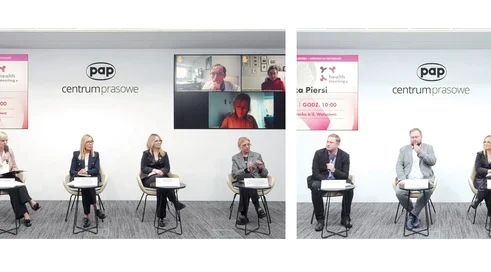
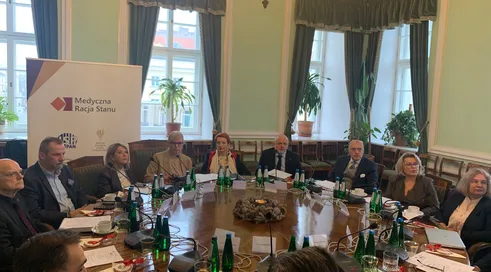
On March 6, 2024, the Ombudsman's Office hosted another meeting of the Expert Committee on Mental Health Care, once again focusing on the situation in child and adolescent psychiatry.
Child and adolescent psychiatry: patient pathway needs to be streamlined

Published March 8, 2024 11:22

The meeting was attended by the Ombudsman Marcin Wiącek, Deputy Ombudsman Valeri Vachev, regular members of the Commission and invited guests, among whom were the Plenipotentiary of the Minister of Health for Reform in Child and Adolescent Psychiatry - Prof. Dr. Małgorzata Janas-Kozik, Paulina Piechna-Więckiewicz - Undersecretary of State at the Ministry of National Education, Dr. Aleksandra Lewandowska - National Consultant for Child and Adolescent Psychiatry. Child and Adolescent Psychiatry, Dariusz Poznański - Director of the Department of Public Health at the Ministry of Health, Damian Marciniak - Director of the Department for Mental Health at the Office of the Patient Ombudsman, Katarzyna Skrętowska-Szyszko - Director of the Social Affairs Team, as well as Ms. Weronika Snoch - Expert from the Office of the Child Ombudsman and Dominik Kuc - member of the Growspace Foundation.
The situation in child and adolescent psychiatry and the changes that have taken place in this area since the introduction of the reform were presented by Prof. Dr. Małgorzata Janas-Kozik - Plenipotentiary of the Minister of Health for Reform in Child and Adolescent Psychiatry. In her speech, she outlined the basic assumptions on which the reform of psychiatry was based, which included: deinstitutionalization, the universalization of the patient pathway in the mental health system, increased accessibility to outpatient and community services at the county level, the development of community-based services, involving the introduction of mandatory cooperation with the family and school environment, the creation of a nationwide, system that provides support to underage patients experiencing mental disorders and their families.
The Plenipotentiary noted that the reform attempted to overhaul the psychiatric treatment system, which prior to the reform was basically based solely on inpatient treatment, and the reform sought a situation in which primary care for people in crisis would be provided by Level I reference centers. It was emphasized that as part of the implemented reform, new professions and specializations were introduced - a community therapist for children and adolescents, a specialization in child and adolescent psychotherapy, and a new specialization program in clinical psychology for children and adolescents.
The Plenipotentiary also identified areas that it believes need further changes, among which are:
- Introduce coordination between reference levels and cross-sectoral coordination;
- reforming the way the 2nd and 3rd reference levels are financed and moving to a hybrid form (lump sum + fee for service). Currently, only benchmark level I has a hybrid system of financing. Level II - is based on payment for services rendered (fee for service), and in Level III, finasation is per so-called "person-day."
- Revision of reporting regulations in child and adolescent psychiatry. It is necessary to improve the technical side of billing, such as simplifying reporting, as treatment entities (which are often not hospitals) without experience focus excessively on correcting irregularities;
- modifying the thinking of professionals working in the field of child and adolescent mental health;
- A thorough and reliable quantitative and qualitative analysis of the consistency of the child and family mental health model (health outcomes), the organizational and financial model, and the research model (treatment evaluation).
Then, Dr. Aleksandra Lewandowska - national consultant for child and adolescent psychiatry - presented the most relevant, from her perspective, problems that require special attention, and these are:
- The need to increase the number of specialists. Currently, psychiatry is becoming increasingly popular among students, but in order for this interest to actually translate into an increase in the number of specialists, it is necessary to increase the number of physicians who can be trained simultaneously by a single internship manager. The above requires an amendment to the provisions of the Law of December 5, 1996 on the professions of physician and dentist (Journal of Laws 2023, item 1516);
- Granting psychiatrists the right to prescribe free drugs for people 65+ and those under 18;
- Improving the "patient pathway." The country already has three reference levels, but the "patient pathway" in the area of adolescent child psychiatry, unfortunately, does not work. The National Consultant noted that there was no public campaign to inform parents, but also doctors, where to refer a young patient.
She also pointed out:
- The need to change the valuation of benefits;
- The need for interdepartmental cooperation;
- Introduce, following the model of the CZP for adults, territorial responsibility for youth in the area;
- Introduce, following the model of the CZP for adults, notification and coordination points.
Paulina Piechna-Więckiewicz - Undersecretary of State at the Ministry of National Education - then spoke in the discussion, also noting the need for inter-ministerial cooperation.
The minister also addressed the issue of the presence of psychologists in schools. According to the data she provided, there is now an increase in the number of psychologists working in schools, but there are still large disparities between provinces in this regard. There is still no psychologist on staff in about 25% of schools.
Another issue raised was the urgent need to improve the image of the psychologist. Unfortunately, those who work as psychologists at school very often do not enjoy the trust of young people.
The minister noted that the education ministry will endeavor to "equip" current teachers with the competencies to deal with emergencies, and will endeavor to change the teacher training system so that this area is included in the course of their education.
A representative of the Ministry of Health - Dariusz Poznański - director of the Department of Public Health - also spoke in the discussion. He stressed that child and adolescent psychiatry is a priority area for the Health Ministry and will soon be injected with more funding.
The director noted the increase in recent years in the availability of publicly funded services.
Like the other speakers, he sees problems in the availability of specialties and the lack of inter-ministerial cooperation. In addition, he reported that the Health Ministry is planning to amend the Law on Mental Health Care.
Then Damian Marciniak - Director of the Department for Mental Health at the Office of the Patient Ombudsman presented the problems with which young patients and their legal guardians come to the Patient Ombudsman, He stressed the need for deinstitutionalization in the area of mental health and pointed out that patients do not know enough about the possibility of obtaining professional help in case of mental health problems. He also pointed out that the multitude of entities that currently exist - Psychological and Psychotherapeutic Care Centers, Pedagogical and Psychological Clinics, psychologists in schools, County Family Assistance Centers - results in a person who seeks help not knowing where to turn.
In addition, he pointed to the need to increase the role of prevention in caring for well-being - a young person needs to know how to take care of his or her mental health and where to seek help for problems that arise. He also signaled the need to introduce health literacy in schools as a new subject, where students would receive comprehensive knowledge in this area.
He also advocated the need to change the laws in regulating access to a psychologist.
The Children's Ombudsman's perspective on the protection of the mental health of children and adolescents was also presented by Katarzyna Skrętowska-Szyszko - Director of the Social Affairs Team at the BRPD. She stressed, as did all the speakers, the need for inter-ministerial cooperation. She pointed to the collapse in the foster care system, resulting in children being placed in psychiatric hospitals for the duration of the resolution of their care situation. She also pointed out the lack of information on where to seek help for a child in crisis.
Dominik Kuc - a member of the Growspace Foundation - spoke next. He drew attention to the need to monitor the health of young people at the school level. He pointed to the lack of regulation of the psychological profession and the lack of trust of students in psychologists.
In addition, he drew attention to the issue of problems that may arise in connection with the introduction of compulsory schooling for Ukrainian youth. This is because currently some of these youth remain outside the school system. He flagged the issue of digital education, as currently school is limited to banning phones in schools, rather than teaching how to use new technologies wisely.
After listening to the speeches of the invited guests, a discussion began, in the course of which, all the invited Experts agreed that cross-ministerial cooperation was necessary. Attention was drawn to the need to change the regulations for prescribing free psychiatric drugs for people 65+ and under 18 years of age.
They stressed that it was high time to eliminate discrimination against psychiatry.
They called for the creation of a National Mental Health Program for children and adolescents, as well as the introduction of pro-health programs in schools and the teaching of competence and taking responsibility for oneself and one's health. They stressed, as did the referents, the need to change the financing of the various reference levels.
Source: RPO