Prominent hematologists from Poland and abroad will spend four days of the 5th International Conference "Clinical and Experimental Hematology" discussing new methods of diagnosis and treatment. The opening lecture will be delivered by the President-elect of the European Society of Hematology. For the first time, the conference will be accompanied by parallel sessions on the safety of treatment with blood components.
Largest hematology conference in 2024 launches in Poland

Published May 9, 2024 14:08
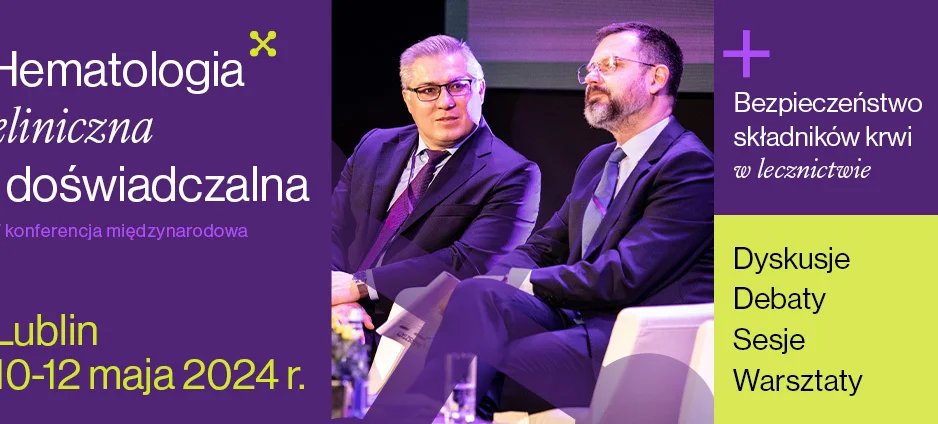
Diagnostic workshops, educational lectures, discussions, systems sessions, panels aimed at young researchers: the program of this year's conference is exceptionally rich. - " This is the largest hematology conference in Poland in the years when the conventions of the Polish Society of Hematologists and Transfusionists are not held, i.e. every two years," stresses Prof. Krzysztof Giannopoulos, president of the Polish Society of Hematologists and Transfusionists, coordinator of the Program of the 5th International Conference "Clinical and Experimental Hematology.
Even before the official start of the conference, practical workshops will be held on modern diagnostic methods, on which both the treatment and monitoring of its effectiveness depend. The topics of the conference are very broad, including diagnosis and treatment of acute and chronic leukemia, plasmocytic myeloma, lymphoma, amyloidosis, Waldenstrom's macroglobulinemia, myelodysplastic syndromes, myelofibrosis, verrucous melanoma, among others. - At the conference, we want to show that there is a lot going on in every area of hematology these days. However, we place special emphasis on the diagnosis and modern treatment of acute myeloid leukemia, which today poses the greatest medical challenge, since 5-year survival rates have only recently begun to exceed 30 percent. We will also talk a lot about new treatments, including CAR-T technology and bispecific antibodies. Every year we expand the formula of topics: this year, for the first time, there will be sessions on transfusionology and the safety of blood components in treatment. There is a lot going on in this area, so we decided to create separate sessions dedicated to modern blood therapy," Prof. Giannopoulos points out.
Lecturers: authorities from Poland and abroad
The development of hematology today is not possible without international cooperation; Polish hematologists are increasingly part of international teams working on new diagnostic and treatment methods. The conference will be attended by prominent experts from both Poland and abroad. The opening lecture on the diagnosis and treatment of acute myeloid leukemia will be given by Prof. Konstanze Döhner of the University Hospital in Ulm, president-elect of the European Hematology Association (EHA) and chairwoman of the German-Austrian AML Study Group (AMLSG), one of the world's leading research groups on this topic.
In the session preceding the opening lecture, Prof. George Vassiliou of the University of Cambrige will speak about basic research aimed at understanding the causes of myeloid leukemia; Dr. Esther Oliva of Reggio Hospital in Calabriaopowa will speak about individualizing the treatment of myelodysplastic tumors, and Prof. Lars Bullinger, a world expert in the treatment and diagnosis of leukemia from the Charité Hospital in Berlin,will summarize the issues of pathomechanism, classification and diagnosis of acute myeloid leukemia.
The conference will be attended by leading Polish hematologists and transfusiologists from the leading hematological treatment centers in Poland. Educational sessions will be interspersed with panels, during which experts will discuss, among other things, the sequence of treatment, the directions of development of diagnostics and therapy, the occurrence of unusual side effects after modern drugs. Educational lectures will be complemented by satellite sessions. Some of the lectures are in English, which emphasizes the role of international cooperation in the development of hematology.
System sessions: treatment options in Poland
An important part of the conference is the system sessions on current opportunities and challenges in Poland, with the participation of hematologists, PCPs and health system experts. - The situation in Poland has improved a lot in recent years; we appreciate this very much. However, there are still reimbursement needs, but seeing how consistently the Ministry of Health has striven in recent years to make new therapies available to patients, we hope this will continue. We have good therapeutic tools, and the patient will benefit most when they are diagnosed efficiently," Prof. Giannopoulos points out.
Challenges now include faster diagnosis of patients (better cooperation with PCPs), improved access to modern diagnostics, and better organization of patient care. It is necessary, among other things, to transfer the care of some patients to specialized outpatient clinics, so that hematology departments in hospitals can quickly admit patients who should be diagnosed and treated urgently, requiring highly specialized procedures or treatment of serious side effects that may occur after the use of modern drugs. Staffing in hematology and encouraging young physicians to choose a clinical and research path in hematology is also a challenge. - We are addressing one panel in particular to young researchers so that they know what, for example, are the opportunities for fellowship trips. It will be attended by people from the most important entities that fund scientific research, including the National Science Center and the Foundation for Polish Science," stresses Prof. Krzysztof Giannopoulos.
Transfusionology in hematology and blood component safety
An important part of hematological treatment is the transfusion of blood components, hence the transfusion sessions at the conference. - Transfusionology is an indispensable part of proper treatment, especially for oncohematology patients, who may require a large number of transfusions of various blood components, sometimes in a short period of time. Clinical efficacy is important, but above all, the safety of blood components is important, to minimize the risk of post-transfusion reactions," says Prof. Jolanta Antoniewicz-Papis of the Institute of Hematology and Transfusion in Warsaw, coordinator of the transfusion sessions of the 5th International Conference "Clinical and Experimental Hematology.
Transfusionology sessions will address both donor and recipient safety. In Poland, the treatment of blood and its components is very well organized; new diagnostic methods are being implemented for serological and virological determinations, and for many years no transmission of any tested virus has been found with blood components. Among other things, blood is checked for markers of HBV, HCV and HIV, as well as markers of syphilis infection. The conference will include discussions on whether additional testing for other pathogens, including hepatitis E virus (HEV), should be introduced. - There will also be a session on new containers in which blood is drawn that do not contain DEHP: it has been found that it can have an adverse effect due to the release of potentially harmful substances. The new regulations call for the use of DEHP-free containers, Prof. Antoniewicz-Papis noted.
Human errors, which are the cause of adverse reactions after transfusion, will also be an important topic. - All over the world, human errors are the most common cause of an adverse reaction or adverse event in the entire blood treatment process. We want to give examples of human errors and make all those who are in any way involved in the blood treatment process aware of the importance of following strict procedures, regulations, guidelines. Any deviation can endanger the donor or the patient," adds Prof. Antoniewicz-Papis.
About the conference "Clinical and Experimental Hematology"
This year's International Conference "Clinical and Experimental Hematology" is being held for the fifth time. However, the history of the conference is much longer: its beginnings were the international conferences on clinical hematooncology, held from 1996 to 2012, on the initiative of Professor Anna Dmoshynskaya, whose main topic was chronic myeloproliferation and lymphoproliferation.
In 2014, the name of the conference changed, and the scope of topics expanded, including acute leukemia, panels on diagnostics and systemic sessions. The 5th International Conference "Clinical and Experimental Hematology" is another expansion of the formula - with sessions on transfusionology and safety of blood components in medical treatment.
The conference is aimed primarily at hematologists, primary care physicians, transfusion specialists and physicians of other specialties interested in hematology and transfusionology, as well as laboratory diagnosticians, employees of blood and blood donation centers and hospital staff involved in the blood treatment process.
Those interested in attending the conference can still register at: konferencja.hematoonkologia.pl/registration
More information about the conference: konferencja.hematoonkologia.pl
Source: Hematooncology.co.uk