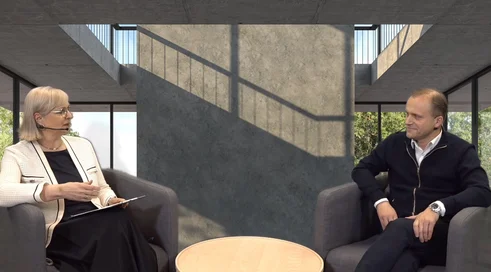
Caregivers of sick people are often alone in their role, while they need specialized knowledge and support both in the context of the patient's health and their own. Drawing attention to this problem is the goal of the 8th edition of the Nutricia Foundation's educational campaign, held under the slogan "You help your loved ones, let you help yourself. Medical nutrition will support you in this". As part of it, a spot was created with exceptional characters - experts who work with the sick and their caregivers on a daily basis, as well as Dorota Wellman, a well-known journalist, who shares in it her experience of being a caregiver.
You help your loved ones, let you help yourself. Medical nutrition will support you in this

Published May 19, 2023 10:01

According to opinion surveys [1], every second person, when becoming a caregiver, is worried about whether he or she will be up to the new role. At the same time, caregivers demand a lot from themselves. At the same time, they are often afraid to ask others for support and feel lost in the maze of information on various aspects of their loved one's illness.
- The diagnosis was like a bolt from the blue. As a caregiver, I needed knowledge and support. I searched in various ways for information on what to do to best help my mother, who had developed cancer. I felt helpless - many caregivers feel the same way. However, I didn't ask anyone for help. My main focus at the time was to save the life of the person closest to me. Medications and painkillers were important. Nutrition or movement became secondary to this, as it turned out - wrongly, " says Dorota Wellman. - I decided to support the campaign run by the Nutricia Foundation, because the educational materials it produces can help caregivers fulfill their role. I feel that if I then - being a caregiver - had access to this kind of knowledge base, I would have felt more confident and it would have taken me less time to learn about many aspects of caregiving on my own, such as the role of medical nutrition, which can significantly support the patient and caregiver in the treatment or recovery process , she adds.
Nearly 42% of caregivers feel helplessness, with 50% admitting that the daily care of their loved one could be facilitated by more help from those around them, including experts [2]. Advice and experience from experts can improve the quality of life for both the patient and the caregiver himself, who often simultaneously takes on the roles of nurse, physiotherapist or, in part, psychologist, boosting the patient's morale and motivating him to fight the disease. However, it turns out that it is not easy for caregivers to ask for help from loved ones, to resort to expert support, and at the same time to take care of themselves, such as using a psychologist to be able to support the patient more effectively.
Asking for help - a sign of weakness or strength?
The barrier often turns out to be shame: "Because what do you mean, I have to ask for help?". Caregivers also very often say that it's not right: "It's not me who is sick, it's my loved one, why am I the one reaching out for help from a psychologist when it's the patient who comes first?".
- Those accompanying the patient and his relatives suffer differently than the patient himself, but often just as much, because they struggle with immense helplessness. They would like to take away at least some of that pain, suffering, treatment. But they can't. They are also helpless in what to say, how to say it, how to accompany and how to support. This is a role that also needs to be learned. Let's not be ashamed of it. Let's seek support, because none of us will be a good caregiver if we don't take care of ourselves first. This is what caregivers most often forget. They often think that they constantly have to be on standby, in action, in help, they can't even take care of everyday life for a while ," says Adrianna Sobol, psychologist and psycho-oncologist.
Medical nutrition your support
One of the pillars of the treatment and recovery processes is proper nutrition - and here an important role falls to doctors, nurses and clinical nutritionists, who can support both the patient and caregiver with their knowledge in this area. Indeed, many patients and caregivers are unaware of the role of nutrition during disease control and recovery.
- Even the best therapy, the most modern drug may not help if the patient is not properly nourished. Meanwhile, it is often forgotten that a sick person also needs to eat. What's more, he needs to eat more, better, differently. Let me give an example from my specialty - oncology - where we have three main pillars of treatment: radiation therapy, chemotherapy and surgical treatment. I compare them to a table that has four legs. The fourth one, which is nutrition, cannot be missing. Just as without the fourth leg the table can topple over, without nutrition there is no treatment," explains Dr. Pawel Kabata, medical oncologist surgeon. - Please understand me correctly - I am not saying that nutrition alone cures. However, it forms the basis of the body's functioning and, like breathing, is an integral part of life. Providing the body with the necessary nutrients is particularly important precisely during illness and treatment, which challenge the body , the doctor adds.
What will a sick person taste? What food will actually provide him with the necessary ingredients to fight the disease? - These are the questions caregivers often ask themselves.
- Patients, caregivers often feel confused about dietary issues. This is not surprising, because the information they receive is often contradictory or unclear. And what often happens is that with the disease comes an aversion to food, a lack of appetite or a rapid feeling of satiety. When the sick person refuses to eat or eats small amounts of food, the traditional dishes we prepare at home may not be enough during the period of illness and convalescence. Especially since the needs of a sick person's body are different from those of a healthy person. A sick person needs a certain amount of energy, protein and nutrients. And here medical nutrition comes to the rescue - essential substances in strictly defined doses. This way we are sure to provide what the patient needs most ," says Maja Czerwinska, MD, PhD, clinical nutritionist. - Patients and their caregivers often think that fatigue or lack of strength to get out of bed during illness are normal. They don't have to be, and we can prevent this and reduce the negative effects of illness and treatment through proper nutrition ," concludes the nutritionist.
A healthy dose of exercise
Illness and the stress caused by it cause a number of changes in the functioning of our body. Its metabolism changes and muscle strength decreases. In addition, this effect is compounded by immobilization, since muscles need movement to function properly. When not used, they begin to atrophy. So while the disease contributes to weakness, faster fatigue, it is useful to know how to alleviate this condition. Some caregivers seem to think that their charges then need even more rest to return to strength. It turns out, however, that movement plays a key role during this time - and this is where physiotherapy comes to the rescue.
- For a sick person, even doing basic activities such as brushing teeth or putting on socks can be difficult. Nevertheless, we should not bail her out, and should even motivate her to undertake such small activities. And this is just the first step, though not the last, on the road to recovery from illness, accident or surgery. In this context, a physiotherapist also plays an important role, as he can suggest to the patient what position to assume to make it easier to get up or sit down, and to the caregiver what maneuvers to use to lift or dress the patient. On the other hand, exercises performed with the support of a physiotherapist can help strengthen the patient's muscles or increase the mobility of his joints. Exercises combined with a proper diet, rich in protein and providing adequate energy, affect muscle function and can translate into better rehabilitation results. I always say that movement combined with proper treatment and nutrition is the best medicine," concludes Luke Klos, a physiotherapist.
Share your experience and benefit from the knowledge of others
- When illness affects the patient, it affects the whole family. The patient's loved ones, especially the caregiver, then need support. The spot, made as part of the 8th edition of the Nutricia Foundation's "Medical Nutrition - Your Meals in the Fight Against Illness" campaign, is designed to show that the caregiver's support by specialists in many fields is important and an integral part of treatment and recovery. In the age of the internet and information chaos, a platform has also been created to provide reliable knowledge and which connects caregivers of sick people - a profile on Instagram @JestemOpiekunem. It is a place to build a community of caregivers, share experiences and a base of expertise - doctors, nurses, clinical nutritionists, physiotherapists and psychologists.
The experts quoted in the material appeared in the spot, which is available on the Nutricia Foundation's YouTube channel: https://www.youtube.com/watch?v=vKER-BvMVHc and on the JestemOpiekunem profile on Instagram.
About the campaign "Medical nutrition - Your meals in the fight against disease"
The educational campaign "Medical Nutrition - Your Meals in the Fight Against Disease" aims to build awareness of medical nutrition as an integral part of healthcare and support patients and their caregivers in the treatment process. Since the first edition implemented in 2016, activities have included education on nutrition support in cancer. In subsequent years, the campaign was expanded to include activities dedicated to neurology, as well as on enteral nutrition through special access to the gastrointestinal tract (directly into the stomach or intestine), taking into account the various disease entities in which it is used.
The initiative was established in 2016 by Nutricia. Since the 5th edition, it has been implemented by Nutricia Foundation.
The campaign has been supported by many scientific societies and patient organizations since its inception.
About Nutricia Foundation
The Nutricia Foundation was established in 1996 by Nutricia Poland Ltd. Since its inception, the Foundation has been raising awareness about the role of nutrition, initially engaging, among other things, in nutrition education during the first 1,000 days of a child's life. As of 2019, the Nutricia Foundation's mission is to educate about the role of nutrition at different stages of a person's life. The Foundation directs its activities to children and parents, patients and their relatives, representatives of the medical community, public institutions and NGOs. The Foundation conducts nationwide educational programs such as: "1000 First Days to Health" or the "Medical Nutrition - Your Meals in the Fight Against Disease" campaign. It also implements a nationwide grant competition, enabling scientists to conduct scientific research in the field of human nutrition.
[1] Caregivers of people with neurological and oncological illnesses, Research report conducted 19.03-27.05.2020 by SW RESEARCH agency.
[2] Ibid.
Topics
żywienie medyczne