- In our opinion, this is a document that condones the degradation of the quality of education," is how the chairman of the OZZL Residents' Agreement assesses the educational quality standards presented in early October by the Ministry of Health and the Ministry.
Residents' Agreement: We view the regulation on educational quality standards negatively

Published Oct. 5, 2023 10:09
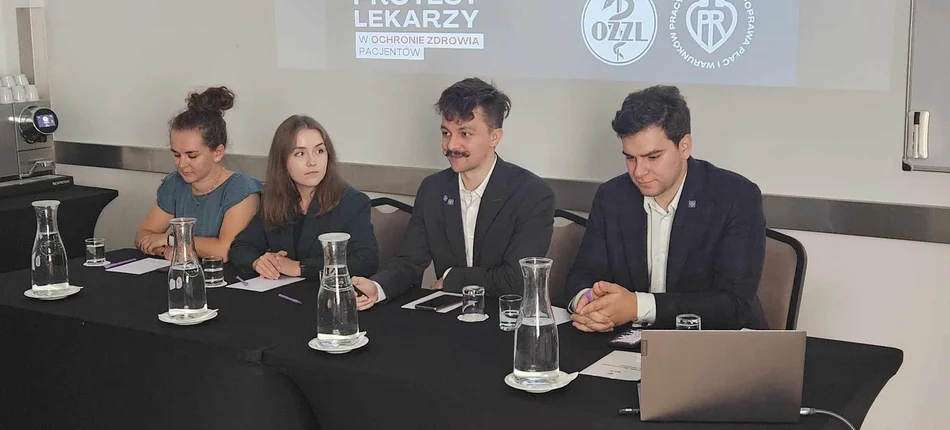
fot. Piotr Wójcik
As residents are reminded, on October 2, 2023, the educational standards were presented by the Ministry of Health and the Ministry of Education and Science as evidence of their concern for the quality of medical education.
"In our opinion, however, it is a document, condoning the degradation of the quality of education. Instead of solving the problems caused by the rapid growth in the number of medical faculty universities and their students, it is an adaptation to the new reality of education, which lacks teaching staff and infrastructure for the growing student population. We view the regulation negatively," reads a statement signed by Sebastian Goncerz, chairman of the Residents' Agreement.
As the residents recall, the standard at medical universities to date has been clinical groups (a group of students who, along with one instructor, take classes in a hospital setting working with patients) of between four and six people. In the sixth year, in some universities classes were held in groups of two. The regulation allows for more numerous clinical groups.
"We believe that such a provision allows teaching patients in far too numerous
groups. This implies a decrease in patient comfort, as well as a decrease in the time spent
with the patient for a single student. We interpret these changes as a response to the excessive increase in the number of students in relation to the teaching staff," we learn from the statement.
Doubts are also raised in such areas as the failure to specify the minimum number of hours that a medical graduate should spend during his studies working with patients, The new draft standards allow residents after the first
year of specialization to teach students. In the opinion of the PZ, a worrying situation is when a young doctor has a large group of patients under his care (for example, 10) and will be added to a group of eight students. Such a burden is a dangerous condition for patients, is not an effective method of training and endangers the doctor and impairs his own specialty training.
Included in the new educational standards is a practical skills exam called OSCE. As residents report, until now some universities have independently organized such an exam.
"I view the change positively. However, it should be noted that no exam is a guarantee of the quality of education. It is much more to take care of education throughout the entire six-year medical studies. The exam should also be conducted by an independent unit not affiliated with the university," writes Sebastian Goncerz.
What is worrisome, however, is the lack of foreseen evaluation methods for such extensive changes. Attention was also drawn to the Polish Accreditation Commission, which is the body that controls the quality of medical education. It should be noted that the PKA's opinion is notoriously ignored by MEiN, as a result of which half of the medical faculties under the supervision of the Ministry run
direction despite the lack of a positive opinion of the Commission.