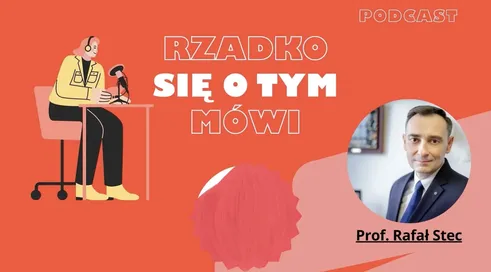
Tumors of the central nervous system are not among the most common, but their treatment is one of the greatest challenges of modern oncology. It requires precise molecular diagnostics, multidisciplinary teams and experience that cannot be replaced by a single specialty. On why patients with brain tumors should go to specialized centers, and on the first new therapy in gliomas in 25 years in the podcast "It's rarely talked about." - is narrated by Professor Rafal Stec, head of the Department of Oncology at the University Clinical Center of Warsaw Medical University.
It is rarely mentioned
Cancers of the brain and nervous system - what does treatment really look like?

Published Feb. 11, 2026 06:51
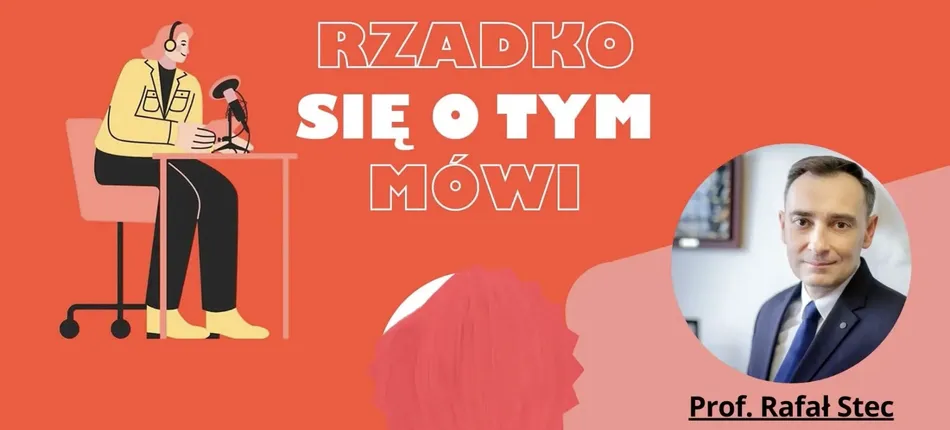
Tumors of the central nervous system are a special group of oncological diseases. As Prof. Rafal Stec points out, the problem is not just the sheer number of patients, but the way treatment is organized. - I would say that the clinical problem is both yes and no, because these cases are not so many. The problem, on the other hand, is that these patients should go to centers that specialize in treating tumors of the central nervous system, for the reason that this is an eminently interdisciplinary treatment, he points out. Treatment of brain tumors cannot be based on the activities of a single specialty.
- No single specialty can treat these patients. We need a very strong background of basic science - neuropathologist, molecular biologist, geneticist. The diagnosis is pathomorphological, but the subtype is already a molecular, genetic diagnosis, " says Prof. Stec.
Glioma: an incurable disease, but one that requires strategies
Glioma remains an incurable disease, regardless of the degree of malignancy. However, long-term treatment planning is crucial. - We, for the patient, have to establish a treatment strategy for years. The team includes a neurosurgeon - I always say 'knife first' - but also a neuroradiologist, a radiation therapist, an oncologist, a neuropathologist, a molecular biologist, a psychologist, a rehabilitation therapist," he enumerates. As he stresses, it is the neuroradiologist's experience that is sometimes decisive in assessing recurrence. - Sometimes the difference between postoperative lesions and relapse is small, and only an experienced neuroradiologist is able to distinguish this with high probability. According to Prof. Stec, the future of nervous system cancer treatment should be based on clearly defined structures. - These cannot be random centers. They must be centers of excellence. We will go in this direction - there is no other way here," he stresses.
New classification and the importance of genetics
In 2021, a new classification of central nervous system tumors was introduced that takes greater account of molecular testing. - It's not just a change in approach. We recognize new genetic biomarkers. We recognize type histologically, but subtype already molecularly. These classifications will have to be updated with the development of molecular biology," the expert explains. For the first time in more than two decades, there is a new therapeutic option for a select group of glioma patients. The therapy is designed for patients after non-radical surgery who do not require immediate radio- or chemotherapy.
Imaging diagnostics without the myths
The conversation also touched on the overuse of imaging tests, particularly PET. - PET is not a miracle test. It can give false-negative results - when the tumor is small or has low metabolic activity - but it can also give false-positive results, such as in inflammatory conditions, explains Prof. Stec. As he stresses, the basis remains a well-performed ultrasound, followed by a CT scan or MRI, selected depending on the organ. - The examination must have a direct bearing on determining the treatment strategy. This is the key.
Will there be a vaccine for cancer?
Asked about the possibility of creating a vaccine against all cancers, Prof. Stec says: Many cancers change genetically very quickly. The immune system may not recognize subsequent mutations. The biology of the cancer changes - also under the influence of treatment," he explains. As he adds, oncology is developing extremely rapidly, but it remains a field that requires not only knowledge, but also mental toughness. - It is a fascinating specialty, but also very difficult. Patients come to us in cycles, with their families. They leave too soon, and this is never indifferent," he concludes.
Topics
badania molekularne / rehabilitacja / neurochirurgia / onkologia / diagnostyka molekularna / leczenie nowotworów / psychologia / radioterapia / badanie PET / glejak / biologia molekularna / Nowotwory ośrodkowego układu nerwowego / neuropatologia / neuroradiologia / biomarkery genetyczne / terapia nowotworów / prof. Rafał Stec / genetyka / Rzadko się o tym mówi