The quality of education at medical faculties, ideas for measures that would remodel the health care system to a more patient-centered one, or the question of space for agreement across divisions. These are the main themes around which the election debate on health care, organized by the Supreme Medical Chamber, focused. It was attended by representatives of the largest nationwide election committees.
Election debate on health care: Politicians see opportunity for agreement across divides

Published Sept. 27, 2023 14:27
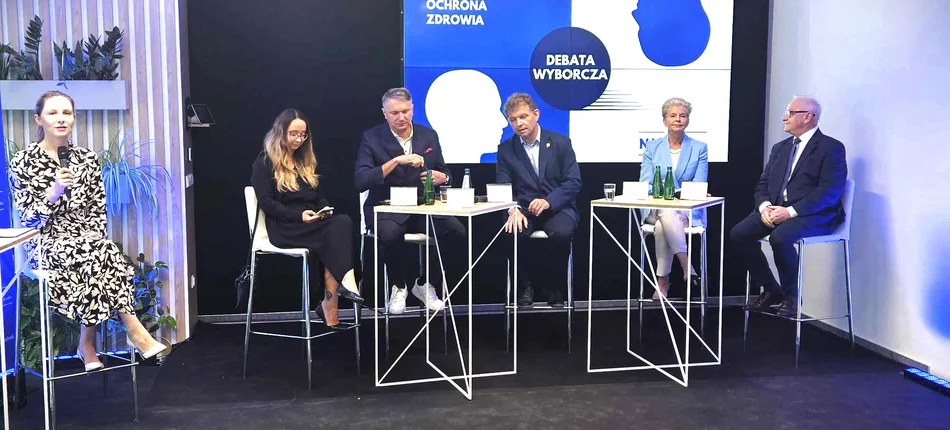
fot. Piotr Wójcik
MORE DOCTORS ARE NEEDED, BUT SOLIDLY EDUCATED ONES
The starting point for the first issue that the debaters leaned on was the words of Anna Rulkiewicz, CEO of the LuxMed Group, who said that she prefers an undereducated doctor to no doctor at all, because companies like the one she heads are able to train such medics properly.
MP Marcelina Zawisza of the Democratic Left Alliance disagreed with such a statement. She admitted that the shortage of doctors is a sore point in the Polish health care system, but every university should give a guarantee that the graduate who graduates from it will be able to ensure the safety of all its patients.
- If a university does not meet specific conditions, it should not be accredited and allowed to teach. We also need to rethink the whole system. It can't be that a doctor is doing tasks he shouldn't be doing. He should treat, take care of the patient. On the other hand, he should not be dealing with technical issues, organizational issues and paperwork. For eight years, the Law and Justice government, despite the very announcements of Minister Lukasz Szumowski, did not create a regulation, concerning medical secretaries," said Marcelina Zawisza.
- It shouldn't be the case that we allow people who don't know the Polish language, who don't have the right level of education, who graduated from a poor university to see patients. The issue of the quality of medical service delivery and patient care is a fundamental issue. We do not intend to lower this standard, and we are against the launching of medical faculties by more non-medical universities, especially since we have an infrastructure in the form of academic universities that is not fully utilized," assessed Przemyslaw Wipler, who is running in the parliamentary elections from the Confederation's list.
- As doctors ourselves, we are victims of our own efforts to increase the number of doctors. Over the past years, we have often said that there are not enough of them. Those in power have misunderstood our expectations. We expected that education in the medical profession would be carried out on the basis of medical universities and universities already in place. It did not cross our minds that we could be led to a situation of producing medical faculties in universities, which do not have the slightest authority to do so and do not offer any guarantee of quality. One more aspect that is connected with the production of these faculties is a definite deterioration in the quality of teaching and how it is controlled," pointed out Cezary Pakulski of Poland 2050 by Szymon Holownia.
Senator Beata Małecka-Libera of the Civic Coalition admitted that insufficient medical staff is indeed a problem for the health care system, and training more doctors, is one of the prescriptions for improving the situation. However, the training should be based on developed standards.
- The most important thing is the quality of these educated young people. In order for this to happen, it is necessary to invest in medical schools that train doctors. At the moment they are also underinvested. It is also necessary to invest in the scientific staff that prepares young doctors for the workforce. However, educating students, which is undoubtedly important, is only one part of the problem we have with cadres. The doctor is burdened with an excess of responsibilities. The competencies of other medical professions are not adequately utilized to, this doctor to assist in his work. The doctor decides on treatment, but nevertheless the system is a team of a number of employees, and it is very often the case that other people, such as pharmacists or physical therapists, have additional competencies that can also be used appropriately," Beata Małecka-Libera noted.
- That we have few doctors per thousand patients is obvious. One course of action is to educate doctors. We must keep in mind that the opening of a course of some university, which has not been medical before, must be preceded by the fulfillment of accreditation conditions. There is no other possibility. I am not in favor of opening an excess of this type of direction, while expansion, especially based on universities that are not necessarily medical, is in my opinion the right direction," assessed MP Boleslaw Piecha of Law and Justice.
THE PATIENT IS TO BE A CUSTOMER, NOT A SUPPLICANT
The second round of questions dealt with systemic issues, specifically what needs to be done to make the health care system in Poland patient-centric.
- On the one hand, there is a need for a transfer of competencies so that the doctor can deal with real treatment. On the other hand, there is a need to strengthen the role of the Patient Ombudsman. Today it has a limited budget and limited capacity to function. The NFZ is concerned with keeping an eye on the piggy bank, not with making sure that benefits are delivered well. We need to focus on increasing the number of benefits and making sure those benefits reach people. We also need to appreciate non-medical employees, who are also part of the hospital and need this appreciation. There needs to be greater use of telemedicine, which right now just isn't happening yet. And it's not a matter of shifting all visits to e-visits, but simply using modern technology and translating access to it into patients' access to services, especially in those towns that are far from big cities," said Marcelina Zawisza.
- A patient-centric system is one in which the patient is a customer, not a supplicant. In order for this to happen, we need to bring the operation of market mechanisms to a place where mechanisms from another era - the era of central planning - are currently operating. The monopoly of the NFZ, as an institution that collects our premiums and contracts services, is something that makes the system in Poland not work. We advocate abolishing the monopoly of the NFZ and introducing the possibility for private entities, which are insurance companies, to collect our premiums and provide us with services. Of course, a certain standard should be imposed on them, that is, what the Constitution guarantees us and what is this basic basket of benefits should be guaranteed," Przemysław Wipler suggested.
- The problem we are facing is the misallocation of medical staff. It is not true that there are far too few doctors at the moment, and we are not at all in the tail of Europe. According to last year's figures, the actual number of doctors who are active would be sufficient to secure medical services, only that they are improperly deployed. The second problem is the share of the so-called private sector. It would be necessary to consider how to bring doctors from it back into the public system," Cezary Pakulski pointed out.
- All medical facilities that provide health services at the moment care about performing the contract, while they do not care about taking care of coordination over the patient. We have two issues to fix. The first, which is the most pressing at the moment, is the huge queues and patients' wait for medical appointments. This is a health debt that has been dragging behind us for two years and growing. That's why it's in ours to eliminate limits to specialized advice and to hospital treatment, precisely to eliminate this debt. The second element is to ensure that our society, our citizens, do not get sick and fall out of the labor market at the moment of greatest activity. This is a challenge that we have been unable to deal with for many years, and the biggest outlay we are giving at the moment is hospital treatment. It is very expensive, because after all, we have all kinds of innovative therapies there that patients should be getting. But we are not able to translate this paradigm into prevention and prophylaxis, which at the moment doctors point to as the most important element, the most effective in getting a healthy population," said Beata Małecka-Libera.
- Is the system doctor-centric? Yes, because the one who applies for the contract is the doctor. The doctor has the responsibility to build a team and direct treatment. In some ways, the performance of certain services by other professions could change this. The transfer of particular competencies to pharmacists or paramedics has so far been accompanied by great discussions. This is certainly a process of some sort. The second issue, of course, is the question of limits. Some of them have been abolished, and still there are queues, because there is a shortage of who would perform these services," Boleslaw Piecha pointed out.
HEALTH A PRIORITY FOR THE (ENTIRE) GOVERNMENT
The last question the debate organizers planned was what slogans on banners the debaters would come out with if they came to organize a health care protest.
Marcelina Zawisza would propose an increase in health care spending, Przemyslaw Wipler said the only protest he would organize in health care would be in the elections, as systemic changes are needed. Cezary Pakulski expressed his belief that the current system would not withstand any sudden change, and therefore an evolutionary process of improvement is needed. Beata Małecka-Libera would see the slogan "Health as a priority of the government" on the banner. In her opinion, health is very often decided by the finance ministry today to a greater extent than the health minister. Boleslaw Piecha, on the other hand, said that he has been dealing with the subject of the health care system for too long to raise a clear slogan. The system is organized with the participation of many stakeholder groups, and each has its own distinct expectations and demands. A much greater consensus of views was shown by the debaters when answering an additional question asked by the president of the Supreme Medical Chamber, Lukasz Jankowski. It concerned the possibility of working for health care in a cross-party agreement. All participants in the debate would see some space for such an agreement.