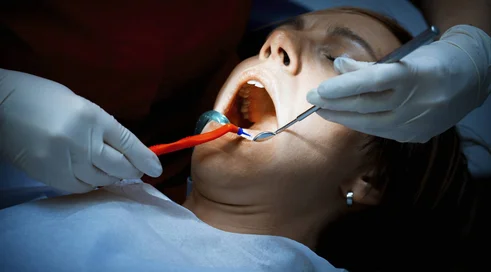
- An anxious patient can be transformed into a cooperative patient who will then be treated in a standardized manner. These techniques are not just reserved for children and adolescents. They can and should also be implemented for adult people who are so afraid of the dentist that they permanently avoid visits," said Dr. Agnieszka Anna Pacyk of the Department of General Dentistry at the Medical University of Lodz in an interview with Medexpress during the Children and Adolescent Health Congress.
Dentophobic can become a cooperative patient

Published Sept. 17, 2024 09:01
What problem do we face when it comes to dental diseases in children and adolescents?
The problem is primarily the intensity of dental caries. Compared with the situation in other European Union countries, our children are unfortunately among the most neglected in this regard. The intensity of caries is high, reaching 80 or even 90 percent in particular age segments. Therefore, it would be appropriate to take a closer look at this problem and find systemic solutions, because the situation fills us with anxiety. We have children and adolescents covered by free treatment. The campaigns conducted so far are insufficient. More resources are certainly needed - funding and reorganization of this system, also in terms of attractiveness for a dentist to work in a school, for example, should such an idea return again
Does modern dentistry give the doctor the tools to get rid of dentophobia in a young patient?
Yes, the field of materials science is developing a lot. We can help patients by introducing minimally invasive techniques and so-called atraumatic cavity preparation. In a child, a young patient, or an adult who clearly has dentophobia, desynesthesia should be gradual. And such a solution is the use of at least manual cavity preparation with a special gel, which allows us to remove infected tissue quite precisely. Then, of course, it should be associated with the use of an appropriate material, preferably bioactive, which will inhibit this process, and in some cases, deep cavities, may even inhibit pulp inflammation. So it would be good if the new materials and techniques were also available to children and adolescents covered by systemic solutions, and not just in private practices. On the other hand, there is no chance that these newer materials and techniques would be for children, who, untreated in this way, are often just very neglected. Then the cost of treating such a child or adult is much higher, because they require a more specialized approach. Therefore, it is necessary in the early stages to take care of prevention and use for treatment everything that modern dentistry in Poland has at its disposal. This is feasible, but it takes, I repeat, systemic solutions.
Let's give an example. How do the new materials work?
A visit to a young patient, a child, may consist of us inserting a preparation into the cavity for two minutes after preparation. During this time, of course, the child must be under our control. We can tell him a story (especially if it is one of the first visits) to attract his attention, to divert it from what is happening in the mouth. And after these two minutes, we can use special tools to remove the infected tissue and then insert the preparation. This tooth, of course, must be under our supervision. Therefore, follow-up visits are necessary. If the child was guided correctly and we established a bond with him, he will let us do a little more at the next visit. That's how it works. In this way, we can transform an anxious patient into a cooperative patient, who will then be treated in the standard way. And these techniques are not just reserved for children and adolescents. They can and should also be implemented for adult people who are so afraid of the dentist that they permanently avoid dental visits. Then, when they do come, there must be procedures, such as, for example, endodontic or implant treatment, very economically burdensome for them. That's why it's necessary to convert dentophobics into cooperative patients, while gaining a reputation as a doctor who can handle any problem and any of our fears. And this is very important.