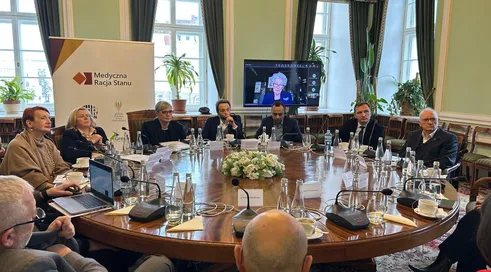
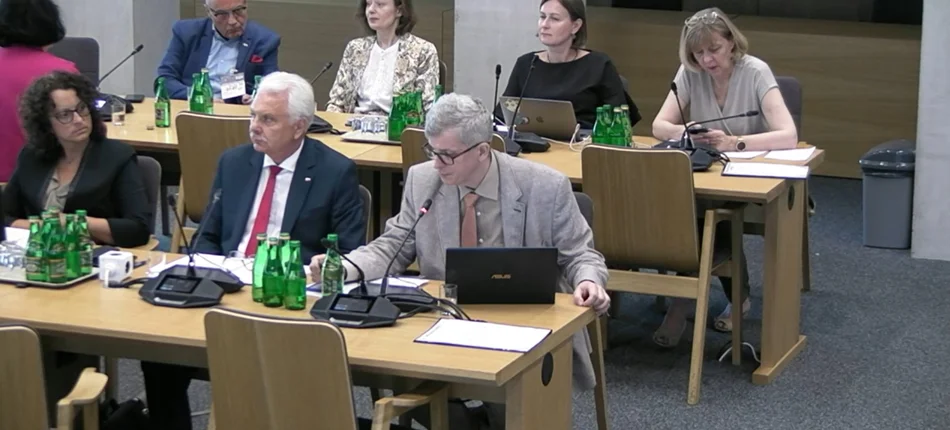
A heated discussion accompanied the meeting of the Parliamentary Health Committee on the report on the implementation of the National Oncology Strategy in 2022. - We had 65 tasks. About three-fourths of them are completed on time, which I think is a very good popandemic result," assessed Professor Piotr Rutkowski, president of the Polish Oncology Society. Criticisms included delays in the implementation of some targets.
Discussion of NSO at the Parliamentary Health Committee

Published July 7, 2023 12:02
The National Oncology Strategy (NSO) is a multi-year program for 2020-2030, introducing comprehensive changes in Polish oncology. The strategy was adopted by the Council of Ministers in February 2020.
The most important goal of the NSO is to increase the number of people surviving five years after completing cancer therapy and to reduce the incidence of cancer. Patients' quality of life during and after cancer treatment is also expected to improve.
The National Cancer Strategy covers five areas, dealing with: investment in the medical workforce, i.e. staff training; investment in public education; investment in the patient; and support for science and innovation and oncology care.
- For 2022, we have provided for and completed 65 tasks in the NSO. We have earmarked 450 million this year, and in subsequent years it will be half a million each. 120 million was allocated for the purchase of HPV vaccines, which have passed to next year. At the moment, purchases are already being made from the Medical Fund. The start of these vaccinations was supposed to begin as envisaged by the NSO in 2021, and for boys in 2026. As the legislative work was prolonged, we started the vaccination in 2023, simultaneously for both boys and girls," said Deputy Health Minister Waldemar Kraska.
The NSO also aims to increase the number of doctors choosing to specialize in oncology. This goal was to be realized through the campaign "Oncology. Turn on your medical passion," which is expected to continue this year as well.
We conducted an extensive promotional and informational campaign targeting medical students. This campaign was under the slogan oncology turn on medical passion. We anticipated a continuation in the current year.
As Waldemar Kraska pointed out, information activities in the field of malignant cancer prevention are also to be implemented to a greater extent among children and adolescents.
According to Prof. Piotr Rutkowski of the National Cancer Institute in Warsaw, last year saw a big increase in the implementation of the NSO. Very important from his point of view is the fact that actions are being taken that had not been initiated before.
- The promotion and information campaign aimed at students is indeed becoming more and more effective, and a lot of elements have entered into pre- and post-graduate training, regarding oncology prevention, which was simply not there before. It is important that the law on the National Oncology Network was successfully passed. New means of communication with targeted patient groups have begun to be used. The first notifications regarding mammography and the possibility of prophylaxis in the direction of prostate cancer were sent via my IKP application," Prof. Rutkowski mentioned.
The PTO president also noted the growing number of non-commercial clinical trials and the lead-up to the completion of accreditation of pathomorphology diagnostic centers. In turn, thanks to the replacement of mammograms, almost all devices in Poland are already electronic, which greatly facilitates data collection. In addition, the assumptions of the National Oncology Portal are being prepared, with the e-Health Center to be responsible for its content.
However, during the meeting of the Parliamentary Health Committee, criticism of the implementation of the NSO was also raised. Joanna Frątczak-Kazana of the Alivia Oncology Foundation pointed out, among other things, that an information program related to HPV vaccination had not been prepared, despite the fact that the vaccination was started two years late compared to the original assumptions.
Andrzej Sosnierz, in turn, acknowledged that the financial effort to change the situation in oncology is admirable, but the report presented by the Health Ministry is mainly about spending money, not the effects of that.
- In fact, on a daily basis, I encounter callousness and a formalistic approach to the oncology patient, and this has not changed for years. We would expect that with such outlays the results of oncology treatment would improve, and they are essentially unchanged. We don't learn from failures and stick to the "add money" trend. Most of the measures taken here will not produce results within the main goal of improving five-year survival rates. The only thing I am pinning my hopes on is HPV vaccination. This is a relatively cheap and effective measure. It would be good if sometimes there would be critical analyses to show whether we are achieving any goals," said Andrzej Sosnierz.
Professor Wojciech Maksymowicz stressed that the National Oncology Strategy lacks anticipatory measures in relation to the demographic phenomena taking place.
- We need to know that a quantitative tsunami of oncology diseases is coming. The strategy must anticipate this. What was missing in this document was the identification of the growing threat and systemic counteraction. I remember when the DiLO card was created. At the time, I was on the team of the abolished Scientific Council under the Minister of Health, and it was referred to us as a sensible idea. However, the system was decomposed and dominated only by economic accounts," assessed Prof. Wojciech Maksymowicz, and noted that the promotion of vaccinations and pro-health attitudes is still not treated as a significant priority in Poland.
In response to comments related to the functioning of the DiLO card, Deputy Health Minister Waldemar Kraska said that the solution was implemented eight years ago and today already requires some changes.
- We are doing this as part of the NSO. The card will be simplified and made more user-friendly, also made available electronically, so that family doctors are more willing to perform it. It is being transformed because it is a good tool for piloting the patient," said Waldemar Kraska.
On the other hand, according to Prof. Mariusz Bidzinski, national consultant in gynecologic oncology, discussion of health issues should take place across divisions. The delays in the implementation of the NSO, in his opinion, were largely due to external factors, and the strategy itself is, after all, multi-year in nature.