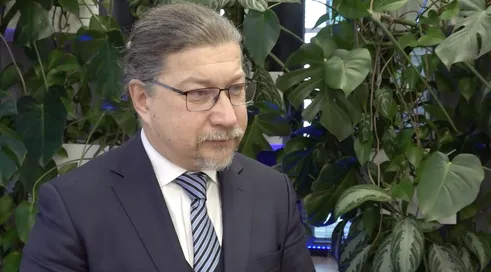
Each additional hour a child spends outdoors means a 2 percent lower risk of developing myopia," stresses Wojciech Hautz, MD, professor of IPCZD, Department of Ophthalmology, Institute "Pomnik - Children's Health Center" in Warsaw. The expert explains why this defect is developing at such a fast pace and what modern methods help slow down its progress.
Myopia epidemic. Ophthalmologists sound the alarm

Published Sept. 10, 2025 13:01
Professor, why is myopia in children nowadays referred to as an epidemic, and what consequences does this problem have for the eye health of the youngest?
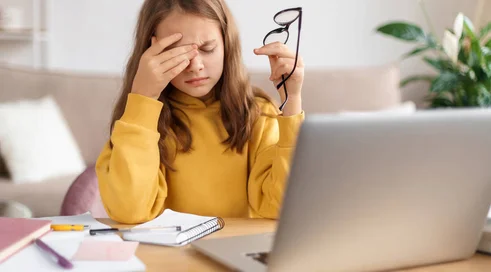
This is an epidemic, as more and more children in Poland, worldwide face this problem. This is primarily due to a change in the behavior of children, young people, namely surviving close work.
The current technology that surrounds us, smartphones, computers, are very attractive to children and children, instead of spending their leisure time outdoors, unfortunately use these media. This causes chronic accommodative tension and this consequently leads to eyeball elongation and myopia.
Unfortunately, an increasing percentage of children have myopia. In Poland this is variously estimated from a dozen to twenty-something percent, but in the United States, for example, as much as 44% of the population has myopia. In Southeast Asian countries it is 80-90% and it is predicted that in 2050 as much as 50% of the world's population will have myopia.
Myopia itself, low myopia, is not some big problem. It is corrected with glasses. But higher myopia can cause additional problems, such as increased risk of retinal inversion, increased risk of glaucoma, increased risk of developing cataracts. As a result, such patients need to be monitored really for life.
How can we prevent myopia?
First of all, it's spending time outdoors, so free time, not a laptop, not a phone, just fresh air. I remember my youthful days, when the arbor was that central place where young people gathered. At the moment it's not very attractive, because these media are so interesting to young people. It is believed that one hour a week of spending more time outdoors is 2% less likely to develop myopia. So imagine how this time outdoors is extremely important here. The eye rests when it looks into the distance. Then the ciliary muscle, which is partly responsible for the development of myopia, relaxes. The eye then rests, it does not work. On the other hand, chronic close-up work unfortunately causes myopia. But once there is myopia, there are also methods to slow the progression of this defect. Generally in myopia, the problem is the elongation of the eyeball. The natural condition is the elongation of the eyeball during development, during adolescence. The whole patient grows, the whole child grows, also the eyeball enlarges. What can we do to slow down this process? We can use special medication in the form of atropine. This is a drug that relaxes the ciliary muscle with low concentrations. But there are also now very modern eyeglass lenses that have a special design that slows the progression of myopia. These are basically two worthy methods recommended in slowing myopia. Spending time outdoors, spending time outdoors, spending time outdoors.
Finally, I will still ask, how often should a parent go with a child to the ophthalmologist? Because - that's how I imagine the child doesn't know he has myopia. What advice do you have for parents here?
Indeed, young children do not realize that they have vision defects. These defects usually become apparent during the school years, when the child does not see what a colleague at the blackboard bench, when he starts to have problems, for example
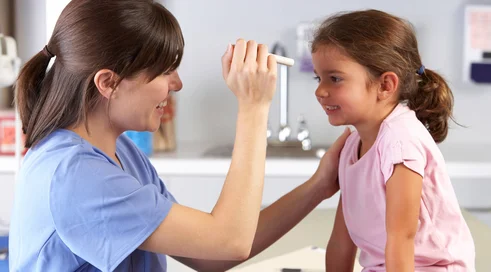
With close-up work. In fact, every child should be examined at age 7 before going to school. And since myopia develops with age during growth, children should be examined at two-year intervals. Unfortunately, there is no system in Poland that mandates such examinations.
Of course, there are screening tests performed during balance sheets by pediatricians, but these tests are unfortunately not always performed as needed. The ideal would be for these examinations to be performed by ophthalmologists or optometrists, that is, trained people who know exactly how to examine the patient under what conditions.
We are working on this, of course. Together with national specialist Professor Rękas, we have submitted a proposal to the Ministry of Health on how to organize this type of testing. Ideally, we would just like school-age children to be examined once every two years.