Experts estimate that the gap in payer finances in the next four years could rub off on a quarter of a trillion zlotys. It's as if next year, when the projected cost of the system will be less than 240 billion zlotys, we will hang up a card on January 1 and announce: Due to the failure, we do not treat. You are welcome on January 1, 2027. A hypothetical situation, of course, but one that captures the scale of the problem. We will lack, approximately, a year's health budget - although this shortfall will be spread "as much as" over four years. What do you need to know about money in health in the short and medium term?
ANYTHING TO ASK
Money for health

Published Feb. 25, 2025 13:03
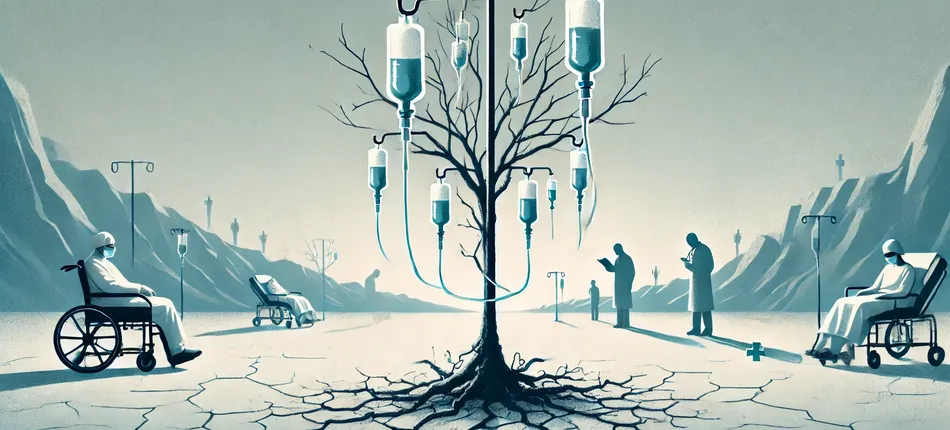
Where did this crisis come from?
First and foremost, from years of neglect and the fact that the system, its stakeholders say, remains starved for decades. For decades, it has been operating with two currencies - money (from public or private sources) and time. Patients' time - that measured in months, sometimes years of waiting in lines - and employees' time, working significantly more than full time (and common sense).
The second reason is the decisions that were made in the previous two terms. In 2017-2018, an increase in public spending to 6 percent of GDP was promised (and enshrined in the form of a law), then the promise was increased to 7 percent of GDP, but statutory provisions, primarily the n-2 rule, meant that this provision remained dead. Poland, according to international reports, still spends less than 5 percent of GDP - this gives us one of the last places in the EU. But that's not all: costs were significantly increased in 2022-2023, with the passage of the Law on Minimum Wages in Health Care without providing a source of funding for it. It also shifted to the Fund the financing of virtually all health services previously paid for by the Ministry of Health.
In turn, changes in the law that reduce the revenue of the NFZ (reduction of the premium for entrepreneurs) are currently being processed. The difficult financial situation of the state budget makes it unclear to what extent and in what form the Ministry of Finance will compensate the Fund for the loss of several billion zlotys (annually).
How could the gap be narrowed?
First, by cutting costs, that is, for example, by opting for a more cost-saving implementation of the minimum wage law.
Second, by increasing revenues. From a political point of view, there is no space to discuss increasing the health premium (since politicians are pushing to reduce it for one group of insured, even less so). Perhaps a way out would be to merge some social insurance (sickness insurance, but the idea of disability insurance was also floated years ago) with health insurance and introduce additional nursing insurance, through which long-term care, which is in its proverbial infancy in Poland, could develop.
Why is this a problem?
Politicians emphasize that the gap between NFZ revenues and costs is natural, for years the budget has been adding money to the Fund, it is, after all, written directly in the revenue law - so why "scare" the public that there will be a shortage of money.
Aside from the fact that warning of potential danger does not mean "scaring," it is worth noting that already in the past year the health care system and, to make matters worse, patients have felt the consequences of the lack of liquidity in the Fund's finances. Failure to regulate, on time, the payer's obligations to (primarily) hospitals resulted in periodic problems with admitting new patients to drug programs and withholding scheduled diagnostics and treatment. Queues for some services have lengthened. Appeared, during the discussion of the possibility of financing new therapies or - for example - vaccinations, quite long unheard of arguments about the "difficult situation of the finances of the National Health Fund" or - even - "difficult situation of the state budget."
Poland, the report's authors also point out, is subject to an excessive deficit procedure. This means, to put it most bluntly, that public finances and the state budget must tighten their belts in the coming years rather than increase spending. In addition, they will, for obvious reasons, continue to increase spending on armaments, which is already approaching 5 percent of GDP - it may soon reach a situation where Poland will spend more on defense than the current public spending on health, which is a complete distortion of this relationship (even if it is difficult to argue with the need to strengthen defense). The position of health in the budget fair is not strong. Even if the Finance Minister assures publicly that health is an "absolute priority."
Is it really "as much as" a quarter of a trillion?
Maybe 216 billion, not 249. 33 billion zlotys is a lot of money, but the scale of the problem - assuming a more conservative estimate - is not smaller at all. The upper limit was estimated by experts, assuming that the parliament will pass a reduction in the health premium for entrepreneurs (which rather seems a foregone conclusion, or at any rate is very likely) and pass - in some form - an amendment to the law on minimum wages, meeting at least in part the demands of nurses - this in turn seems very unlikely, even impossible. On the contrary, it seems that one can expect, if not statutory changes, then a significant reduction in the "field of fire" of the law (for example, in the direction of limiting its implementation to salaries of full-time employees only).
Why "until" and not until?
Exactly at the time the gap report was published, the OECD presented the results of a study of 109,000 intensive care patients with chronic diseases in 19 countries (not just European). The study measured ten indicators and looked at how patients in each country rated the system. Poland was not on the list, but the results provide food for thought. In the group of countries where patients rated all ten indicators positively, in addition to such certainties as Norway and Switzerland, were the Czech Republic and Slovenia, spending - according to the report's authors - "relatively little money." In concrete figures, the two countries combined (public and private spending) spend about EUR 2.8 thousand PPP per capita on health each. Poland - about EUR 1.9 thousand PPP. In terms of GDP, in the Czech Republic and Slovenia, public spending accounts for about 8 percent of GDP. In Poland - less than 5 percent. Be that as it may, we can speak of a difference of up to 40 percent. - Such is the scale of the current underfunding of the system. If we took total per capita spending, we should "add" at least 33 billion. Euros.
Experts have estimated - or counted - the gap only between the NHF's revenues and the cost of the current system, with its queues and other restrictions on access to services. The gap between the current level of health care funding and how much it costs for a system that delivers the quality of services to patients when they need it is much larger.