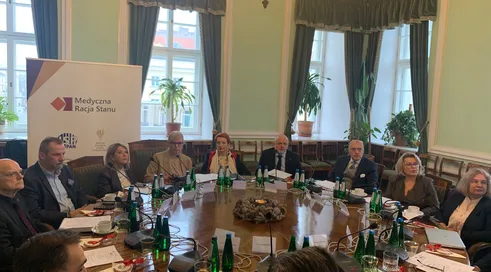
On Wednesday, the Parliamentary Health Committee dealt with the information of the Supreme Audit Office on the control of the availability of prophylaxis and treatment for children and adolescents with metabolic disorders resulting from obesity and lifestyle diseases. The report itself is not new, as it was published in December 2021, but only now did the deputies have the opportunity to discuss it and listen to the comment of the Ministry of Health.
MZ: In 2023, children's health records will be electronic

Published Sept. 29, 2022 09:09
The most important conclusion from the NIK audit is clear: systemic care for obese and overweight children does not work. Weight reduction was achieved in the case of only a dozen or so percent of such patients, both in primary health care facilities and in AOS. Children struggling with such problems have to wait even more than a year for an appointment with a specialist - although, as many MPs emphasized in the discussion, in fact the lion's share of patients with abnormal body weight do not need consultations, let alone specialist treatment. Rajmund Miller (KO) stated that access to specialists treating overweight and obesity as a result of, for example, hormonal disorders, may need 5 percent. young patients. Incorrect body weight in others is the result of an unhealthy diet and insufficient physical activity, which should be diagnosed at the primary health care level, but understood very broadly, including advice from a dietitian and the care of a school nurse.
Information from the Supreme Audit Office that in 2018-2020 (the period covered by the audit, which ended in the first quarter of 2020), when there was no question of a pandemic yet, the percentage of children and adolescents covered by health balances fell to approx. 60%. (when it was 90% in 2013), on the one hand, it resulted in Rajmund Miller's proposal to transfer the balance sheets to schools and perform them every year, on the other - the declaration of Deputy Minister Maciej Miłkowski that, from next year, the balance sheets will be part of electronic documentation, which will make that it will be possible to keep track of both health trends and whether they are being implemented at all - because the deputy head of the Ministry of Health admitted that the NIK report sounds disturbing in this respect (it is also known that balance visits were routinely canceled and canceled in the pandemic). sliding, so it can be expected that if the percentage of completed balances was examined at the moment, it could be even lower). Healthcare centers, which in this respect will be different from the median, are going to "promote negatively" (although the minister and MPs admitted that it is also, and perhaps above all, a matter of parental responsibility).
- In our audit, we found that problems with excessive weight occur in approx. 21.7% of kids. As many as 1/3 of this population is obese and 2/3 overweight. The solutions in the health care system do not meet the needs of this group. There are no uniform studies in the country covering the entire population of children in terms of overweight and obesity, hence the lack of certain data showing the full scale of this problem - emphasized Robert Łukasz, deputy director of the NIK Delegation in Rzeszów (she coordinated the inspection).
Referring to the speech of the Supreme Audit Office's representative and the entire report, Maciej Miłkowski said that the Ministry of Health is aware of "there is still a lot of work to do in this area". - The problem of the growing number of people suffering from overweight and obesity does not only concern Poland, but is common in developed countries - he emphasized.