Cybercriminals are again impersonating the National Health Fund. This time they are sending out fake emails about supposed "reimbursement for the purchase of medicines." The National Health Fund warns that it's another phishing campaign this year to trick people out of their data and money, and reminds them how not to get scammed.
The National Health Service never does

Published Nov. 3, 2025 10:57
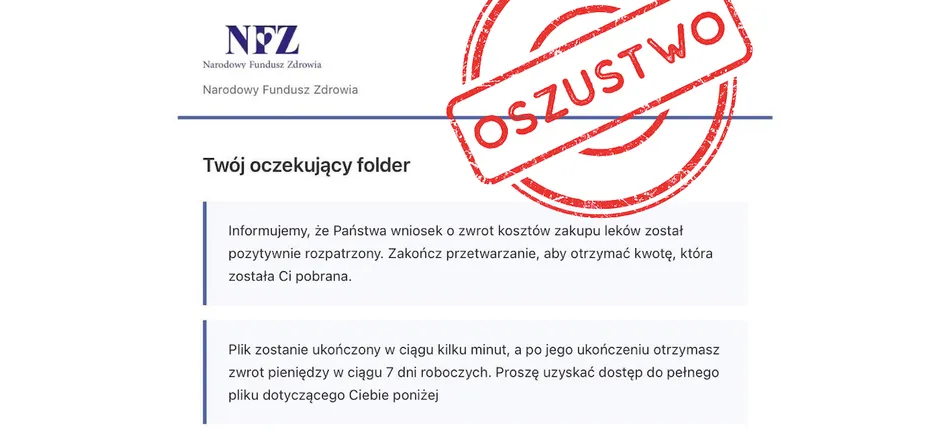
This is another attempt this year to scam "the National Health Service." This time, cybercriminals are sending out professional-looking messages claiming supposed "reimbursement for the purchase of medicines."
The messages bear the Fund's logo, and the sender looks credible. The content includes a "Proceed to Verification" button, which is supposed, according to the email, to allow confirmation of the data necessary to process the reimbursement. However, the National Health Fund stresses that this is a trap. Clicking on the link leads to fake pages prepared to defraud people of their personal data and sometimes of their funds.
The Fund reminds that drug reimbursement is billed only to pharmacies, not directly to patients. This means that the NHF does not send messages to citizens about drug reimbursement and never asks them to confirm their data in this way.
More and more attempts to defraud "the National Health Service"
This is not the first case of NFZ impersonation in recent months. Previously, scammers have offered, among other things, to buy first-aid kits, insurance cards, vouchers to pharmacies, and even to enter into loan agreements supposedly intended for medical treatment.
As the Fund points out, cybercriminals are using increasingly sophisticated social engineering techniques and methods. They use graphic elements, official language, and time pressure to get recipients to provide personal data, bank account information or e-banking logins. Data obtained in this way can be used to steal money or extort loans and credit.
How not to get scammed? NFZ reminds of safety rules
The National Health Fund urges people to be vigilant and follow basic cybersecurity principles:
- Do not click on suspicious links or open unexpected attachments.
- Verify website addresses, looking out for typos, unusual characters and domain names.
- If you have any doubts about a message allegedly sent by the National Health Service, contact the toll-free hotline at 800 190 590.
- Report any attempted fraud to the Police or through the form available at incident.cert.pl.
The National Health Service never does
The Fund reiterates that:
- does not ask for personal information via instant messaging, e-mail or SMS,
- does not send links to log in or verify data,
- does not conduct online sales,
- does not urge people to sign loan agreements to finance health services.
The National Health Service is urging caution and informing loved ones about the dangers of such scams - especially the elderly, who are most often victims of phishing.
Source: NFZ