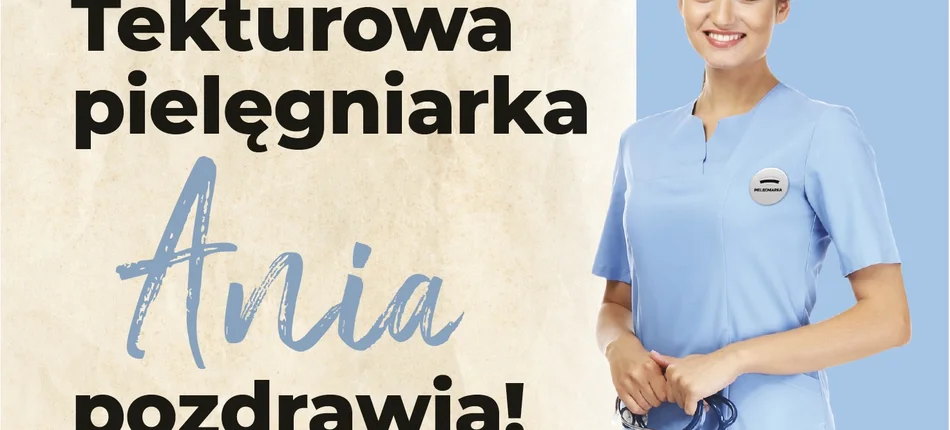
People, get out of the way, because the letter carrier is coming. Heavy with letters is the mailman's bag today.... In recent weeks, the Chancellery of Prime Minister Donald Tusk has received several thousand greeting cards from the cardboard nurse Ania, referring to the symbolic figure representing Polish nurses and midwives, and asking how the Polish government intends to guarantee citizens' constitutional right to health care in a situation of a dramatic shortage of nursing staff.
Prime Minister Donald Tusk gets greeting from cardboard nurse

Published Sept. 4, 2024 07:40
Alarming shortage of nurses in Poland
The problem is increasingly acute. According to the Institute of Public Health at Jagiellonian University, there is currently a shortage of nurses in 72% of Polish hospitals. The average age of a nurse in Poland is more than 54, and the age structure of this professional group is very worrying: almost a third of nurses and midwives are between 51 and 60 years old, about 30% are over 60, and only one in six is under 40. Moreover, 34% of nurses and nearly 30% of midwives have already reached retirement age or have been retired for many years. Projections are even more alarming - by 2030, as many as 65% of currently employed nurses and 60% of midwives will be of retirement age.
Nurses and midwives' action vs politicians' response
In response to the staffing crisis, the nursing and midwifery community has prepared a civic bill aimed at improving working conditions and strengthening the professional position of these key health care workers. The initiative has received a strong public response. Krystyna Ptok, chairwoman of the civic committee responsible for preparing and submitting the bill to the Sejm, notes that patients have also become involved in supporting the initiative. Seeing the problems nurses face with politicians, patients decided to show their support by sending cards to the prime minister. As Ptok points out, several thousand such parcels were delivered to the Prime Minister's Office.
However, as the chairwoman notes, despite such strong public support and a growing problem, the response from politicians remains inadequate. "The Minister of Health speaks on television about the shortage of doctors, while the NIL (Supreme Chamber of Physicians) indicates that if current medical students graduate, the problem of a shortage of doctors will be alleviated. However, in the case of nurses, the situation is alarming," Ptok stresses. Single-person and inadequate staffing on nursing duty is a daily occurrence, and replacing nurses with other medical professions, such as paramedics or medical caregivers, is not a solution, as they have other competencies.
A threat to the health care system
The shortage of nurses poses a real danger to patients and medical staff, and the current situation threatens to paralyze the entire health care system in Poland. Krystyna Ptok says that "the Health Ministry is conducting a lame monologue," and Prime Minister Donald Tusk finds no time to meet and learn about this serious problem. She points out that this problem goes beyond the competence of the Health Minister and requires broader reflection and involvement of decision-makers.
What's next?
The nursing and midwifery community is not about to give up. More actions are planned in the near future to force decision-makers to take urgent rescue measures. A lack of response from the government could lead to even more protests and civic actions aimed at pressuring politicians to finally address a problem that could weigh on the future of Poland's health system.
Source: OZZPiP