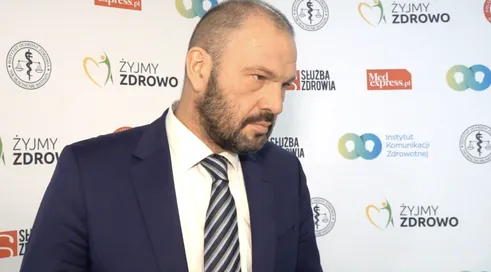
Starting September 1, 2024, the free HPV vaccination program will be extended to children from age 9 to age 14, the Health Ministry says. - We should include this vaccination as early as possible," Dr. Pawel Grzesiowski, Chief Sanitary Inspector, stressed in an interview with Medexpress.
HPV vaccination program will be expanded. GIS: This will not be an improvisation

Published Aug. 14, 2024 08:38

Recall, currently the Ministry's HPV vaccination program under the National Cancer Strategy 2020-2030 covers children from age 11 to age 14, in a two-dose schedule. After the change, it will cover all children from the age of 9. Independently of this program, free drugs for children and adolescents up to age 18 are available by individual prescription, a bivalent vaccine and with 50% reimbursement of all for adults.
THE INVESTMENT WILL PAY OFF
- Any expansion of the program is eminently justifiable. Wider vaccination coverage means more people protected from infection. We should start this vaccination as early as possible, because infections can also be transmitted through routes other than sexual contact. An infected adult who has active lesions can transmit the virus to a child even through touch. I know of cases of HPV infection among preschool children as a result of one parent having active lesions in the intimate area," Dr. Pawel Grzesiowski comments for Medexpress.
One of the crowning arguments for promoting HPV vaccination and starting it in younger children is its effectiveness. Countries where widespread vaccination programs have been in place for a long time have succeeded in pushing the problem of the incidence of diseases dependent on this pathogen, especially cervical cancer, to the level of a marginal threat.
- We can expect this investment in public health to pay off quickly. If we vaccinate more children even before exposure, we stand a chance of reducing the incidence of HPV-dependent diseases by as much as 90-95 percent, as we see in Canada, Australia or Scandinavian countries, the Chief Sanitary Inspector adds.
FAILURE HAD MANY CAUSES
Meanwhile, Poland has one of the highest incidence and mortality rates for cervical cancer in Europe. In 2020, there were nearly 3,900 new cases of cervical cancer and more than 2,100 deaths. Every day, 6 Polish women learn that they have cervical cancer, and 4 Polish women die from the disease. The free and widely available HPV vaccination program was launched on June 1, 2023. It was expected to be a spectacular success, but the reality was severely disappointing. At the end of last year, the vaccination rate was only about 20 percent.
- There are very many reasons for the failure of this program. The previous government did not care about active promotion of vaccinations at the level of schools and parents. One could say that it was a passive promotion. Information was published on websites and it was hoped that interested parties would find it on their own. There was no publicly funded active and multidirectional social campaign when it came to HPV," says Dr. Pawel Grzesiowski.
As he adds, it was also not well explained why we have two formulations with different compositions. As a result, 90 percent of parents chose the 9-valent vaccine, while only 10 percent chose the bivalent vaccine.
- Another issue is that of awareness of the disease itself. I am after many meetings with teachers and educators working in places with large groups of children, and it turns out that these people are completely unaware that HPV causes cancerous changes. Such low awareness prevents people from making the decision to vaccinate, and let's remember that it is recommended, not mandatory, which means that parents have to make the decision themselves and organize the entire procedure from applying for a prescription to finding a vaccination center, GIS adds.
Nor did HPV vaccination get good press from conservative circles, who claimed that vaccinating elementary school students was an invitation to sexual promiscuity. Another paradox was that the vaccination was originally promoted by gynecologists. So it's hard to say that the information had any chance of reaching parents of elementary school-aged children, especially boys, also after all covered by the vaccination program. They will never get to a gynecologist.
- It is necessary to put all this in order. To return to pediatricians, doctors involved in adolescent medicine, because this is the right address to promote vaccination. At present, the ministerial program will be implemented in cooperation with schools, but this does not mean that we will start vaccinating children as early as September 1. It is necessary to first reach schools and parents with information, and find doctors and nurses from POZ who will implement vaccinations in schools. The whole campaign must be well planned and prepared, so realistically the vaccinations will probably start in mid-October. This cannot and will not be an improvisation or a one-off spurt," stresses Dr. Pawel Grzesiowski.