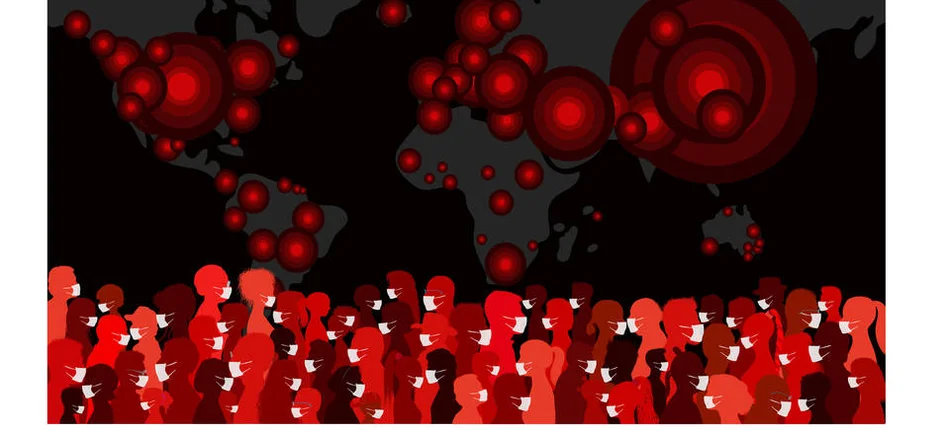
In August, in the journal Science of the Total Environment, a team of scientists presented a study that showed that the most polluted cities in Western Europe had significantly higher rates of death from COVID-19 than in others.
Research: COVID-19 mortality highest where air pollution is high

Published Aug. 25, 2022 12:32
Fot. Getty Images/iStockphoto
The authors emphasize that they examined only selected countries of the Old Continent (including France, Italy and Germany), where the pollution level is mostly low or moderate even in winter. They call for research to be carried out also in other European countries and on other continents to confirm the strong relationship between the intensity of air pollution and the high death rate due to COVID-19. That there is such a relationship, the results of earlier studies have already suggested - the latest ones only dot i.
Jean-Baptiste Renard, one of the authors of the published research, puts forward and proves the thesis that Paris and Lombardy did not accidentally record a record number of deaths - they are united by a common aggravating factor: poor air quality. - It is the most polluted cities that experienced the highest mortality rates - emphasizes the expert, quoted by the French daily Le Monde. The cities of Bordeaux and Brest, affected in a comparable way by the number of infections, much less polluted due to their location by the ocean, did not record such a high mortality.
Scientists emphasize in particular the high correlation between the level of exposure to fine particles (PM2.5, diameter less than 2.5 micrometers) and the death rate due to Covid-19. Starting with the Paris case (best described pollution levels superimposed on the covid death timeline) and looking at 31 other cities and regions in six Western European countries (France, Germany, Italy, Spain, the Netherlands and the UK) in 2020-2022, Scientists have shown that the highest levels of mortality occur during pollution peaks and vary according to their intensity. For example, in Lombardy, the highest number of COVID-19 deaths occurred during pollution peaks, in particular because "PM2.5 also has a strong indirect effect on Covid-19 mortality through inhalation of its irritants."
It is not known whether the results of these studies will be taken into account when analyzing the causes of the high mortality rate due to COVID-19 in Poland to date. But it is particularly worrying that the upcoming heating season, when the level of pollution throughout Poland (except for the narrow strip of the Baltic coast), not only in large cities, is critical, may be even worse in terms of pollution than in recent years: rising energy prices may induce some people to switch to additional heating of houses (and flats) not only with coal, but also with waste. In addition, some local governments (including the council of the Małopolskie Voivodeship) are considering delaying the entry into force of anti-smog resolutions. At the end of July, activists of the Polish Smog Alert warned that smog could be record-breaking in Poland in the coming season, and this would translate not only into disastrous long-term health effects, but also into a wave of premature deaths - regardless of the pandemic. Official data from before 2020 indicate that about 40,000 people die prematurely due to air pollution in Poland.