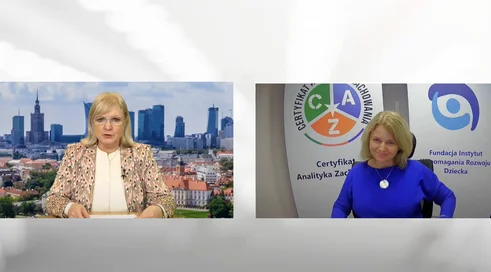
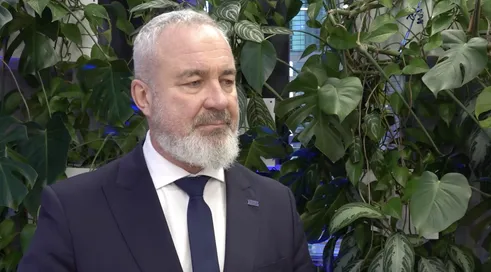
A conversation with psychologist Joanna Grochowska, vice president of the Synapsis Foundation.
System fails to safeguard the needs of people on the autism spectrum

Published April 27, 2023 12:28
April is coming to an end. It is autism awareness month. Establishing it is to raise public awareness of the developmental disorder. How much do we already know about autism?
Public awareness and knowledge of the autism spectrum is already far greater than it was 30 years ago. However, it is still the case that the average person has often not heard at all, and if even heard about autism, this knowledge is very often based on false beliefs, myths and stereotypes. It seems to me that all activities that aim to transfer knowledge, to raise this awareness, are extremely important. The more we know as a society, the better we will be able to understand people on the autism spectrum, and thus better support them.
We know that with autism are associated disorders of communication, interaction with other people. Abnormal behavior also appears. What is this caused by?
We don't really know what the causes of autism spectrum are. We know that they are neurodevelopmental disorders with a genetic basis, while there is no one gene or one group of genes that is responsible for the spectrum appearing or not. Research is still going on and there is information that the spectrum is linked to some genes, but there are many. Therefore, no genetic tests can help us diagnose autism spectrum and explain the cause. What we do know for sure is that the nervous system, especially if we are talking about the brain, develops differently, receives information differently and processes it differently. As a result, it builds a slightly different picture of the world. Different doesn't mean inferior. Just different. I said that there is no gene that is responsible for the autism spectrum, and this is true. On the other hand, the genetic factor is clear, because there are families where there is more than one person on the spectrum.
There are also an increasing number of autism diagnoses. What is the reason for this? Are there indeed more and more of these disorders, or were they simply not recognized before and the child was said to be different, naughty or withdrawn?
I think this is due to several different factors. We have different diagnostic criteria at the moment than we had in the 1980s or even in the 1990s. In the early 1990s, the term "Asperger's syndrome" was introduced into the diagnosis, which had not previously been diagnosed. As a result, it was rare that people who speak well, do relatively well, have all sorts of difficulties, but nevertheless also have an average or above-average intelligence quotient, were diagnosed. When scientists and clinicians realized that such people also met the criteria, a group of people began to be diagnosed who had not previously received this diagnosis. In addition, it is important to remember that in the 1980s and earlier, very little was said about autism. Very many people were diagnosed as simply intellectually disabled, people with other kinds of problems, sometimes with mental problems, and no one thought in such terms that maybe it was autism or the autism spectrum. The fact that we now diagnose more is not only due to the diagnostic criteria, but we certainly also have much more knowledge as specialists, doctors or psychologists. As a result, we are diagnosing better, catching such people who once would probably not have received this diagnosis.
There is also talk of the influence of environmental factors. Among the things mentioned are the fact that we are becoming parents at an increasingly older age, that we are able to save such pregnancies and such babies that we once would not have saved. There are studies that indicate that 25 percent of babies with very low birth weight, less than 1,500 grams, will have a diagnosis of autism spectrum disorder. These causes are very many.
What symptoms may raise suspicion of autism?
We are talking about a spectrum, so on the one hand we have here people with profound autism, and on the other hand - also people who speak very well, can work professionally, have a family and be very successful. Quite differently these symptoms can look in young children and quite differently in adults. In addition, there is more and more talk about it, the image of the spectrum looks a little different in girls and women.
First of all, however, we pay attention to social communication. The basic question is whether a person communicates at all, whether he uses language to communicate, whether he speaks. If he or she speaks, we consider how: for example, is it speech that allows reciprocity, does someone listen, ask questions and keep the conversation going, or does he or she speak only on topics of interest. In people who speak well, attention is paid to whether the person catches certain nuances in speech, such as subtext. Attention is also paid to eye contact, facial expressions, and gesticulation.
In the case of people who do not communicate, we ask what is the reason for this, because it could be, for example, problems in the structure of the articulatory apparatus. It is important whether the person is able to use alternative forms of communication. We also pay attention to whether and what kind of difficulties the person has in receiving sensory impressions. We know, and there is an emphasis on this in the new diagnostic criteria, that people on the autism spectrum are often hypersensitive to various stimuli or have reduced sensitivity. Sometimes a very quiet sound causes a very violent reaction, and sometimes they may give the impression that they can't hear. Both of these behaviors can occur even in one person. The result of sensory overload, and the resulting stress, can be a violent breakdown, an outburst of anger, screaming or crying.
When is the earliest a diagnosis can be made?
The youngest children I have had the opportunity to diagnose were in the first year of life, but such situations that the symptoms of autism are very clearly visible at this age are rather rare. Most often, if we are talking about young children, we diagnose them between 18 and 24 months of age. By then, certain skills should have already appeared, such as responding to a name or playing pretend. Children from 18 months to 3 years to be diagnosed a lot.
How often do you have to deal with parents observing worrying symptoms much earlier, but delaying a visit.
This does happen, but such situations are now much less than they used to be. Today, parents are mostly looking for support for their child. For many of them, a diagnosis of autism, even though it means that the child will have some difficulties motivates them to act. On the other hand, we also have people who, as children, had low enough symptoms and a supportive enough environment that they only get to the diagnosis as teenagers. This happens when social demands increase much more. There are also cases of adults.
One of your initiatives is an early detection program for autism in infants and children. How successful has this program been in spreading the word more widely?
A lot has been accomplished. We have introduced and tested all sorts of screening tools that can be carried out in a primary care clinic, for example. The queues to see specialists, especially those who accept under contract with the National Health Service, are very long, reaching up to two years. Since 2014, when we launched this program, we have trained several thousand people and also carried out thousands of diagnoses on young children. I feel that a great deal has indeed changed, but the system is still not keeping up with the needs.
Is autism treatable, or can we even talk about treatment?
This is a very good question, and I'm glad you asked it. Autism spectrum disorder is not a disease. On the medical side, it is a neurodevelopmental disorder. People on the autism spectrum, especially those who communicate well and who act as self-advocates, insist that it is not necessarily a disorder, that it may just be a different way of functioning. Since it is not a disease, we do not treat it.
People on the spectrum need appropriate support, appropriate adjustments. At the same time, these are not adjustments like those for the blind or visually impaired. Here the biggest support is the other person. There are, of course, systems to support communication, especially for those who do not speak or speak in a very limited way, but therapy is also a very important part of this support. Therapy, however, should be very individually oriented, to take into account the individual needs of the person on the spectrum, his or her strengths and difficulties, and focus on working on strengthening the strengths. We certainly also think about what to do to make it easier to cope with the reception of stimuli, so that breakdowns do not occur. Sometimes in the workplace or school, it is enough to introduce the possibility of being in a quiet room during breaks, for example, or to allow people to sit in headphones.
An important issue is the support of a family that has a child on the autism spectrum. To what extent does the system support these families and safeguard those on the autism spectrum who are coping less well?
Definitely not protective. There is a group of people who have been referred to as profoundly autistic for several years. They don't speak, they don't communicate sufficiently, they often have a lowered intelligence quotient, they are intellectually disabled and require constant, round-the-clock care virtually all their lives. For this group, this system is inadequate at all, completely disregarding their needs. Caregivers are on their own, every thing has to be fought for. There are very few places that provide activities for such people, and if there are any, they are geared towards working with a person on the spectrum. Few are involved in supporting parents in such a way as to advise them and help them also think about the future, because as long as we have a young child who is in kindergarten or school, education in our country is compulsory up to a certain point. Therefore, even if it is not the best suited, at least such a child can at least get out of the house. After leaving school, there is a black hole. There are no places providing care. People on the autism spectrum with severe difficulties are not admitted to nursing homes or occupational therapy workshops. There is also a shortage of vocational activity centers. Figures from the Supreme Audit Office show that the percentage of employed people on the autism spectrum in Poland is less than 1 percent of people with disabilities. These are dire statistics. As for those speakers, for example, with Asperger's syndrome, they too need support, if only in the education system. Self-advocates also often talk about how they can't hold down a job. What's the use of having a great resume if no one wants to hire them because, for example, they're not flexible enough, it's hard to move them from position to position, sometimes they don't understand something verbatim, or they don't have soft skills and find it hard to make friends at work?