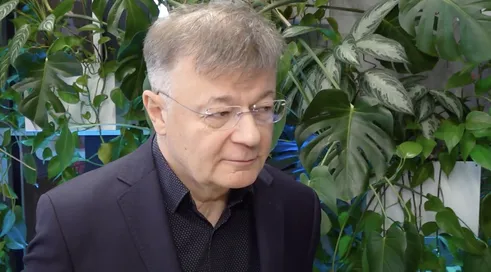
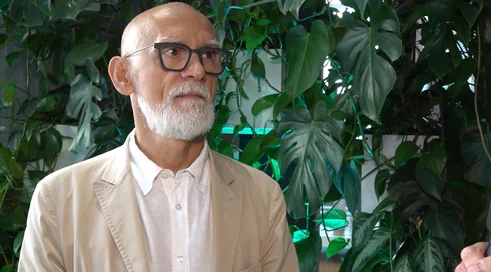
The beginning of the school year is a good time to check your child's vision. How to recognize that a child sees worse and what is the prevention of myopia, says Joanna Przeździecka-Dołyk, MD, Department and Clinic of Ophthalmology, Wroclaw University of Medical Sciences, in an interview with Medexpress.
A visit to the ophthalmologist mandatory for a seven-year-old?

Published Sept. 20, 2024 10:26
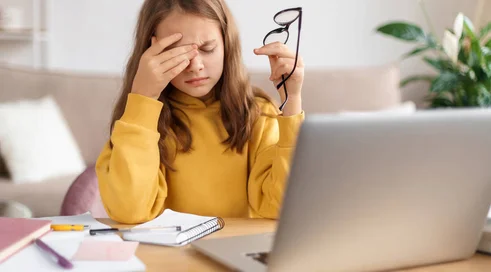
What are the symptoms of myopia? What should a parent, teacher pay attention to? Will the child say: mom, dad I see a little worse?
It can be different. A child does not have to tell us at all that he sees worse or that he has related problems at school. This is because myopia can develop very slowly at the very beginning. When the child sits in the last bench and moves to the first bench, he will still see reasonably well, but it doesn't stop there. At some point, the defect will grow and even the first bench won't help. We should not wait until that point. The onset of vision problems at school, or even when the child goes to the first grade, is the time for a parent to go with the child to a specialist to check how he sees.
Ophthalmologist or optometrist? Who do we check our child's eyesight with?
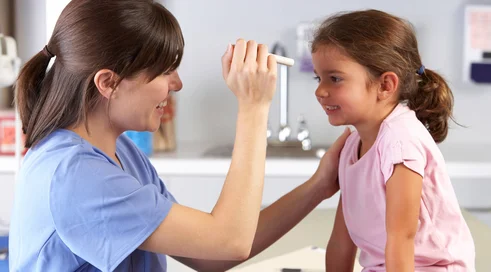
The first examination must be after the drops. An optometrist will not be able to drop the child. The best option is a combined visit, that is, a visit to an optometrist and an ophthalmologist with the administration of drops. Short-sightedness is not the only vision problem. There can be various problems of a binocular vision nature. Then, for example, a teacher may see that a child has dyslexia, or swaps the letters or numbers "p" with "d" or "b" with "p," or swaps a three with a five, and it will be a completely different defect. These are also things that can be caught before the child goes to school. Nevertheless, an eye-optometry visit as mandatory for a seven-year-old was introduced by the WHO a very long time ago. At the moment, the WHO is promoting an ophthalmic-optometric visit for a three-year-old! In the world, this is the standard. We have not yet grown up with a standard ophthalmology visit for seven-year-olds. The world has moved on, as three-year-olds already have problems with vision, binocular vision or visual defects. So we should aim for that ideal solution, which is to examine children at the age of three, not just seven - seven is the absolute minimum before they go to school!
What is myopia associated with? What problems can it cause in the future?
It all depends on whether it is progressive myopia or not. Let's imagine a balloon to be our eyeball. If this balloon is inflated to normative values, nothing happens, everything is ok. We correct the defects. On the other hand, if I inflate it too much, the material (our tissues) can't withstand the overstretching and we have weaker areas at that point. Such weaker areas in the eye will predispose to retinal detachment, to myopic maculopathy, which cannot be reversed. That is, in adulthood or after the age of 40, ischemic glaucoma, retinal detachment and various degenerations can happen. This structural damage resulting from excessive tissue distension carries very large consequences in the future.
And can myopia be prevented?
Reading prevention is very important. The problem is small screens and reading in front of one eye. What happened in the covid pandemic, i.e., moving all digital items very close to the eye, can be overcome by moving all items back from the eye, increasing the time the child spends outside - up to two-three hours every day. If myopia occurs, we can no longer undo it. We are not able to take out the eyeball, cut off a piece and sew it back in. If myopia has already occurred, it will stay. Especially the one resulting from the distension of the eyeball and its structures. We can inhibit the growth of myopia and there are various methods, such as pharmacological. There is low-dose atropine. Optical methods, or myopic defocus, which can be implemented in contact lenses, lenses that we wear at night: that is, the child sleeps in lenses, and during the day he does not wear any lenses. And he also sees, has his defect corrected and his myopia slowed down. This can be accomplished with glasses. It is the specialist who has to choose the best method for a particular child. We can't choose it arbitrarily ourselves. That's why an optometrist-ophthalmologist visit at the very beginning, with a lot of additional examinations, is important to know if we have a chance at all methods of correcting and slowing myopia.
The beginning of the school year is a good time to appeal to parents. What would you say to them?
Dear parent, get your child examined. Remember that you are the one who has your child's health, his future, in hand. Your decision to examine your child will affect his future, what he will go further into the world with, whether certain career opportunities will open or close to him. It may happen that, because of his eyesight, his dream profession will be out of reach for him, or he may not be able to drive a car because a large visual defect is already irreversible.