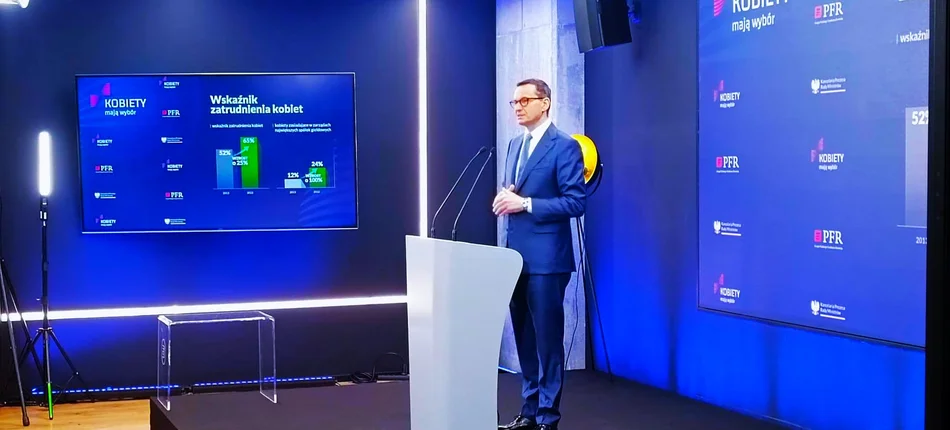
- The Family 500+ program was supposed to lead to a decline in women's labor force participation. Nothing of the sort has happened, instead, there has been an increase in women's participation in the labor market, Prime Minister Mateusz Morawiecki said during the "Women have a choice" conference organized by the PFR Foundation. However, it turns out that the PiS government's social programs have not led to such an increase in the fertility rate that would be sustained over several years.
Women have a choice. Polish women want to be professionally and socially active

Published May 15, 2023 13:17
The report, compiled by the Generation Institute, shows that after the introduction of the United Right government's social programs, there was an increase in the fertility rate not seen since 1997.
- Unfortunately, this growth has not continued to this day. The fertility rate began to decline after a few years, then instability and insecurity set in as a result of the pandemic and then the war in Ukraine. Today we are still above the level before the introduction of social programs, but at a lower level than in 2016, just after their introduction," said Michal Kot, director of the Generation Institute.
According to Prime Minister Mateusz Morawiecki, women's increased labor force participation is not only the result of the flagship social program, Family 500+, but also the policy of increasing the number of nursery places.
- 7-8 years ago, the number of nursery places was about 80-90 thousand. Now there are more than 230 thousand, and about 90 thousand more are being built. The greatest help is needed in the first years of motherhood and when returning to work, the prime minister said.
As assessed by Minister of Family and Social Policy Marlena Maląg, modern Polish women want to be active, are well educated and want to combine work and family life.
An important issue related to the social perspective of women's situation is health. A report by the Polish Economic Institute shows that women in Poland live longer on average than men. In 2021, the gender gap in life expectancy was 8 years, one of the largest in the European Union. The average healthy life expectancy of women for the past 15 years has oscillated around the value of 62-64 years, and this value is close to the average in the Community. In contrast, the share of women who perceived their health as good or very good in 2006 was 51 percent and 59 percent in 2020.