The Interactive Report on the Most Important Indicators Describing the Treatment Process for Plasmacytoma in Poland is designed to enable Data monitoring - essential for ensuring effective treatment. - It will influence the effectiveness of treatment so that all reimbursement achievements have an impact on prolonging the lives of patients - emphasized clinicians during the meeting at the National Health Fund.
Hematologists have chosen myeloma. An interactive report is being produced

Published April 9, 2025 08:10
Clinicians have long called for access to the data of the System for Monitoring Therapeutic Programs (SMPT), where they themselves enter information on completed tests and the course of treatment of patients treated under Drug Programs. Insight into this data means better evaluation of the effectiveness of therapy, the effectiveness of drug programs, and more precise planning of health measures.
On March 26 this year, the EU's European Data Space Regulation came into force, which introduces key changes in the way patients' medical information is processed, shared. This opens up new opportunities for scientific analysis.
Interactive report
At the end of March, clinicians including Prof. Ewa Lech-Marańda, Prof. Krzysztof Giannopoulos, representatives of the Institute for Health Protection and the Polish Society for Personalized Medicine sent a letter to Health Minister Izabela Leszczyna and Filip Nowak, president of the National Health Fund, requesting approval for the Interactive Report on the Most Important Indicators Describing the Treatment Process for Plasmacytoma Myeloma in Poland project.
The National Health Service has previously launched a website - a report - where data on AMD, the neovascular (exudative) form of age-related macular degeneration, is made available in a simple, graphical way. There is information on the most important indicators describing the treatment process. The values presented relate both to the most recent data and allow one to track trends over the past 36 months. All indicators and data - both nationwide and regional - are presented in the form of charts and tables, and you can easily compare them with each other or select only particular ones.
The Interactive Report on the Most Important Indicators Describing the Treatment Process for Plasmacytoma in Poland will be constructed along the lines of the AMD report. It will be freely available to patients, clinicians, officials and drug suppliers. All indicators and data - both nationwide and regional - will be presented in the form of charts and tables that can be easily compared with each other or select only particular ones. Anonymized and aggregated population data will enable the preparation of better population-epidemiological and system analyses, evaluation of patient pathways and their effectiveness, which will allow clinical and economic decisions to be made based on real and verified information from the local population. Patients will be able to choose the center where they want to be treated based on the material it contains.
The most effective use of NHF funds
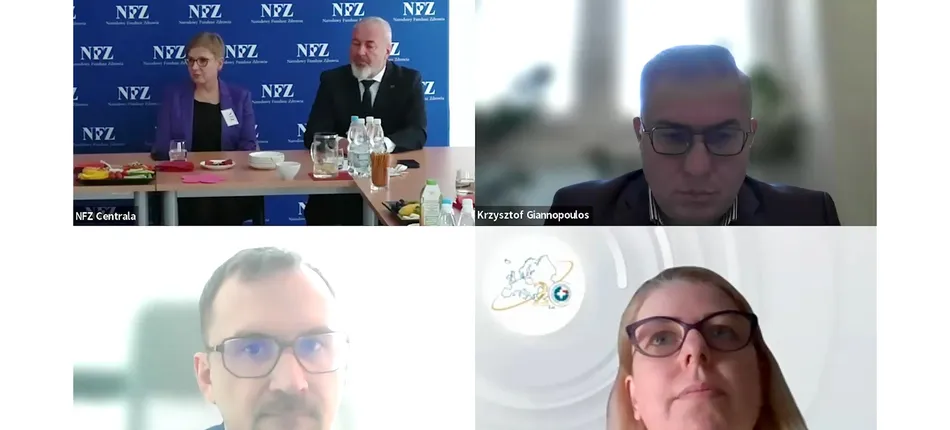
During the debate, which took place at the headquarters of the National Health Fund on April 3. Marek Augustyn, vice president of the National Health Fund, assured that the Fund is reviewing usable data resources. - This must be done in an extremely responsible manner. The goal of using this huge base is to improve patient treatment. We will make every effort to serve this initiative. We will make this data available, keeping an eye on compliance with data sharing regulations," he declared. - We would like to make the best use of this pool of money at our disposal, which is not unlimited, he added.
According to him, the Interactive Report on Key Indicators Describing the Treatment Process for Plasmacytoma Myeloma is an initiative to guide the treatment process and result in cost optimization. - The money we manage not to spend unnecessarily will be allocated to modern treatment technologies and further drug programs, he announced.
Hematologists have chosen myeloma
- We chose plasmocytic myeloma as a model disease for implementing the first interactive system because its treatment has been linked to the B54 program since its inception . We have a lot of data on the fate of patients ," explained Prof. Ewa Lech-Marańda, national consultant in hematology.
She informed that thanks to the report in the clinical-systems aspect, it will be possible to accurately map the fate of patients from the first line of treatment to the next. - We will assess the compliance of clinical practice with standards. Thanks to the analyses, we will know in which provinces and in which places in Poland the treatment could look better, how many patients are qualified according to the drug program for the line of treatment with autologous transplantation and how many receive it, what the further lines of treatment look like, how many patients benefit from the best therapies available in the drug program at the moment , she enumerated. - From a systemic aspect, it will be possible to obtain important information for the public payer on how the treatment is carried out, what the effectiveness of the therapy is, and if it is suboptimal, why. For patients, such analyses mean an increase in the quality of treatment, she added.
A mine of knowledge
According to Prof. Krzysztof Giannopoulos, president of the Polish Society of Hematologists and Transfusiologists, the interactive report will be a mine of knowledge that will allow experts preparing recommendations to see what is optimal, whether and which age groups could be treated better, to whom to direct education from hematologists, and from a systemic aspect to determine whether current solutions help bring reimbursement decisions to the level of optimal patient therapy. The data will answer why transplants are performed relatively late in Poland. - Now we have a regime imposed by the drug program - after four cycles of induction treatment, the transplant procedure should be performed. The data will show whether indeed this introduction of rigor in the drug program has improved the functioning of transplant centers. And as the P1 system expands, we would like to have insights into the supportive treatment and multi-disease status of our patients, he added.
Filip Urbanski, director of the NFZ's Department of Analysis, Quality Monitoring and Optimization of Benefits, assured that all relevant information is in the therapeutic program monitoring system. And supplementing this with data from services billed by the NFZ will give a complete picture.
- I will encourage us to focus on a more static area, so that we define for ourselves exactly what indicators we want to track, in what cross sections and areas. Then it will be possible to move on to technical implementation," he pointed out.
Influence on payer decisions
Filip Urbanski stressed that access to such information is critical, especially when more costly therapies are included in reimbursement. - As of April this year, we have two more molecules in the fourth line, which can generate a multimillion-dollar burden on our budget. Thanks to the interactive report, it will be possible to see whether we will actually observe in our Polish conditions the benefit that was presented in the materials at the level of reimbursement proceedings," he pointed out.
Iwona Kasprzak, director of the Department of Drug Management of the National Health Fund, added that the data will allow analysis of the effectiveness of treatment, because often what seems at first to be a promising therapy does not always turn out to be so. - And this can also be influenced by how treatment is carried out at individual centers. The report through such comparisons between centers will serve to improve quality," she noted.
Filip Urbanski added that the Health Ministry, as part of a major, rapid amendment to the Reimbursement Law, envisions the creation of a drug policy decision support system, and one of the elements is to be the use of data to evaluate and to monitor the therapeutic effectiveness of drugs included in reimbursement.
- Technologically, we are ready and we have the commitment of high-level hematology clinicians who are good at defining their needs," he declared.
Inverting the pyramid of benefits
- Currently, the NHF is focusing on reversing the pyramid of benefits. We are starting to work on such drug programs, in which it will be possible to receive patients in outpatient and same-day modes, " recalled Iwona Kasprzak.
Prof. Christopher Giannopoulos pointed out the report's potential to be used to evaluate the effectiveness of reversing the benefit pyramid.
- It is possible to analyze how it looks in each region and see if the inversion of the pyramid of benefits and increased accessibility to drug programs within the AOS, as we have advocated, would improve accessibility to modern treatment within the drug program for patients with plasmocytic myeloma," he said.
Prof. Ewa Lech Marańda also spoke about how important it will be for the National Health Service to check whether the huge funds allocated for treatment are producing the results they should. - If they don't, well, one has to wonder why. Inverting the pyramid of benefits and broad access to drug programs at lower levels of reference could improve this, she said.
Facts instead of perceptions
Marta Slomka, head of the Medical Technology Assessment Process Integration Unit, Medical Technology Assessment Department of AOTMiT spoke about the use of data in HTA assessment.
- In addition to the classic HTA evaluation, we are also involved in the evaluation and listing of highly innovative technologies, and the Reimbursement Act requires us to verify the practical effectiveness in Polish conditions of technologies that have entered the reimbursement list in just this way. The datasets here are invaluable," she pointed out
Iryna Laba, deputy director of the NFZ's Customer Service and Prevention Department, spoke a about the role of data for the department targeting standards and quality of service for patients who come to the NFZ's customer service rooms and points of service.
During the debate, experts and Fund officials agreed that anonymized and aggregated population data would allow clinical and economic decisions to be based on real and verified data from the local population.
According to director Filip Urbanski, opening data and making it available changes the level of discussion. - We don't refer to perceptions, but to, what we really observe," he concluded.