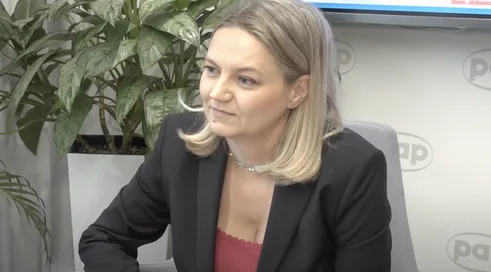
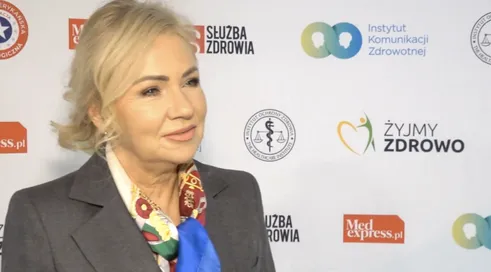
An interview with Prof. Karina Jahnz-Różyk, national consultant in allergology and head of the Department of Internal Medicine, Pneumonology, Allergology, Clinical Immunology and Rare Diseases at the Military Medical Institute in Warsaw.
Prof. Karina Jahnz-Różyk: Stop the allergy march

Published July 2, 2025 14:42
Professor, what are the key arguments for extending reimbursement of sublingual therapy for children as young as five years old as a preventive treatment in the development of the so-called allergic march, or even in the development of asthma? What benefits could this bring to the system in such a long-term perspective?
Allergen specific immunotherapy is a causal treatment for many allergic diseases caused by inhalant allergens. In Poland, these are most often house dust mites, but also grasses, cereals, weeds or animal dander; venoms of bitternut insects (but this is not a topic we would like to discuss today, as it is well organized in Poland). However, when it comes to inhalant allergens, we have two basic methods of applying this therapy, which is quite long. It lasts from 3 to 5 years. It can be a subcutaneous, or injection treatment, so the patient has to see a health care facility quite often at first, because he has to come every week for an injection, and then once every 4-6 weeks for 3, sometimes up to 5 years. The alternative is just sublingual vaccination, which is easier to arrange such treatment for patients, but including children.
We know that allergic disease begins in childhood. Most often it is a skin allergy caused by an allergy to milk or hen's egg, which causes atopic dermatitis, and this is the beginning of the allergic march. Then other allergens join in, which also cause allergic diseases: from rhinitis, conjunctivitis, but including bronchial asthma and just atopic dermatitis. And this is the treatment that breaks the allergic march, hence the idea to try to treat patients with immunotherapy also in these younger age groups, because we have a fairly well organized system of reimbursement of allergens administered subcutaneously, they are available in Poland, at good prices (patient subsidies for treatment, for example, for as little as PLN 3.20 you can get such a vaccine). Sublingual therapies, on the other hand, were until recently still more expensive therapies, because they were not reimbursed. What does this mean? If a treatment is unreimbursed, it is usually more difficult to make it available to the patient. However, why the idea to try to administer in these younger age groups: it is to inhibit the allergic march, interfering with the immune system, but in effect it is also asthma prevention.
We are very afraid of this asthma, because it is one of the more difficult allergic diseases, threatening the health, quality of life and sometimes the life of the patient. So even the latest international guidelines (we often use the GINA document - it's an international document updated every year) already indicate at this time that even in these milder forms of asthma, if the patient is sensitized to house dust mites, such sublingual treatment should be used.
Hence, in order for this availability to be there, without detracting from any of these methods, because we have to individualize this therapy, there are patients who require subcutaneous therapies, these are patients also who we are sure have taken the vaccine, so this is a compliance issue. On the other hand, if we are talking about sublingual therapies this problem of compliance can be somewhat different. This is especially true for adolescents - between the ages of 12 and 18. In the case of a young child, it is certainly the mother or father who will make sure that the medicine is taken. Whereas already in this older group, not necessarily. If the payer and the regulator, i.e. in our system the Minister of Health and the National Health Fund decide to introduce such reimbursable treatment, these aspects must also be taken into account.
In the context of sublingual vaccines, it is worth mentioning that not all allergens are available. In Poland, the most allergenic ones are available, namely house dust mites, grasses and birch, mugwort. Also, this is also an aspect that needs to be discussed. For now, the discussion revolves around the most common ones.
Professor, and from your clinical practice, how common is it for parents to opt out of starting sublingual immunotherapy because of the high cost of treatment? And what health consequences can this have for children?
We have to remember that with any chronic treatment we use, we always have to reckon that either the patient or the child's parents may abandon this treatment at some stage, because if the symptoms subside sooner, and despite the fact that we recommend that the immune balance be maintained, for various reasons such as price, the parents no longer decide to continue this treatment.
Sometimes there are side effects, but certainly we always have to think about the cost of such treatment, because certainly with regard to those vaccines administered subcutaneously, these proportions are different, this therapy is a more expensive therapy. I know that there is a reimbursement process going on right now precisely to allow sublingual vaccination for these young children as well, and we are waiting for that as well. Without belittling any method, we would like the treatment to be carried out by allergologists, because we have a very well-trained group of allergologists In Poland there are already more than 1500, so the number is sufficient. Of course, we can think about some kind of cooperation with family doctors, e.g. within the framework of coordinated care, because such a possibility also exists, but we must always remember that there will be no effectiveness of the vaccine if the diagnosis is not well made, and to prevent certain abuses associated with this, because, for example, there are patients who are allergic to several allergens, they have to take two vaccines, so this diagnosis at the moment is also very much developed, it is based on various molecular factors, so the diagnostic process is difficult and quite costly, this also needs to be said, and a topic that is important in my opinion, that is, the introduction of molecular diagnostics into the basket of services for some patients so that the diagnosis is good and the treatment is tailor-made.
Ms. Professor, in closing, I will still quote the results of the survey. 91% of parents indicated that reimbursement for immunotherapy would encourage them to seek treatment. In your opinion, would the decision to introduce reduce inequalities in access to effective treatment in real terms?
Probably yes, because as I say, where there is reimbursement, there is availability, and this applies not only to allergen vaccines, but actually to all drugs especially the more expensive ones.
There is also a very important aspect that I would like to raise, in the context of cooperation with pharmaceutical companies. Let's remember that we in Poland do not manufacture these vaccines. We are dependent on multinationals and the issue of reimbursement is one thing, but the other is the issue of availability related to lack of supply.
There was a covid period when we had a problem, related to the fact that the number of desensitized patients dropped sharply for various reasons: some did not want to come to the hospital, there were lockdowns. On the other hand, in all discussions at the administrative level, these are very important aspects, that is, ensuring continuity. Let's remember that it's not so simple to exchange one vaccine for another, just because we ran out of those at a particular time. Because if we want to change treatment, we have to start from the beginning. And here there is also such a small point, a small question mark, which always has to be considered in all reimbursement decisions also, that is, the company has to commit in a sense that this access will be.
Topics
astma / refundacja / alergeny wziewne / terapia podjęzykowa / immunoterapia / marsz alergiczny