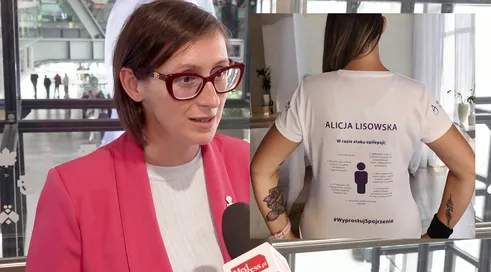
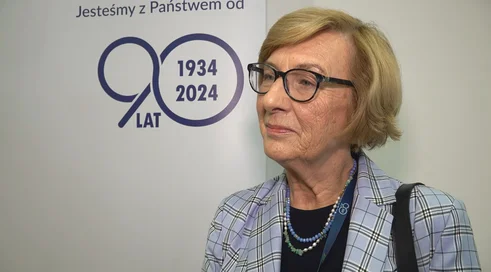
An interview with Anna Alicja Lisowska, founder of the EPI-BOHATER Foundation.
Anna Alicja Lisowska: We appeal because people with epilepsy have come to love themselves. Then they will open up to others

Published Feb. 14, 2024 12:00
Today is February 14. Everyone certainly knows that it is St. Valentine's Day, the Day of Lovers. Slightly fewer people probably know, however, that on this day in Poland we also pay special attention to people with epilepsy. "Love yourself" is the slogan of this year's campaign. What's behind it?
To add at the outset that Saint Valentine is also the patron saint of epilepsy sufferers. Hence World Epilepsy Day and our foundation's reference in the campaign to Valentine's Day. To love another person, we must first love ourselves internally. Epileptics do not have it easy in life. We have a lot of stereotypes and prejudices in connection with their disease. So it is very difficult for epileptics to befriend another person, to enter into any kind of relationship. Very often they think that this fault is on their side, that something is wrong with them. In this campaign we want to emphasize that everything is fine with them, that they are fantastic people, warm, kind, intelligent. They have a great deal to offer other people. But I appeal: love yourself first, only then go outside.
This self-awareness and self-love are crucial, but also not easy, because I think there is still a lack of knowledge in society about epilepsy, what the disease is. For example, many people are convinced that it is a mental illness.
Yes it is true. We must point out very strongly that epilepsy is a neurological disease. It is the disease that is most common in neurology, with 1 percent of the population, or almost 400,000 people, suffering from it. Just because someone has epilepsy doesn't mean they have any mental disorder. Very often we pass people with epilepsy on the street without even having a clue that they are sick. If an epileptic is hiding an illness, we might as well function with them on a daily basis, work, study.
Knowledge is that tool that can be a weapon against the lack of proper awareness in society. How encyclopedias provide a definition of epilepsy is therefore crucial. There has been some significant change.
We bow to the authors of the PWN Internet Dictionary, who, in contact with us, Professor Konrad Rejdak of the Polish Neurological Society and with the help of the Patient Ombudsman, decided to expand the definition of epilepsy. As recently as 50 years ago, everyone thought it was a disease where someone is walking down the street, for example, suddenly falls to the ground, gets a seizure, experiences a complete loss of consciousness. We know very well that 60 percent of epileptics have no such symptoms at all. An epileptic seizure does not equal only convulsions and loss of consciousness. It could just as well be a tremor in the limbs or loss of consciousness that is not accompanied by a fall. PWN, by changing the definition, has opened up a lot on this, which is very important for us. People who don't come into contact with epilepsy patients, but want to find out what the disease is, probably immediately typed the term into a search engine. Now they'll see a new search term that makes it clear that it's a neurological disease and that in addition to falling and twitching, there can also be muscle tremors.
However, there are a lot of people who do not seek this information. They need to be reached with knowledge. This is the foundation's task.
Our "You are not alone, you are not alone" campaign continues. Some of its activities have already been implemented. First of all, in this campaign we are trying to reach out precisely to outsiders who do not have sick people in their midst. We have created several videos in which we explain what an epileptic seizure is, how to properly provide assistance to a person who gets a tonic-clonic seizure, that is, falls and gets convulsions, often drooling. We also show the daily life of sick people and try to make it clear that on a daily basis it is no different from the life of a standard Kowalski. People with epilepsy also study, have families, go to work, and we show all this. There was also a billboard campaign. In eight cities in Poland you could see my likeness on bus stops. There was a telling slogan: Epilepsy - yes, I get sick. So what? In this way we wanted to show such an unhealthy desire to find out what the disease is. When we hear that someone is diabetic, we accept it without emotion. When someone says they are an epileptic, suddenly additional questions arise: When did it start? What does it look like? And is anyone in the family sick? How does it affect your life? This is often very embarrassing. Our foundation also runs a series of videos, interviews: "Epic Conversations." Tom we also meet epileptics who have different varieties of epilepsy, different epileptic syndromes, different types of seizures. We spend the whole day with them, not only talking about the disease, but taking part in a number of activities. in a number of activities, we have already painted pictures with Daria Luksza, who is a painter with epilepsy, the presenter baked a cake together with Epirella our blogger, who informs about what epileptic seizures are like and in general how to live with epilepsy. We try to be visible all the time. We are very happy that our Foundation is already getting noticed in some way. We get invitations to a number of conferences, we have already been to the Economic Forum in Karpacz twice, where we took part in a panel.