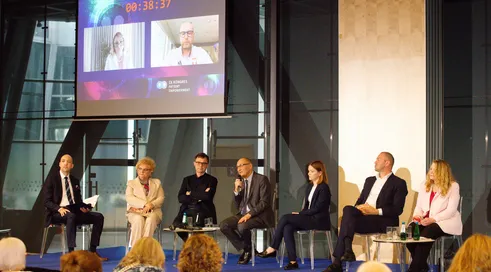
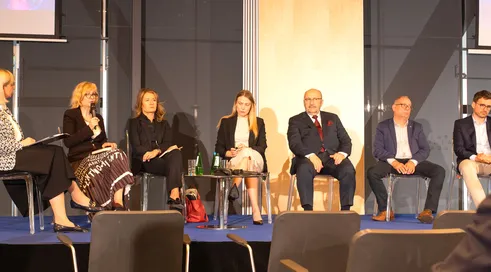
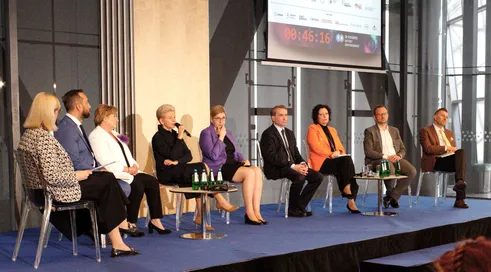
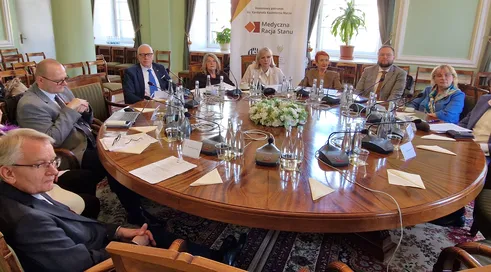
Are diseases divided into "pretty" and "not pretty"? Those that are widely talked about, and those around which there is silence? And how to change this situation at the local level, that is, where the sick live and function? These, among other things, were discussed during the panel "Health begins in the community - how local initiatives are changing approaches to prevention and treatment management" at the Patient Empowerment 2025 Congress.
Health begins in the community - how local initiatives are changing approaches to prevention and treatment management

Published June 17, 2025 07:28
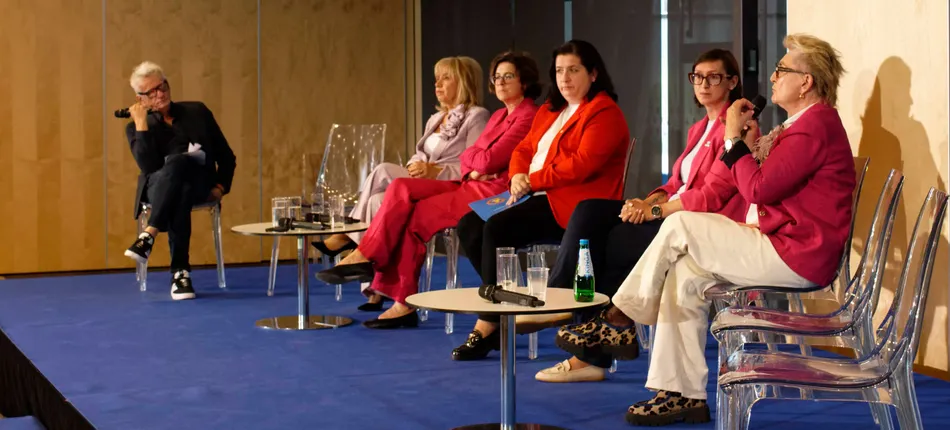
- Epilepsy is undoubtedly in the catalog of "disorderly" diseases - a thesis put forward by discussion leader Witold Laskowski was immediately confirmed by Alicja Lisowska, president of the EPI-BOHATER Foundation, adding that influencing public awareness and changing attitudes towards this - and other "disorderly" diseases - can in principle only be done at the local community level, where one can effectively talk, tame and educate. Epilepsy, as Alicja Lisowska stressed, undoubtedly needs education and taming. - According to a report we prepared as part of the "Straighten the Gaze" campaign, half of Poles believe that epilepsy patients should be isolated. More than half are of the opinion that a person having a seizure should have an object put in his mouth, which is absolutely forbidden," she stressed. - Poles' knowledge of epilepsy is poor. Poles do not know, for example, that 60 percent of epilepsy patients do not fall and have seizures, she reported, recalling that an epileptic seizure can take the form of a brief "suspension," after which the patient returns to previous activity or behavior.
The Foundation took the results as an opportunity to identify gaps and as an impetus to plan an educational campaign. To educate, as President Lisowska stressed, one can do it in various ways, for example - by running. - I have been running for ten years, because physical activity is even advisable in this disease. By running around Tarchomin wearing a T-shirt with information about my disease written on the back and tips on how to help me in case of a seizure, I educate. Even though there has been no seizure during these ten years of running," she said. Education is also served by "Lavender Days," dedicated to creating awareness about epilepsy. One way is to create opportunities - in shopping centers, for example - for healthy and sick children to play together. - This is an opportunity to see for yourself, to see that these children are the same as healthy ones, a chance to break stereotypes. - Local initiatives drill the rock," stressed Alicja Lisowska.
Certainly a much more media-savvy disease is diabetes. Prof. Anna Jeznach-Steinhagen, Department of Clinical Dietetics, Faculty of Health Sciences, Warsaw Medical University reminded us that it is actually a number of diseases with different causes. Type one is an autoimmune disease that absolutely requires insulin treatment for life. Type two diabetes, which is not insulin-dependent, is also not homogeneous, but the largest group are patients for whom it is a kind of complication of excessive body weight, an obesity-related disease (although diabetes can also develop as a result of pancreatic cancer or pancreatitis, or on an endocrine basis or as a complication of pregnancy). - Most cases of type two diabetes result from poor health choices, unhealthy behaviors. Inadequate nutrition, lack of physical activity, stress, smoking," the expert enumerated.
According to estimates, the number of people with diabetes reaches 3.5 million in Poland, of which more than a million are undiagnosed. One of the organizations working on their behalf is the Polish Association of Diabetics. As Monika Kaczmarek, president, said, the association has 330 branches in all provinces and has 50,000 members. The organization is focused on local activities, as it undertakes and implements many initiatives in cooperation with local governments. An example is the educational points, which operate not only for members of the association, but all patients with diabetes and their families, as well as people interested in the disease and its prevention. - Thanks to this, also residents of smaller towns and cities, where access to specialists is limited, can receive reliable, verified information," she stressed, adding that interest in either doctors' and nurses' duty hours or organized meetings is very high. At the same time, she pointed out that such activity, while very important, should not replace the system. - Every patient should have equal access to specialized care.
The tools available to patients and specialists at the moment to manage diabetes well, Prof. Anna Jeznach-Steinhagen assessed unequivocally: - We have a great deal. We don't have an artificial pancreas, but we have a great deal of modern, effective pharmacotherapy, including in a form that can be dosed once a week. For patients with type one diabetes, we have technologies, extremely effective in leveling the disease, primarily insulin pumps," she enumerated. Modern hybrid pumps, which operate automatically, represent another huge step toward controlling diabetes, as do sensors for continuous measurement of blood glucose. - This means moving away from point measurements, which on the one hand gives a huge improvement in the quality of life, and on the other hand is simply an educational tool, making it possible, for example, to choose a diet in such a way as to achieve optimal diabetes control.
The tools for controlling diabetes are increasing. - We need them very much," stressed Professor Maciej Malecki, Jagiellonian University Vice-Rector for Collegium Medicum, head of the Clinical Department of Diabetology, Internal and Metabolic Diseases at the University Hospital in Krakow, pointing out the importance of such solutions as prolonged-release tablets or preparations containing more than one drug. - Also worth pointing out are IT tools that remind patients of the need to take a drug or take insulin, programs that calculate the caloric content of a meal based on a photo or provide the number of carbohydrate substitutes. Undoubtedly, we are in a phase of dynamic development of medical technologies that meet the needs of patients and clinicians, facilitating the improvement of compliance, he assessed.
To what extent are patients themselves involved in the process of their treatment? The expert admitted that there is a sizable group of patients who treat therapy with great commitment, analyze every detail, ask about everything, even mobilize doctors (and themselves) to achieve even better results. Most patients approach the process without such commitment, but enough to achieve decent results. - There is also a not insignificant group of patients who are poorly committed, he said, stressing that this could be due to characterological issues, low awareness, but also concomitant diseases, cognitive disorders or dementia. Poor compliance translates into shorter survival, earlier complications or their more severe course. According to Prof. Malecki, doctors should all the time try to improve ways of reaching such patients as well. - A big part of this is the role of small, local, community-based groups in which it is easier to talk, he pointed out, adding that one environment in which such groups could function is, for example, universities of the third age.
Breast cancer, as recalled by Krystyna Wechmann, president of the Federation of Amazon Associations, was a taboo subject more than three decades ago. - In 1991, when I developed breast cancer, journalists avoided the topic of cancer in general, and breast cancer in particular. When the topic was taken up by "Twój Styl", when the Pink Ribbon appeared, and amazon clubs were formed, the topic became fashionable," she recalled the difficult beginnings. There are now 210 clubs nationwide for women who have undergone breast cancer. They, too - like branches of diabetes associations - operate locally, in consultation with local governments, primarily municipalities. And while breast cancer itself has ceased to be a taboo subject and has largely become a disease that can either be cured or lived with for many years, the biggest challenge in is breaking the taboo around prevention on the one hand, and organizing it on the other. - We spend the least in Europe on prevention, 2 percent of the health budget," Wechmann pointed out, hinting that part of the European funds should go to local government budgets not for infrastructure, but precisely for health prevention. - We have treatment at the European level, but prevention, unfortunately, not," she assessed.
Could nurses and midwives, of whom there are about 270,000 working in the system (there are 360,000 registered nurses), be more effectively involved in breaking various taboos? Mariola Lodzinska, president of the Supreme Council of Nurses and Midwives, pointed out that, on the one hand, nurses and midwives are increasingly better prepared, for example, to communicate with patients, thanks, among other things, to EU-funded training in soft skills. She also pointed out the still untapped potential of school nurses, not only in the context of conducting health education classes, but most importantly - making use of the data they collect. - There is a database in the drawers of school nurses that no one looks into, she recalled. The lack of computerization of school medicine means that nurses have no access to electronic medical records (the professional self-government has been striving to change this for years, she reminded). - Data from schools could be the basis for creating apt preventive health programs at the level of municipalities or regions, but decision-makers won't get to know them, because this data is not sent anywhere, she stressed.
The president of the nursing self-government also said that although the demand for increased investment in prevention is right and worthy of support, one has to wait not months, but years - and not just a few months, but even a dozen or more years - for the effects of prevention. - Hence the reluctance of politicians to invest more money, she explained.
Topics
Patient Empowerment