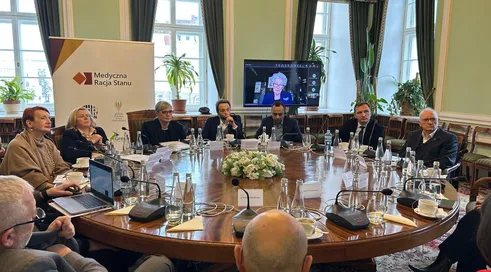
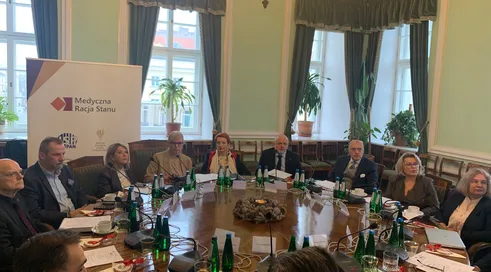
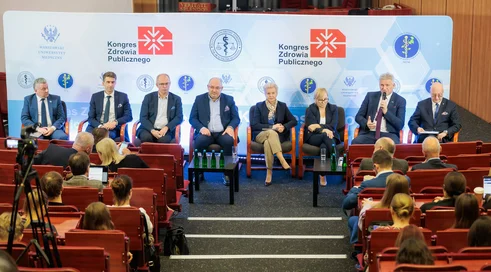
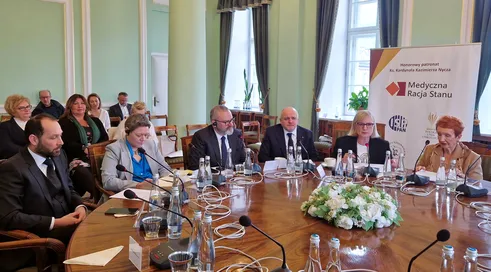
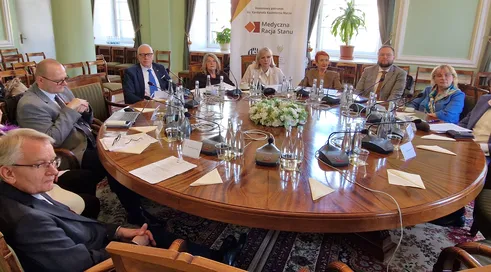
- Oncology is associated with dying and this stereotype should be changed, because cancer is already a chronic disease. In Poland, almost one million people have cured cancer and only undergo regular check-ups. But, unfortunately, the number of patients will increase, which is why we need to encourage medical students to choose this specialty," said Deputy Health Minister Prof. Urszula Demkow during the Medical Rationale of State "Health - a common value. World Cancer Day - Cancer Moonshot".
Medical Rationale
"Health - a Shared Value. World Cancer Day - Cancer Moonshot".

Published Feb. 7, 2024 12:17
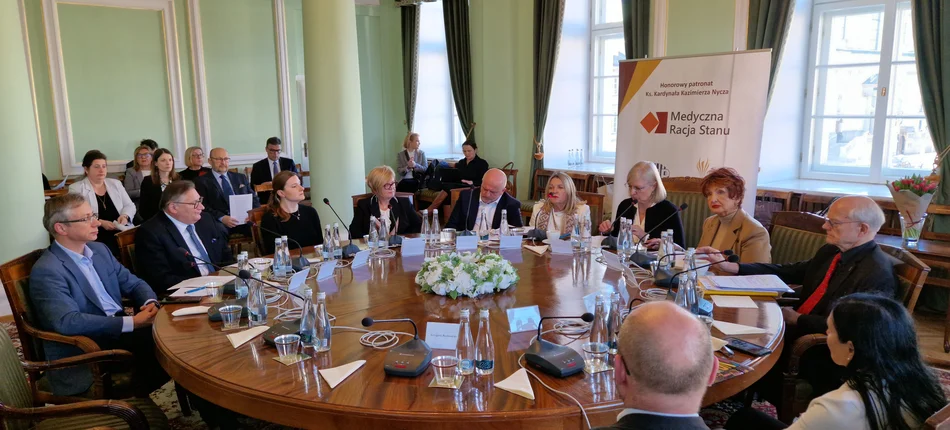
- There will be a 70% increase in cancer cases worldwide in the next 10-15 years, reported Dr. Janusz Meder, president of the Polish Union of Oncology.
- So let's bet on health management, because although disease management is pretty good, there are too many sick people," he added.
Prof. Maciej Krzakowski, national consultant in clinical oncology, admitted that there is currently an increase in cancer incidence and an even greater increase in prevalence. - Unfortunately, in terms of five-year survival, we are still below the EU average, he lamented. Therefore, in his opinion, there is a need for comprehensive treatment, i.e. the emergence of organ units, improved reporting for screening, availability of genetic testing and quality control of services. He also pointed to the role of family physicians in primary prevention.
1,300 oncologists are not enough
Prof. Maciej Krzakowski informed that there are 1,300 oncologists in Poland, while, for example, in the Czech Republic, which has almost four times less population, there are 1,500. Deputy Health Minister Prof. Urszula Demkow spoke of the need to introduce incentives for medical graduates to choose this specialty. - After all, this is a fantastic specialty that offers many opportunities, she stressed.
Staff shortages also apply to hematology. Prof. Ewa Lech-Marańda, national consultant in this field, informed that there are 593 hematologists in Poland and the rate per 100,000 residents is 1.57, while the optimal rate is 3 doctors per 100,000 residents. - Hematology is included in the list of priority specialties and every year there are more and more residents, but we have about 90 vacant specialty places, she added. Patients and hematologists are waiting for the introduction of the pilot National Hematology Network. The network is designed to improve and level the playing field for hematology patients across Poland. As Prof. Ewa Lech-Marańda emphasized, the pilot project of the National Hematology Network is ready and waiting for further action.
Prof. Maciej Krzakowski also mentioned the need to improve molecular diagnostics, which is used at an early stage of treatment with a radical goal.
Prof. Piotr Rutkowski, president of the Polish Oncology Society, said that a full package of molecular tests will be implemented this year. - We need to implement the National Oncology Strategy in a planned mode, he urged. - The work is strenuous, but it is yielding improvements in five-year treatment outcomes, spectacularly in some areas, such as prostate cancer and melanoma, he said.
Prof. Adam Maciejczyk, director of the Lower Silesian Center for Oncology, Pulmonology and Hematology and chairman of the AOTMiT Transparency Council, indicated that there is an urgent need for changes in oncology prevention. Patient Ombudsman Bartlomiej Chmielowiec recalled that we are still waiting for the implementation of the so-called "hour for health" in all schools. He recounted the results of a pilot study conducted in Spain, where education about health at school has succeeded in increasing enrollment in preventive examinations by several tens of percent.
The initiative to introduce such a subject to schools in Poland was supported by Katarzyna Skrętowska-Szyszko, director of the Social Affairs Team at the Office of the Ombudsman for Children.
Successes of hematology
Prof. Ewa Lech-Marańda stressed that the last few months have brought many positive decisions in hematology and fewer needs remain unmet. However, we still have too little success in the treatment of acute myeloid leukemia. Only 30% of patients survive 5 years, and most patients are not eligible for intensive treatment. The answer to these challenges lies in molecularly targeted therapies, which primarily allow to increase treatment efficacy and also reduce the risk of side effects of systemic chemotherapy in this difficult patient population. The results of the latest AGILE trial confirm that the newly registered drug ivosidenib is the first targeted therapy for IDH1 mutations, which, in combination with azacitidine, shows a more than 3-fold increase in overall survival of patients in this patient population. Prof. Krzysztof Giannopoulos, president of the New Generation Hematology Association and pro-vice-chancellor for the Doctoral School and Clinical Research at the Medical University of Lublin, spoke about the treatment of patients with plasmocytic myeloma resistant to lenalidomide and bortezomib. - Treatment with lenalidomide is carried out as long as it is effective. And already in the second line we have to deal with resistance. Then even three-drug regimens that include lenalidomide will not be effective. That's why we have to change the core of therapy to carfilzomib. And since the three-drug regimens have far greater efficacy, a regimen of carfilzomib with dexamethasone and daratumumab was desirable in reimbursement," he said.
Prof. Krzysztof Giannopoulos also reminded that in the treatment of patients with stage IV classical Hodgkin's lymphoma, as of January 1 this year, it is possible to use the brentuximab vedotin regimen in combination with doxorubicin, vinblastine and dacarbazine already in the first line of treatment. The results of a long-term registration study have confirmed the efficacy and safety of the A+AVD regimen relative to ABVD. It provides a benefit both in terms of time to progression, but also in terms of overall survival.
Problems of oncology
Prof. Tadeusz Pienkowski, head of the CMKP Department of Oncology and Breast Diseases and head of the Radom Oncology Center's oncology department, pointed out that women in Poland are still dying of cervical cancer. In his opinion, the promotion of HPV vaccination is insufficient, and the reporting of screening tests, as shown by the experience of other countries, can be improved by sending individual invitations in paper form. Prof. Barbara Radecka, head of the Oncology Clinic of the Opole Oncology Center
named after Prof. Tadeusz Koszarowski in Opole and the University of Opole, stressed that in the case of breast cancer, treatment options have improved greatly. - We are waiting for the reimbursement process for abemacycline to be completed for patients with early breast cancer with a high risk factor for recurrence, which in some patients is as high as 50%. Administration of this drug significantly reduces this risk. - She informed.
Among the unmet reimbursement needs, she also cited trastuzumab and derukstekan in a new indication with a specific cancer subtype, and the combination of two drugs, pertuzumab and trastuzumab in subcutaneous form, which simplifies administration, which reduces treatment time, frees up staff resources and the chemotherapy chair.
HCV elimination
For years, specialists have been calling for a National HCV Elimination Plan. Prof. Robert Flisiak, president of the Polish Society of Epidemiologists and Doctors of Infectious Diseases, chairman of the Team for Monitoring and Assessing the Situation of Infectious Disease Risks, reminded of the underestimation of infectious challenges despite the dramatic experiences of recent years. As a result of these, prevention of serious threats - such as HCV, if only because of oncological complications - should be gaining importance.
Prof. Robert Flisiak recalled that HCV testing is supposed to take place in PCPs, prisons and EDs, but this is not happening. - Cheaper cassette tests have not been made possible, GPs have limited tests and are afraid to perform them. Prison services, which should perform the tests when admitting convicts to the facility, do not do so, explaining the decision of prisoners, and the project for testing in the ED has been lost at the National Health Service, he lamented. - Meanwhile, it would cost about PLN 30 million a year and would eliminate HCV completely within five years, he stressed.
Also Prof. Krzysztof Tomasiewicz, head of the Department of Infectious Diseases at the Independent Clinical Hospital No. 1 in Lublin and vice president of PTEiLChZ, pointed out the importance of prevention of infectious diseases.
Treating obesity with cancer prevention
Prof. Mariusz Wyleżoł, president-elect of the Polish Society for the Treatment of Obesity and head of the Warsaw Center for Comprehensive Obesity Treatment and Bariatric Surgery at the Czerniakowski Hospital in Warsaw, noted that treating obese patients may prove to be the most effective prevention of malignant tumors.
The KOS-BAR pilot program, introduced in Poland, has been extended until December 2024. It is a globally unique value-based comprehensive health care (VBHC) program dedicated to patients with surgically treated giant obesity. Its uniqueness lies, among other things, in its long-term follow-up and support for patients, and in paying for the health outcome. KOS-BAR was entirely funded by a sugar tax.
KOS-BMI 30 PLUS, on the other hand, is designed to guarantee multidisciplinary care at a single center, ensuring coordination at every stage of treatment including monitoring of outcomes. The goal of the program is to improve the quality and effectiveness of treatment for patients aged 18 and older. years of age with obesity caused by excessive energy intake, who have a body mass index BMI of 30 or more and who have been diagnosed with at least one of the following complications of obesity: Prediabetes, type 2 diabetes, hypertension, dyslipidemia, obstructive sleep apnea requiring ventilatory support (CPAP), polycystic ovarian syndrome, metabolic syndrome, impaired liver function (elevated transaminases), need for weight reduction prior to planned endoprosthesis or other surgical treatment.
Prof. Artur Mamcarz, head of the Third Department of Cardiology at WUM mentioned familial hypercholesterolemia with a genetic basis. Considering the low detection rate of familial hypercholesterolemia in Poland and the dangers of this disease - associated with the premature development of atherosclerosis, ischemic heart disease and the resulting numerous cardiovascular events, such as myocardial infarction or stroke - it seems necessary to introduce screening among children in the form of a lipidogram during the balance of a 6-year-old. It is important to enable effective treatment of children from the age of 10 with genetically determined familial hypercholesterolemia, both heterozygous and homozygous. Current statins and ezetimibe do not achieve the therapeutic goal in most patients. Evolocumab, which is registered but not reimbursed in the pediatric population, would allow these patients to avoid developing atherosclerosis, ischemic heart disease, myocardial infarction and stroke at a young age in the future. Therefore, reimbursement of this therapy is expected.
Spectacular results of biological treatment
Prof. Zbigniew Żuber, head of the Department of Pediatrics at Krakow's Andrzej Frycz Modrzewski Academy, chairman of the Expert Council on Rare Diseases of the Medical Council of State, spoke about biological treatment. He stressed that patient comfort resulting from the forms of administration of these drugs has improved spectacularly. Prof. Brigid Kwiatkowska, national consultant in rheumatology daily, added that the patient must feel safe during treatment, which is why patients with stabilized disease should have the drug administered in an outpatient clinic rather than in the hospital. Providing the drug outside the hospital in an outpatient specialty care setting, that is, at the local clinic, the one closest to the patient, is a very effective solution. The drug would be administered to the patient at the time of the patient's cyclical health check and issued for continued therapy at home.
Prof. Brigid also spoke about the neglect of osteoporosis treatment. - In Poland, 2 million people suffer from it, of which 30% are diagnosed, and 5% take medication. The result is health and financial losses for fracture treatment and endoprosthesis. There are no screening tests and effective treatment incorporated at early stages. And the number of patients will increase. What is needed is diagnosis at the level of the PCP, that is, measuring the patient, not asking about growth," she recommended. She stressed that so far there is no anabolic drug in reimbursement, and this is how treatment should begin for patients in whom we want to prevent further fractures, disability and even death. In the reimbursement process is romosozumab.The reimbursement of romosozumab was included in the demands of the National Consultant in Rheumatology indicated in the 2023 report "The current state of rheumatology. "The current state of rheumatology and future directions of change - the perspective of the National Consultant in Rheumatology".