The Trade Union of Psychiatric and Addiction Treatment Workers has announced a protest outside the Health Ministry building for May 12. We publish the protesters' demands on Medexpress.
It's going to be May - a protest by addiction therapists

Published March 28, 2023 17:01
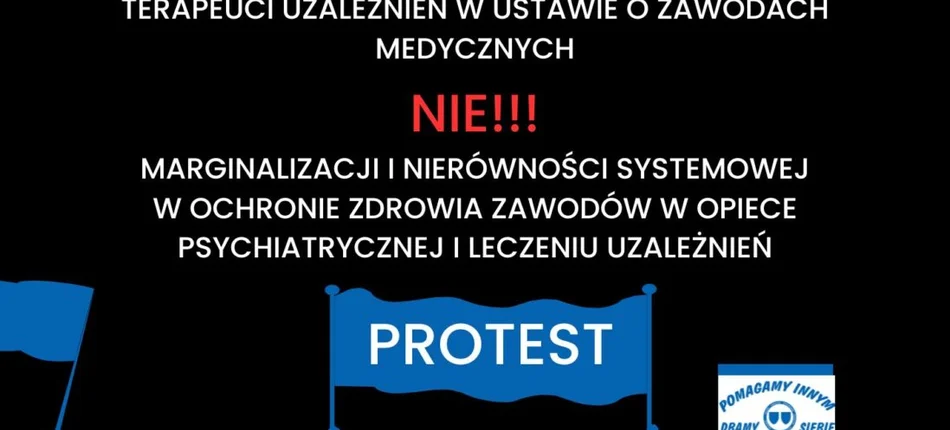
Included in the draft Law on Certain Health Professions (draft UD 328 dated 20.01.2022):
- psychotherapy/addiction therapy specialist,
- addiction therapy instructor
Since at least 2008, the addiction therapist community has been pushing for a piece of legislation that will ensure equal professional treatment in health care for this professional group. Included in the National Program for the Prevention and Solving of Alcohol Problems 2011-2015 was the goal of the Minister of Health to create a system of professional development and professional responsibility. Nothing of the sort has occurred.
Since 2015. ZZPLPiU has been taking up the issue and making the therapist community aware of the need for legal professional solutions. In 2020, there was a meeting with the MZZ. We received general and often evasive assurances about ongoing work to change the training of addiction therapists. The issue of professional law was again marginalized by the MZ.
In December 2021, on the occasion of the parliamentary debate on the draft Law on Amendments to the Law on Public Health and Provisions on the Powers of Addiction Therapists, MZ Undersecretary of State Maciej Miłkowski said that the issue of the medical profession of addiction therapists would be completed in the Law on Certain Medical Professions. The draft law was published in the Government Legislation Center in January 2022. Without the inclusion of addiction therapists.
It is extremely regrettable that the institution in charge of addiction treatment in Poland, i.e. the National Center for Addiction Prevention, does not support the inclusion of addiction therapists in the Law on Certain Medical Professions. The ZZPLPiU, as a member of the Team for Reform of the Addiction Treatment System - the chairman of the Team is the director of the KCPU - has voiced the ZZPLPiU's demands in this regard at meetings of the Team. According to us, the reform should change for the better not only institutions, training, but also strengthen the legal status of the health care profession.
The Union's speaking out on this issue has resulted in an informational cutoff from the Team's work which has been ongoing since October 2022. The Team is due to finish its work in June 2023, and the Union at this point does not know the recommendations on desirable, workforce and qualitatively better solutions for human resources in the addiction treatment reform being developed by the Team.
Inclusion of the profession of psychotherapy/addiction therapy specialist and addiction therapy instructor in the table of labor coefficients of the Law of June 8, 2017 on the manner of determining the lowest basic salary of certain employees working in medical entities by:
a) entering in the table in group 2 - psychotherapy/addiction therapy specialist,
b) entering in the table in the group - appropriate to the level of base education possessed instructor of addiction therapy,
c) modifying the table with the changes in salaries.
This demand emerged as early as 2017 with the passage of the so-called Health Care Salary Act. It turned out that employers had a big problem with classifying specialists and instructors into the appropriate group from the Act. There was - and in fact sometimes prevails until now - a great deal of confusion and , "free America. Admittedly, over time it has become accepted that a specialist should be in Group 6 - higher education - until 2021. Few employers even for those with a certificate gave gr. 5 - higher and specialization. An instructor, on the other hand, was given a group from the lowest to even gr. 6. The ZZPLPiU called for the names of the professions of specialist and instructor to be written into the Law from 2021. The Ministry of Health has not taken up this demand.
The situation has been exacerbated since July 2022 with another amendment to the Law and the revision and addition of groups. Despite the entry into force of other regulations - the Law on Amendments to the Law on Public Health and the Regulation of the Ministry of Health on the specialization of addiction psychotherapy - employers were willing to undercut groups for addiction therapists for several months. The reason and their arguments? You are not in the table as a profession, which means we don't have to treat you as a medical profession. At the time, the ZZPLPiU launched information on pay rights.
We have been approached by many therapists in the country for help. For several months, in at least 24 medical entities, therapists have been proving the legal basis for a raise - specialists certified for gr. 2 (higher education and specialization), instructors - here, unfortunately, it is much worse...some got gr. 6 but there are further cases that some employers treat them as non-medical staff. There are cases that their salaries are equivalent to cleaning staff....Now, puzzlingly, the problem with raises for certified specialists is seen in some teaching hospitals.
Why this demand? Because some employers are questioning the right of addiction therapists as a medical profession. In the context of a crisis in the funding of entities where the profession does not have solid support in professional regulations, there will be a gateway to interpret the rules to the detriment of this professional group. And I don't suppose the idea is that the employee should be stressed by the results of a PIP inspection or a labor court decision? Rather, these are options of last resort, which should not be the only way to assert one's rights.
In this case, too, unfortunately, ZZPLPiU could not reach an agreement with KCPU. We asked for a meeting with the MZ, the management of the NCPU and the ZZPLPiU to adopt a joint demand for the empowerment of addiction therapists regarding salary security. The union had substantive arguments prepared for discussion. This did not meet with the interest of the KCPU management.
Supplementing the National Mental Health Program for 2023 - 2030 with goals, objectives and directions for addiction treatment for children, adolescents and adults.
We are surprised that in the Program, despite the clear indication of the results of the EZOP II study that the main problem of mental disorders is disorders related to psychoactive substances (alcohol+other drugs) in people under 18 years of age, the Program does not formulate goals and tasks in this area for this group of people!
Similarly, there are no described goals for helping adults with substance use disorders or habits and urges disorders. These are not some new findings regarding adults in Poland. We have known about this for at least 20 years. How could the Minister of Health approve such a program?
In addition, the MZ points to the need to help children and adolescents with mental disorders and does not care to create a course of action for the 100,000 addicts or those at risk of addiction - these are also mental disorders.
Amendment to the Law of December 17, 2021, amending the Law on Public Health and certain other laws in Article 12, para. 2 after the pause of the discriminatory provision about the time-limited opportunity to take the State Specialty Examination.
According to the Association, this is a provision that treats unequally specialists trained until the entry into force of the above-mentioned Law from those trained later. In addition, the adopted criteria for the recognition of professional achievements before the PES are highly controversial for the Union and a significant part of the community.
A team of experts appointed by the National Consultant in Addiction Psychotherapy has created criteria that exacerbate inequality in the profession. We therefore want the MZ and others responsible for shaping the current changes to explain why they are introducing regulations that we perceive as discriminatory against addiction therapists.
Resignation by the Government of the draft Law on Industrial Disputes (UD 408).
According to ZZPLPiU, the draft is contrary to the Polish Constitution, particularly Article 59 , which speaks of freedom of association in trade unions. Introducing restrictions on the number or other criteria or requirements that a union would have to meet is interfering with this right.
We believe that the current Law, which has been in place since 2004, is a good one. We observe, also from our own example of conducting industrial disputes, that trade union organizations always have a weaker position than the employer anyway. We consider additional ideas that take away freedoms in this area by the Government - which declares itself to be from the Solidarity tradition - to be unfair and detrimental to labor, civil and human rights.
The above unsettled issues, and even those promised for implementation, have triggered in the Union the need to manifest to the MZ our disappointment and disagreement with such treatment of the medical profession. Since the Ministry does not want to meet with us in a social dialogue at the level of consultations, a substantive exchange of arguments in the form of a cabinet, the Union will come to the Ministry and speak out.
We invite all of you who have a civic spirit in you that is sometimes stifled, perhaps overtired by an excess of work to participate in the Protest on May 12 at 12:00 p.m. Let's not wait but act! We need you! Together we can achieve success!