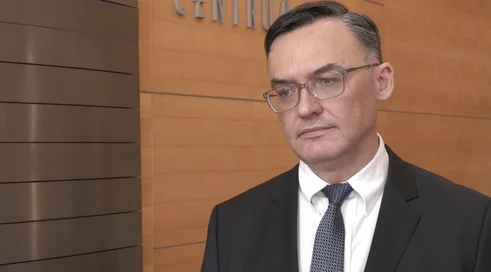
Interview with Prof. Konrad Rejdak, president of the Polish Neurological Society
Konrad Rejdak: Neurology plays an important role in the health care system

Published May 24, 2024 08:59
The brain health strategy in Poland began to be talked about intensively about five years ago. Has it been followed by action?
It is important to start this discussion, of course, because for years, despite the fact that the brain is the most important organ of our body, very little has been said about it. It was therefore necessary to initiate this discussion in order to break through with information about the important role the nervous system plays in our lives, but also the important role neurology plays in the health care system.
There are numbers behind what you say. About 40 percent of the population is struggling with brain diseases. This is a huge number of people. If these people are not taken care of properly, and prevention is not taken care of as well, the effects will be felt not only in the health care system, but in the economy as a whole.
Indeed, these estimates indicate the enormity of the problem. Let's pay attention to the fact that each of us experiences complaints from the nervous system, such as headaches and back pain, for example. 30-40 percent of people will unfortunately be diagnosed with a neurological disease during their lifetime. The scale of the problem is therefore enormous, and hence the need for urgent action. Demographics unfortunately do not favor us. The number of elderly people is increasing, and thus the share of nervous system diseases will increase, both in terms of neurodegenerative diseases, but also strokes and a whole long list of other ailments. Investing in prevention will therefore have very tangible benefits. We can protect ourselves from the invasion of all the problems associated with it.
Should these activities be clothed in something like a comprehensive strategy for brain health in Poland?
We are talking about two threads here. On the one hand, the strategy for brain health is aimed at the public. It's informing, educating, making people aware of the need to change their lifestyle, take diagnostic measures, start a diet, but also take care of their sleep hygiene. Very many factors can help protect us from diseases of the nervous system. The second issue, on the other hand, is addressed to policy makers and specialists. It is about understanding the essence of what care and building a proper neurological care system is all about.
This raises needs and challenges. What are they?
We are not just talking about money, although let's remember that over the years a very large backlog has accumulated. We are investing in cardiovascular diseases, in oncology, and we should also remember that the nervous system has the peculiarity that once it is damaged, it is difficult to repair, so we will see the consequences in the form of loss of neurological function, and therefore disability. There is also a need for changes in organization. We have a very well-functioning system of general neurological outpatient clinics, but a link with a higher degree of specialization is missing. The idea is to focus on specific neurological diseases. This will prevent patients from wandering. Also, we won't be wasting resources on duplicating tests just to meet certain system requirements, while we don't do the important ones, which are often costly, but which we can only do once for that. These are, for example, genetic tests, or biochemical tests, which are very specialized. These are not done as part of a regular neurology clinic.
What is the situation in Europe when it comes to such strategies? Do we have anyone to look up to?
We are part of a large community of European and global neurologists. Our society is also a member of the European Academy of Neurology, the most important and largest neurological organization in Europe. A campaign to promote brain health was undertaken there much earlier. It is also worth looking for inspiration in terms of systemic change. Of course, we have very different systems, different approaches. So problems need to be identified, and one ideal system for all countries will not be created, but we have a big contribution to make to the debate, and I am glad that colleagues from the rest of Europe are listening to us. I recently had the privilege of attending such a very prestigious European meeting, where we exchanged, among other things, views on how to promote brain health.