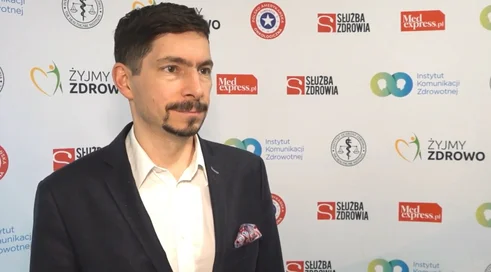
- This will be a year that will fall under the banner of Poland's presidency of the Council of the European Union. Our department will also be focused on these aspects in the first half of the year. We have great potential in new technologies - there are about 90 proceedings underway. We are also finishing the preparation of an amendment to the Reimbursement Law. This law has always stirred up emotions. So this year will be demanding," Mateusz Oczkowski, deputy director of the Drug Policy and Pharmacy Department at the Health Ministry, said in an interview with Medexpress.
Summary of the year
Matthew Oczkowski: We will enter the year 2025 with a bump

Published Dec. 31, 2024 07:33
The year 2024 is coming to an end. How can you sum it up from a drug policy perspective?
The year 2024 for the Department of Drug Policy and Pharmacy, as well as for the Ministry of Health as a whole, was a special year. On the one hand, our pace of work on making drug technologies available did not slow down, and in fact maintained a similar level. We had 135 new technologies introduced for reimbursement, of which 100 were for non-oncology indications and 36 for oncology indications. Among them, we also had about 35 technologies dedicated to rare and ultra-rare diseases. On the other hand, the uniqueness of this year also consisted in the fact that every three years we renew reimbursement decisions, including from the first announcement, which took place in 2011. That was several thousand decisions to be issued. In the last quarter, we focused on working on the January announcement.
We were still successful in that we provided lists of drugs from Polish manufacturers and a list of drugs with established efficacy in cardiology. This demonstrates a certain potential and interest on the part of responsible parties in submitting applications for indications that have already been rationalized and have never had success in terms of reimbursement coverage, as this has always involved the expenditure of about half a million zlotys, and the process took several months. We are proving that it can take as little as 2-3 months, which is especially important for cardiac patients. We have an example of one indication that can cover a group of up to 1.5 million patients. I used to work in a pharmacy myself, and not a day went by that at least 20 patients didn't ask about the price of a rivaroxaban drug. It was the Holy Grail that pharmacies were looking for. Now finally this indication, atrial fibrillation, will be made available to patients.
This year is also special because we also dealt with expanding availability, we focused on creating a list of critical drugs. The department also dealt with activities such as the process of creating automatic reimbursement. Work on this is nearing completion. What remains is to implement the tool and present it to the community.
I hope that we will enter the year 2025 with a bump, a year that will fall under the banner of Poland's presidency of the Council of the European Union. Our department will also be focused on these aspects in the first half of the year. We have great potential in new technologies - there are about 90 proceedings underway. We are also finishing the preparation of an amendment to the Reimbursement Law. This law has always stirred up emotions. So this year will be demanding.