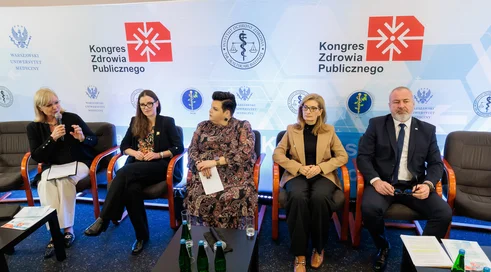
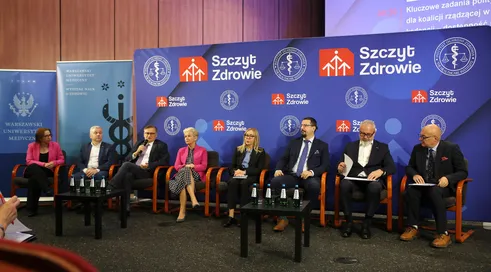
Poland spends less on prevention than other EU countries. And according to the WHO, it can prevent up to 50% of cases of civilization diseases or delay their development, which allows to reduce spending on treatment tenfold," stressed Dr. Janusz Meder, during the debate on June 4 this year.
Medical Rationale of State: Education, Prevention, Diagnosis - Foundations of Health Security

Published June 6, 2024 12:35

Medical Ration co-founder Grazyna Mierzejewska noted at the beginning of the debate that without education, prevention and good diagnostics, which make up the country's health culture, success in health care is impossible.
Experts discussed, among other things, the need for reimbursement of adult vaccinations to prevent many dangerous diseases, the need for reimbursement of pharmacological treatment of obesity disease, which generates more than 200 complications, including cardiovascular disease, diabetes and cancer, as well as so-called "embarrassing" diseases, whose treatment is often neglected.
We are not using medical advances
Prof. Jaroslaw Pinkas, national consultant in public health, reported more than 80,000 vaccination refusals in 2023. - We will witness a loss of population immunity and dramas caused by infectious diseases and their complications, which until now doctors in our country have not encountered - polio or measles, he warned.
Attorney Piotr Mierzejewski, director of the Administrative and Economic Law Team at the BRPO and co-chair of the Ombudsman's Health Expert Committee, also spoke about the need for broad access to vaccinations.
Prof. Krzysztof Tomasiewicz, head of the Department of Infectious Diseases at the Independent Public Hospital in Lublin, added that we do not use such effective and affordable medical advances as vaccination of adults. He talked about his patient who got life-threatening encephalitis as a result of complications from hemiplegia. - How much suffering and systemic costs we could avoid by spending a few zlotys on vaccination, he stressed.
Adult vaccinations
National consultant in infectious diseases Prof. Milosz Parczewski spoke about the need to implement infectious disease prevention in the aging population. - Vaccines that reduce the risk of severe infectious diseases in people 65 and older should be reimbursed for this age group, i.e. vaccinations against herpes zoster, RSV and pneumococcus - he mentioned.
Prof. Krzysztof Tomasiewicz added that the herpes zoster vaccination should also be reimbursed regardless of age to people who are particularly vulnerable to the disease, i.e. immunocompromised patients, cancer patients, those treated with chemotherapy, steroid therapy, immunosuppressive therapy and those infected with HIV.
Currently, 50% reimbursement for the herpes zoster vaccine is available to people 65 and older and those in at-risk groups. They have to pay 375.53 zloty for one dose, and you have to take two doses 2 months apart. For many, this amount is a serious barrier.
Hemiplegia interrupts treatment of other diseases
Shingles is an infectious viral disease to which people over 50 are particularly vulnerable. The disease is associated with the risk of numerous complications, and its distressing consequence is often chronic neuropathic pain resistant to treatment, which can severely impair quality of life and functional ability. In addition, the disease can force the interruption or delay of treatment for other conditions and affect their course. - The idea, therefore, is to vaccinate healthy people before they develop such conditions. This will allow them to get on the treatment path without the risk of interrupting it. This also applies to cancer treatment," Prof. Krzysztof Tomasiewicz pointed out.
Prof. Brigid Kwiatkowska, national consultant in rheumatology, noted that reimbursement of these vaccinations is needed for patients with autoimmune diseases, because many of the drugs used increase the risk of reactivation of hemiplegia.
Prof. Konrad Rejdak, president of the Polish Neurological Society, admonished the reimbursement of the vaccine for MS patients treated with immunomodulatory and immunosuppressive therapies.
Treatment of obesity
Grażyna Mierzejewska reminded that Polish children are the most obese in the European Union. And obesity is a gateway to more than 200 different diseases. She added that the composition of the committee preparing the assumptions and guidelines for the subject of health education to be introduced in schools from September 1, 2025 lacks, among others, a nutritionist.
Prof. Mariusz Wylezol, head of the Warsaw Center for Comprehensive Obesity Treatment and Bariatric Surgery at the Czerniakowski Hospital in Warsaw, reported that obesity increases the risk of cancer by about 50 percent, while treatment of obesity reduces the rate of death from malignant tumors by about 50 percent.
He reminded that patients and doctors are waiting for the implementation of the pilot program for conservative treatment of obesity - KOS-BMI 30 Plus. This is the second obesity treatment program after KOS-BAR. It assumes comprehensive treatment of obesity disease, but without reimbursement for pharmacotherapy. - And, unfortunately, among obesity patients, the majority are people who have severely limited financial means, he pointed out.
Prof. Lucyna Ostrowska, president of the Polish Society for the Treatment of Obesity, stressed that pharmacotherapy based on the so-called dual agonist of glucose-dependent insulinotropic polypeptide (GIP) and glucagon-like peptide-1 (GLP-1) receptors catches up with the effectiveness of bariatric surgery. It achieves a sustained weight reduction of at least 15-17 percent over time. Meanwhile, it is still not reimbursed, even in giant obesity.
Prof. Mariusz Wylezol appealed that, at least for the most obese patients, drug treatment should be reimbursed. - And so we bear the cost of treating all complications of obesity disease, he pointed out.
Urological diseases require therapy
Prof. Ewa Barcz, head of the Department of Gynecology and Obstetrics at the Medical College UKSW Międzyleski Specialized Hospital in Warsaw, spoke about the problems of urinary incontinence and pelvic floor diseases. - There is a lack of reimbursement for modern drugs and physiotherapy, she lamented.
As many as 30 percent of adult women in the Polish population will have some kind of pelvic floor disease, and after the age of 50 the incidence rises to as much as 50 percent The most common pelvic floor disorders are all forms of incontinence, lowering and prolapse of the pelvic floor organs, and fecal incontinence Urinary incontinence is a problem for up to several million women in Poland, and can not only reduce quality of life, but almost completely eliminate a woman from social activity.
Dr. Anna Czech of the Department of Urology at Jagiellonian University's Collegium Medicum reported that Polish patients with overactive bladder syndrome do not have access to the full range of pharmacological solutions recommended by Polish and European scientific societies. Among them is mirabegron, which is indicated for the symptomatic treatment of urinary urgency, frequent urination and urge incontinence, which can occur in adult patients with overactive bladder syndrome. Poland is the only country in the EU where the molecule has not been reimbursed, despite the fact that proceedings have been initiated twice.
Overactive bladder syndrome affects women 3 times more often, exposing them to suffering, feelings of shame and helplessness, and through this exclusion from professional and social life.
Dr. Anna Czech pointed out that further education, access to a urologist specialist without a referral, and increasing reimbursement for diagnostic and therapeutic procedures are needed in the treatment of prostate cancer. Currently, MRI-based biopsy is not reimbursed.
The challenge is also wider access to therapy so that the drug can be used according to clinical indications without administrative restrictions.
In bladder cancer, clinicians and patients are waiting for reimbursement for maintenance treatment after DD MVAC chemotherapy (doxorubicin, methotrexate, cisplatin, vinblastine) and the possibility of second-line immunotherapy for patients who received first-line chemotherapy and had disease progression during its course.