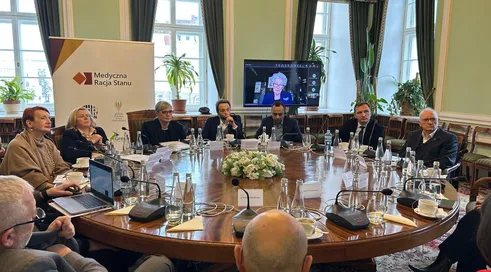
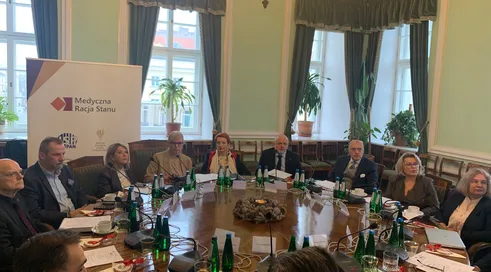
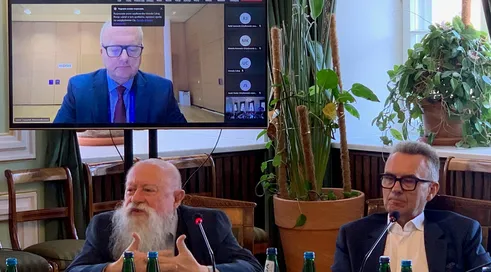
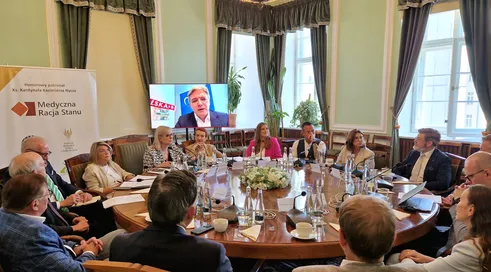
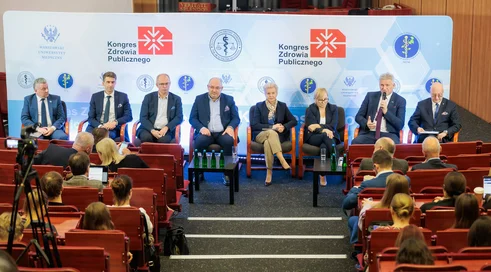
It is impossible to realize better healthcare and implement those solutions available to clinicians without raising healthcare spending, experts stressed at the December meeting of the Medical Rationale of State.
Relation
Medical Rationale: Europe and Poland facing the challenges of health

Published Jan. 9, 2025 08:06
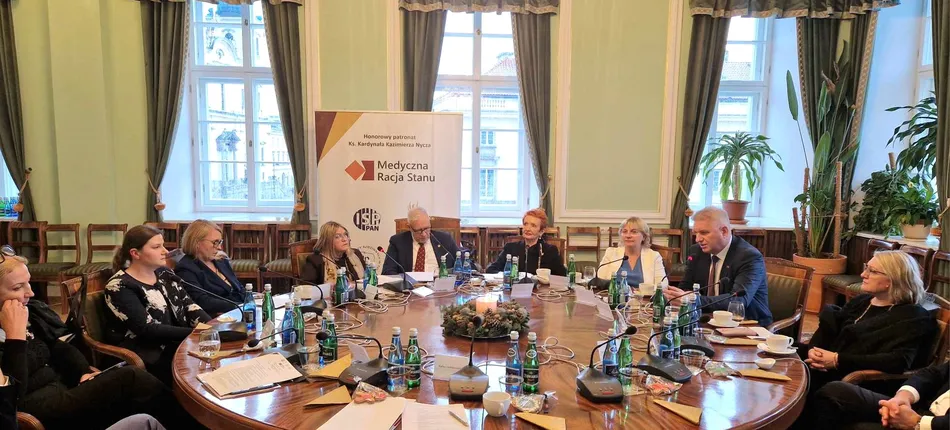
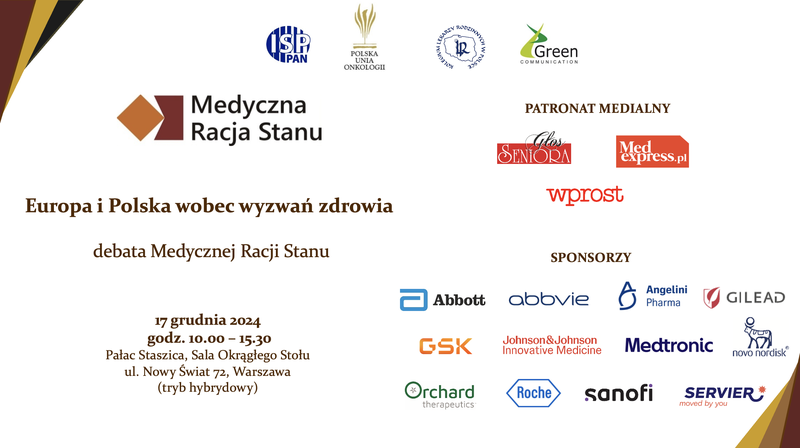
A meeting was held in Warsaw on December 17 to discuss the key challenges facing the health care system in the coming year. This will be, due to the Polish presidency of the EU, a special year. Poland has defined the priorities of its presidency, centered around the issue of security in the broadest sense. In health care, the leading topics will be, in addition to drug safety: digitization, prevention and the mental health of children and adolescents, which we want, as a country, to put permanently on the agenda of the European Commission.
- Although the area of health is the responsibility of member states, the European Parliament wants to take more initiatives in this area. Already in 2019, on the initiative of Poland, the area of cancer was dealt with by a specially established subcommittee. A European Cancer Plan has been created, and the declarations of the new health commissioner go in the direction of preparing analogous programs for cardiovascular and neurodegenerative diseases, among others," said Adam Jarubas, MEP (elected chairman of the new EP Health Committee in December). In turn, Prof. Boleslaw Samolinski spoke about common challenges of Poland and the entire European Union - such as demographic changes, addiction prevention, especially among the young (e-cigarettes!) or obesity.
However, as Dr. Jakub Gierczynski stressed in his summary of the several-hour discussion, the list of issues that can and should be addressed during the Polish presidency is longer. - The issue that is unquestionably the most important at the moment is the level of public spending on health, he pointed out.
- We must stand in the truth. Health outlays are growing, but they are not yet sufficient," said Deputy Health Minister Wojciech Konieczny. The Left politician was clearly at a crossroads: on the one hand, he stressed that the increase had helped solve the problem of health care salaries, for example, and on the other, he admitted that the amount of outlays would not allow the system to heal. - But this is already on the horizon, he argued, adding that we are past the time when it seemed necessary to "double outlays." However, Dr. Jakub Gierczynski, citing a November OECD report, stressed that looking at expenditures per capita (EUR PPP), Poland spends EUR 1.9 thousand, the Czech Republic spends just over EUR 2.8 thousand, and the EU average is close to EUR 3.6 thousand - so we're not much above the level where, to reach the average, we would just have to double outlays.
And while the discussion at the December meeting tended to focus on challenges and plans for 2025 (and probably subsequent years), the question of the financial framework within which decisions will be made resonated strongly in the background. Whether, for example, decisions will be made to expand accessibility to drug programs already in place. An example is the treatment of drug-resistant depression. The drug program is in place, but, as Prof. Piotr Galecki, national consultant in psychiatry, said, the exorbitant criteria mean that instead of about a thousand patients - as was assumed at the stage of work on the program - it covers about 150. After a year of operation, experts have prepared a proposal to change, to soften the criteria - the idea is to allow patients with a first episode of the disease to be included in the program as well, or to remove the age limit (75 years). This is important, as evidenced by the many voices of experts at the MRS meeting, emphasizing how big - and growing - a challenge the deteriorating mental health of seniors is. - Escetamine, unlike commonly used antidepressants, has an immediate effect. The patient gets the drug, ten minutes pass and he starts smiling," explained Prof. Galecki, adding that the drug also has high efficacy.
Some of the panelists formulated their concerns very directly. Prof. Leszek Czupryniak, emphasizing how much good has happened in the last few years in the area of diabetes treatment in terms of reimbursement - and therefore availability - of new therapies, even said that information about the crisis in the finances of the National Health Fund raises concerns about the possibility of not only halting progress, but even reversing some decisions. That's a black scenario, but not much less optimistic would be "only" a halt in a favorable direction for patients. Because diabetes epidemiology is one thing (as the expert estimated, there are about 4 million people living with type 2 diabetes in Poland, of whom several hundred thousand are undiagnosed), the obesity epidemic - for the treatment of which the same drugs are used - is another. This is one of the primary public health challenges, and at the individual level, a disease in which a doctor at the moment can offer a patient an effective (albeit unreimbursed) treatment. - Until recently, the only medical intervention was bariatric surgery, the specialist reminded.
Certainly, the reimbursement decisions on modern diabetes drugs made in 2019 can be considered a revolution. Now, as experts stressed, the revolution is primarily glycemic monitoring systems, the availability of which began to increase in January 2023. - It is known that the scale of reimbursement surprised the Ministry of Health," commented Prof. Czupryniak, adding that many patients at the moment cannot imagine life without this solution and the need for glucometers. - The benefits are obvious - elimination of severe hypoglycemia and halving of mild ones. The number of ambulance trips to hypoglycemic cases has decreased," he enumerated the benefits. In January 2024, reimbursement was extended to all pregnant women with diabetes. - At the moment, we are fighting for all patients on insulin therapy.
The incidence of type 1 diabetes is increasing, Prof. Czupryniak admitted, "We are diagnosing more and more young adults, but it is known that the disease does not start at the time of diagnosis, but several years earlier, and in its first stages certain combinations of antibodies appear," he explained. That's why individual countries are introducing or considering introducing screening of young people, precisely for antibodies. However, as Prof. Czupryniak stressed, these decisions are not free of controversy, including among doctors: the occurrence of antibody combinations is an indication that the disease may develop, not a diagnosis of the disease. The result can be quite a psychological burden. Will Poland follow in the footsteps of, for example, Scandinavian countries that perform such tests?
For now, another area where Scandinavian countries are also blazing trails is an even more pressing problem. As Prof. Czupryniak (who was echoed by other experts, including Piotr Mierzejewski, who represented the Ombudsman) emphasized, we are faced with the drama of many patients of senior age, especially the elderly, who have no one to take care of them after the hospital treatment stage is over. - The phenomenon of so-called "holiday babes," i.e. seniors dropped off at hospitals before the holidays or during the holiday season, is not all that common, although cases do occur. A real problem is the prolonged hospitalization, for example, in internal wards of seniors for whom no one is able to provide care. The family, at any rate a loved one, is not there, or even if they are and would like to take such care, there is no possibility to do so," he pointed out. According to Prof. Czupryniak, it is necessary to quickly make directional decisions on the integration of health care and social support systems. Not everything, as emphasized during the discussion, will be solved by a larger number of long-term care beds, because the rapid aging of the population makes the institutional care model financially unsustainable. - It is necessary to create conditions so that seniors are cared for as long as possible in their places of residence, experts agreed.
Although diabetes was for decades associated with senior age, it is increasingly affecting people who are relatively young - and type 1 diabetes primarily affects the young, including children. Prof. Małgorzata Myśliwiec, MD, provincial consultant in pediatric endocrinology and diabetology, emphasized the role of prevention of complications of the disease. - Continuous glycemic monitoring systems should not only be reimbursed for children and young adults. Insulin pumps are reimbursed until the age of 26. The result? We have the best compensated patients out of 56 countries, but then funding for pumps is withdrawn and these results are significantly worse, complications appear, she pointed out, stressing that Western European countries are increasingly moving away from monitoring diabetes with glucometers. - Modern technology means fewer sickness absences, fewer hospitalizations, better quality of life, she reminded. - Diabetes cannot be treated "moderately," because a patient treated in this way at the age of 60-70 will have all possible complications. The cost of treating them will be greater than the cost of good diabetes treatment.
A powerful block of issues addressed at the December MRS meeting concerned infectious diseases.
- Every time a new minister comes to the Ministry of Health, we submit a new proposal to create a National HCV Elimination Program. Very good drugs are available, on top of that they are getting cheaper and cheaper, so they don't put as much of a burden on the state budget. We have a reimbursable treatment program that works very well. However, the plan to eliminate this infection requires large-scale testing, so identifying people who are infected and don't know it. We have repeatedly said that this will avoid the enormous costs associated with treating cirrhosis, liver cancer, and transplants. The matter is simple, because the test costs a few zlotys, and we could have great success in the form of elimination of HCV. It's a shame for us that all the countries around us already have such a program," said Professor Krzysztof Tomasiewicz, president of the Polish Society of Epidemiologists and Doctors of Infectious Diseases, chairman of the Polish HCV Expert Group, during the Medical Rationale of State debate.
Dr. Michal Sutkowski, president-elect of the College of Family Physicians, reminded that anti-HCV testing is available in primary care within the budget entrusted to diagnostics, but they are not a substitute for screening. In primary care facilities, HCV testing is done annually for approx. 83,000 people, while in the meantime, in order to achieve the targets set for HCV elimination by the WHO, we would need to test a minimum of 2 million people annually. According to the recommendations of the Polish HCV Expert Group, screening should be carried out in primary care facilities, in EDs and in prisons (due to the high percentage of HCV-infected inmates).
The problem of HIV infection has been growing in recent years. Prof. Milosz Parczewski, national consultant in infectious diseases, reminded that there are about 2.3 million people living with HIV in Europe - mainly in Russia, Ukraine and Belarus, while our region, compared to other countries, is relatively least affected by infections. It is, or at any rate was, because since 2022 there has been a clear, even sharp increase in the number of HIV infections and also cases of other sexually transmitted diseases. And although we have a very good, one might say exemplary, program for treating the infected, at the present time we cannot say that we are in control of the situation. First of all, because we are not reaching the level of 95 percent of diagnosed carriers. - At the moment, it has to be estimated that even more than 20 percent of the infected are unaware of it, the expert said. This percentage could be as high as 30 percent. It is necessary, he stressed, to change the approach to testing, so that tests are performed and available to the public - in primary care centers, in hospitals (in the ED), but also for self-testing. A big problem is that up to half of those infected are diagnosed late, even with developed AIDS. It is also a problem that about 15 percent of diagnosed patients are untreated - mainly migrants. We also lack solutions for pre-exposure prophylaxis, although, as Prof. Parczewski reminded us, many countries fund it due to its high effectiveness in preventing new infections.
Dr. Pawel Grzesiowski, Chief Sanitary Inspector, also spoke about the need for an offensive and new opening in the approach to testing - in the area of HCV or HIV. As he stressed, this applies to all chronic infectious diseases, as the situation in the area of drug-resistant tuberculosis has also been changing in recent years - to the disadvantage. - The number of cases of drug-resistant tuberculosis is growing, the pandemic and the war have generated huge migrations, including from Africa and Asia, he recalled. The problem is also that patients are "disappearing," and monitoring solutions are lacking.
The GIS also announced steps to improve PSO implementation. A "census of vaccinated children and adolescents" will be launched in early 2025. - Health inspectors will visit PSO clinics to organize knowledge of vaccination (and non-vaccination) levels. In 2025 - perhaps in the middle - changes to the vaccination card are also expected, specifically, a shift from paper documentation to an e-vaccination card.
Will there be significant changes in the approach to vaccination of adults? Prof. Alicja Chybicka, who at the Sejm is in charge of, among other things, the health aspect of senior citizen policy, particularly admonished decisions regarding the herpes zoster vaccine. Although the vaccine is reimbursed for seniors, it still remains very expensive and inaccessible for a large part of this group, while seniors are not the only group that needs this vaccination: the list includes patients with autoimmune diseases, and, as Prof. Chybicka said, transplant patients.
Although the list of challenges, problems and even concerns raised at the year-end meeting was long, it is hard not to notice that successes were also talked about, as well as - hopes for positive resolutions to come in the coming months.
An undoubted success, Prof. Mysliwiec said, is the introduction of a lipidogram, a screening test for familial hypercholesterolemia, into the balance sheet of a six-year-old. Why exactly in the balance sheet of a six-year-old? As the specialist said, this balance sheet has a relatively high reporting rate - over 70 percent. - With the balance sheets of two- and four-year-olds, it is even below 50 percent. - she stressed. And although the balance sheet of a six-year-old will not be non-invasive, because it will be necessary to draw blood, thanks to this it will be possible to diagnose not only the child. - It is a test that literally saves the lives of many young adults, mothers, fathers of a child diagnosed with a disease, she reminded.
Experts have high hopes for plans to expand the newborn screening program and include more diseases in the panel. The Polish program is assessed as very good and working very well, but, experts said, the possibilities of medicine are advancing all the time and it is possible to diagnose (even) more diseases. - Newborn screening is an unquestionable success, we observe the development, expansion of screening programs in the world," said Prof. Jolanta Sykut-Cegielska, national consultant in metabolic pediatrics, while stressing that the expansion of the screening program must be accompanied by prudence. Because screening results provide opportunities - if there is therapy then treatment, if there is not, at least better preparation for the challenges of the disease, but a genetic deviation does not always translate into a symptomatic disease.
Of course, it makes sense to include new tests in the screening of newborns, especially when there are therapies available that can be used (or, at least, other forms of care, symptomatic treatment, support can be offered to the patient). During the MRS meeting, Prof. Alicja Chybicka announced a conference to be held in early January at the Sejm on metachromatic leukodystrophy, a genetically determined storage disease that impairs myelin development, leading to demyelination in the brain and peripheral nerves. Gene therapy - one of the most expensive drugs in the world - has been registered for MLD for several years. Experts want to prepare a solution along the lines of the SMA drug program. As Prof. Maria Mazurkiewicz-Bełdzinska, president of the Society of Child Neurology, stressed, there is hope that MLD treatment "will find its place in the system."
National consultant Professor Ewa Wender-Ożegowska spoke about systemic changes in the field of gynecology and obstetrics. As she stressed, one of the pressing problems is the implementation of the announcement on improving access to perinatal anesthesia. - Anesthesiologists are defensive about the simultaneous anesthesia of several parturients. One of the points in which we are chasing Europe," she admitted. On the other hand, one can speak of success when it comes to the availability of prenatal diagnostics. - The percentage of women who have benefited has increased by 25 percent, but some centers have problems with the National Health Service's billing of the procedures performed, she stressed, adding that the Health Minister has promised to regulate all procedures performed. The challenge is - among other things - vaccinations. - Pertussis vaccination, which has been free since October 2024, is still not very popular. It is necessary to build awareness among pregnant women about prevention," she said, emphasizing the role that midwives have to play in this regard. She also referred to one of the discussion threads, namely glycemic monitoring systems. - Despite reimbursement, the fee for many pregnant women is still prohibitive, and glucometer monitoring is not optimal, she admitted.
The issue of adherence, patient compliance with recommendations, also resonated strongly in the debate. - Sixty percent of patients do not adhere to medical recommendations. Adherence is a challenge, because we can reimburse more and more new therapies, but so what if patients do not cooperate. This also applies to patients who use free drugs - they fill prescriptions, the drugs linger in drawers, this way we won't achieve anything," said Grazyna Mierzejewska, one of the leaders of the Medical Rationale of State.
Topics
Medyczna Racja Stanu