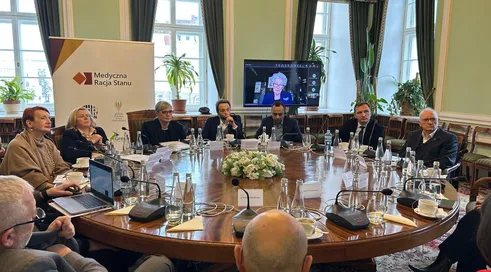
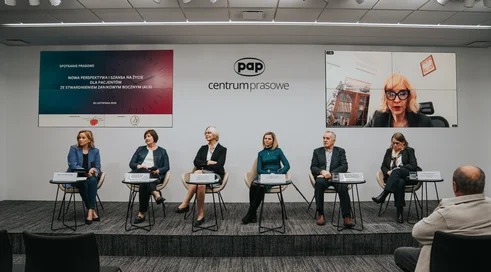
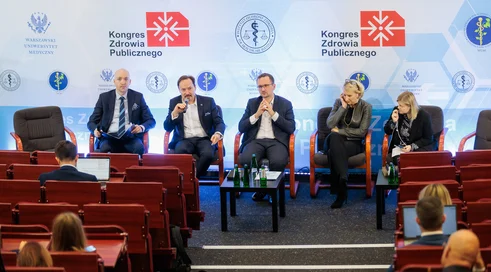
Poland's performance in pediatric cancer treatment is better than the European average. Unfortunately, in adult oncology they are 10% -15% worse than this average. How to improve these indicators was discussed by experts from the Medical Rationale of State during a debate entitled. "Time in oncology. Time for Oncology. A community of European challenges" on January 31 this year. The perspective and experiences of European countries were presented by representatives of Switzerland, the UK and Denmark.
Medical Rationale
Time in oncology. Time for Oncology. A community of European challenges

Published Feb. 4, 2025 12:04
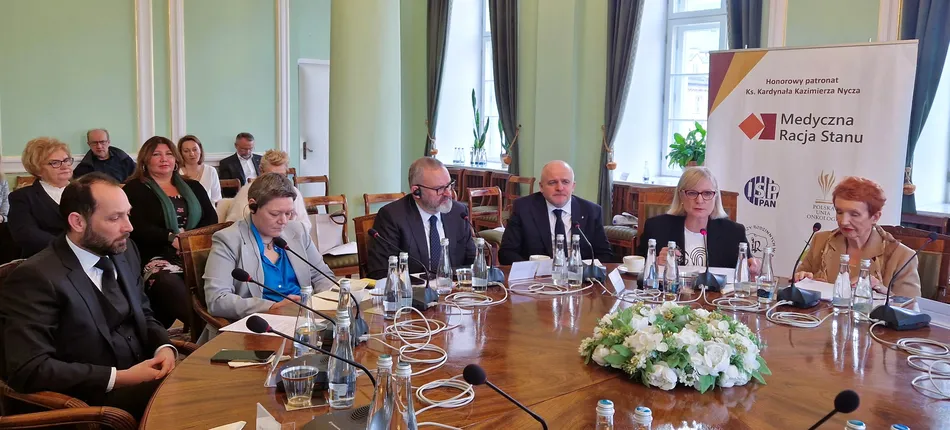
Deputy Health Minister Ursula Demkow recalled that the incidence of cancer is growing exponentially and younger and younger people are getting sick. - The cause is lifestyle, processed food, chemical-assisted agriculture, polluted water and air. That's why, as part of the EU's "One Health" approach, we all need to lean into the health issue. All ministries must keep the health aspect in mind," she pointed out.
She noted that in the context of Poland's presidency and one of its health security priorities - oncology is very important, because in addition to cardiovascular disease, cancer is the leading cause of death among citizens. - In terms of prevention and prophylaxis, we have a lot of catching up to do in order to detect cancer at an early stage. Early, rapid and efficient diagnosis is necessary. Within the framework of the national oncology network that is being created, patients with suspected cancer will be referred to the centers of highest reference, where they will also be provided with molecular and genetic diagnostics. Treatment coordinators will guide patients through the treatment pathway developed by the multidisciplinary consortium. Access to modern molecular therapies and immunotherapies is also needed, she enumerated.
Without modern diagnostics, there is no modern treatment
Prof. Artur Kowalik, head of the Department of Molecular Diagnostics at the Świętokrzyskie Oncology Center, lamented that in Poland, diagnostics is limping along and "dragging on therapy." - It should be the other way around. We plan diagnosis first and introduce therapy in parallel. Meanwhile, there is no way to reimburse tests that are performed on material taken in an outpatient clinic, such as molecular testing performed on an outpatient basis on material taken during a prostate biopsy, he pointed out.
Prof. Artur Kowalik called for the introduction of three baskets of diagnostic tests: simple, complex and advanced. He pointed out that today, in order to do a molecular and genetic test, a doctor orders a one-day hospitalization, the cost of which equals or even exceeds the price of the test.
- This is simply a curiosity, a waste of time for doctors and other staff at the hospital," he indignantly said. He added that a fourth basket with more advanced tests is also needed, but only for certain indications and not for everyone. - That, for example, a test should be performed when material from a prostatectomy performed many years earlier is not suitable, and to increase the possibility of opening the way to modern therapy for prostate cancer patients by performing a liquid biopsy of BRCA1, BRCA2. This is a costly test that the third basket did not include in reimbursement. Or, for example, a liquid biopsy test for lung cancer. Pharmacotherapy is developing in lung cancer, and in some cases there is also a problem with the quality or quantity of material," he pointed out.
The expert also called for referring patients to facilities that offer comprehensive diagnostics. - There may be a counter-argument that they will not be able to take care of all patients. But the point is to make a diagnosis, perform complex treatments. And further treatment can already take place in other facilities," he explained.
Access to innovative drugs improves treatment outcomes
Dr. Leszek Kraj of the UCK WUM Oncology Clinic pointed out that one of the most common cancers is colorectal cancer. - We are talking about 20,000 patients a year in Poland," he informed. He added that an increase in the incidence of gastrointestinal cancers is being observed, and in younger and younger patients. - When I started working 12-15 years ago, I don't recall 20-year-olds with colorectal cancer. Today I have such patients in clinical practice," he pointed out. He added that improving treatment outcomes requires an efficient diagnostic process, followed by rapid diagnostic and therapeutic decisions. - Unfortunately, we diagnose a large proportion of patients when we are dealing with advanced disease. These patients are no longer interested in prevention, but in access to therapy," he stressed. He added that taking into account European and American guidelines, treatment options in Poland are not bad.
Iga Rawicka,president of the EuropaColon Poland Foundation, drew attention to the situation of patients in terminal states, when quality of life is insanely important.
April 25, 2024. The EMA has given a positive opinion on the granting of marketing authorization for fruquintinib. The study showed that treatment with fruquintinib resulted in a statistically significant and clinically meaningful improvement in overall survival and disease progression-free survival time, regardless of previous therapies that patients had received. - We hope that this drug will be reimbursed in a while," she said. - We are aware of the NHF's financial problems, but the therapy affects a small group, she added.
Dr. Leszek Kraj pointed out the problem of inequality in access to treatment in different parts of the country. - We see a difference in the duration of diagnosis and the process of reaching a diagnosis," he said. He also called for making drug programs more flexible. - There is a huge bureaucracy behind it all. Today, an oncologist's work often boils down to navigating between these documents. Simplifying these procedures would certainly also improve this availability of treatment, he pointed out.
Aleksandra Wilk, director of the Lung Cancer Section of the "It Cures Itself" Foundation, stressed that she is grateful to the Health Ministry for extending the lung cancer screening pilot until the middle of this year. - I hold the ministry to its word that this will be in the basket of guaranteed benefits from the middle of the year. It will be the same program as mammography, cytology or colonoscopy," she added.
- After the positive opinion of the AOTMiT, we are waiting a second year for the introduction of comprehensive genomic profiling. This is not a test for all lung cancer patients. And because of the fact that there is no properly performed diagnosis, we are wasting money on drugs, because the patient gets a therapy at the beginning that will not work," she pointed out.
This is a problem of many chronic diseases, which generates medical, but also systemic and financial losses. In Poland they are estimated at 6 billion zlotys, in the EU at more than 120 billion euros. And it's not just money, because 200,000 people in Europe die every year because they don't follow therapeutic recommendations.
In turn, Prof. Maciej Harat from the Department of Neurooncology and Radiosurgery, Department and Clinical Division of Radiotherapy at the Prof. F. Lukaszczyk Oncology Center in Bydgoszcz spoke about the availability of innovations in glioblastoma multiforme. While nothing has changed in the reimbursable services catalog in Poland for more than 20 years, a few years ago there was a breakthrough in the world, both in therapy and diagnostics. This involves alternating magnetic field therapy and precise diagnostics using positron emission tomography with dedicated radioactivity. - While there are devices at almost every oncology center, the availability of rare radioactivity is very limited, he stressed.
Grazyna Mierzejewska, an MRS and PUO expert, and Iwona Schymalla, who moderated the debate, drew attention to the importance of adherence. This is a problem of many chronic diseases, which generates medical, but also systemic and financial losses. In Poland they are estimated at 6 billion zlotys, in the EU at more than 120 billion euros. And it's not just money, because 200,000 people in Europe die every year because they don't adhere to therapeutic recommendations.
By treating obesity, we prevent cancer
Prof. Lucyna Ostrowska, president of the Polish Society for the Treatment of Obesity and head of the Department of Dietetics and Clinical Nutrition at the Medical University of Bialystok, informed that those suffering from obesity have a high risk of developing cancer for various reasons. - The reason is the very clinic of this disease, as the presence of insulin resistance, which is a complication of diseased visceral lipocyte, generates the possibility of increased tumorigenesis in the body. There is also systemic inflammation, which increases with the enlargement of the visceral adipose tissue field and ectopic adipose tissue. There is also the phenomenon, at least in some patients, of hyperestrogenization of the system, as the adipose tissue stroma causes conversion of androgens to estrogens, so we have estrogen-dependent cancers," she pointed out.
She pointed out that a contributing factor to cancer in obesity sufferers is the Western diet model, i.e. a high-fat, high-protein, low-fiber diet. Hence the incidence of colorectal cancer. This diet also alters the gut microbiota, which is also a cancer risk factor. Also, the so-called dysbiosis in the gastrointestinal tract can promote both the phenomenon of insulin resistance and the worsening of inflammation in adipose tissue, she added.
She also pointed out that among patients suffering from obesity, cancer diagnosis is definitely delayed. - Patients suffering from obesity, especially grade II or III obesity, are less likely to go for check-ups, even gynecological ones, because of the stigma they may experience there and complain about. In addition, imaging diagnosis itself is more difficult due to the translucency of the tissues. The ultrasound itself, or the use of CT scans, the use of densitometry or MRI, can be a problem, because we are not always able to place the patient in the machine and diagnose them, she explained.
She reported that as a result, the results of cancer treatment for patients suffering from obesity are worse. - Regarding the development of a pathway for the obese patient, we are still at the beginning of the road, but experts have already been called to the Ministry of Health and are working on solutions to more effectively diagnose and treat the obese patient, she pointed out.
She added that this affects 9,000 people suffering from obesity in Poland.
Prof. Lucyna Ostrowska informed that 60% of cancers in Poland would not occur if there was no obesity, and 40% of cancers are related to obesity. - We have a lot of work to do. When it comes to treating obesity, we have very effective tools in the form of pharmacotherapy, and we can combine it with non-pharmacological methods. This really gives us very good effectiveness. However, in Poland, of these 9 million people, only 800,000 are treated, which is less than 1%," she lamented.
Without new technologies, we won't beat cancer
Arkadiusz Grądkowski, president of Polmed and member of the board of TechnoMed Europe, reminded that the National Health Service's budget is short of PLN 20 billion. - This does not inspire optimism. Meanwhile, 1 in 3 suppliers of new technologies do not choose Europe as their first launch site, 1 in 5 medical devices will go out of business in the next few years because the regulations here in Europe are so unfavorable. And 1 in 3 doctors are already noticing shortages in access to medical devices, especially those for treating children, he reported.
He stressed that problems should be solved in dialogue with the Health Ministry, not just at conferences. - It should be a dialogue at the working level, not just at the level of already drafted legislation. We lack the courage for systemic changes in Poland. And although outlays for oncology are increasing, patients do not feel the improvement. The solution would be to increase the competence of the provincial branches of the National Health Fund to facilitate communication with providers and distribution of funds. This translates into equipment, new services, new procedures. It would also be appropriate to empower national consultants and scientific societies to request the creation of new guaranteed services. The Ministry of Health should be obliged by a term to make a key decision so that this transfer of knowledge and decision-making about new technologies can just flow," he postulated.