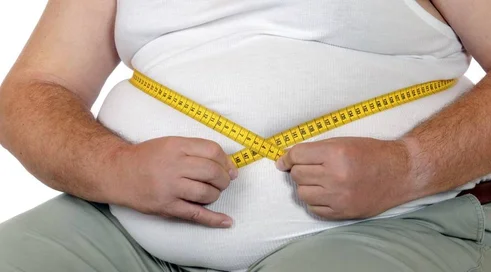
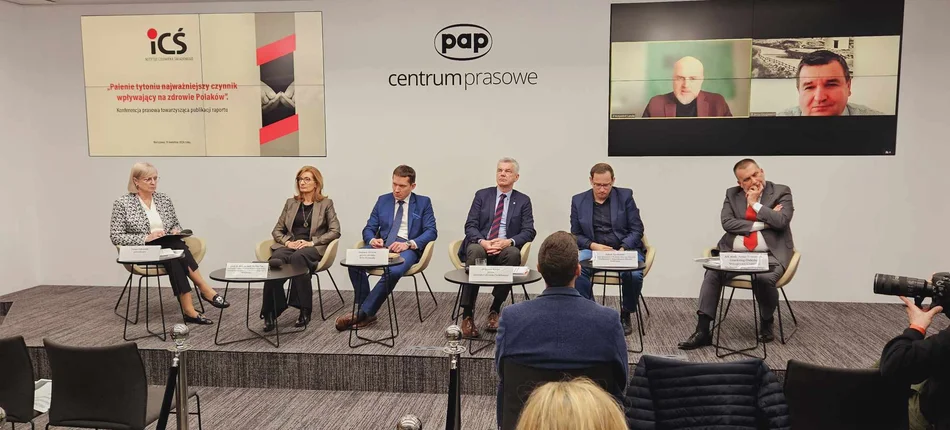
- The most years in health and the most years of life are taken away from us by smoking, high blood pressure and high BMI, i.e. overweight and obesity," said Dr. Janusz Krupa, president of the Institute for Conscious Man, during the presentation of the report "Smoking - the most important health risk factor in Poland," prepared by the WHO. From the recommendations in the publication, it is clear that a national anti-tobacco strategy should be created, including effective measures to reduce the percentage of smokers.
Will Poland be a smoke-free country? The condition is to change the anti-smoking policy

Published April 24, 2024 08:33
fot. Piotr Wójcik
The European Union assumes that, by 2040 at the latest, the percentage of smokers in the Community countries should not exceed 5%. For Poland, this means a very ambitious challenge, because today almost every third adult smokes. Translated into numbers, this is about 8 million people, so within 14 years 6.5 million Poles will have to be convinced to quit smoking.
- We should develop a national anti-tobacco strategy. We already have a lot of these strategies, but eventually there may be one that will then be implemented. We should consider the creation and strong position of an agency for the prevention and treatment of addiction. It exists in Poland, but it's really advisable that it has either more power or more influence on the shape of prevention in Poland. It is also necessary to ensure that public spending on addiction treatment is financed at a level of at least 0.1 percent of GDP. In Poland, an average of only 36 euros per person is spent on prevention annually," stressed Dr. Janusz Krupa.
According to the report's authors, a dense network of anti-smoking consultation points is also needed. Information about a patient's use of tobacco products, meanwhile, should be entered in the medical record. Health education in health lessons is also needed. As announced by the Ministry of Health, such a subject will replace upbringing for family life in the 2025/2026 school year.
- A national prevention program seems particularly relevant, especially in the context of the recommendation by the president of the Agency for Health Technology Assessment and Tarification on December 31 last year. The program we are proposing is based precisely on the AOTMiT guidelines. We need to separate the two important aspects of the problem, namely the issue of children and adolescents, where education is key, and adults, in whom we are talking about addiction and medical procedures are most important. The idea is to give these people the tools to quit addiction," explained Dr. Jerzy Gryglewicz, a medical market expert from the Institute of Healthcare Management at Lazarski University in Warsaw.
- Ideally, a program like the one we described would be implemented by the Ministry of Health, perhaps in cooperation with the National Health Fund. This would make it possible to cover the entire population. Should this prove unrealistic, this is a model that local governments could implement at their level," Dr. Jerzy Gryglewicz pointed out.
An alternative solution is to embed the program in a coordinated care framework.
The report's recommendations are also based on the experience of other countries. A model example in this case is Sweden, which has already succeeded in reducing the smoking rate to 5.6 percent. The tool the Swedes relied on was a harm reduction strategy. The approach was originally designed for those severely addicted to opioids, and consisted of giving patients struggling with addiction weaker agents in this category.
- Given the popularity of the use of snus, or tobacco pouches, it was easier to engage Swedes to switch to this product, but also to e-cigarettes, in order to stop smoking. The results of the study clearly show that switching to smokeless products means a reduction of 95 percent of the substances contained in tobacco smoke. These are very harmful and perfectly described substances. This approach clearly translated into the number of cancer cases and mortality from them," pointed out Professor Halina Car, head of the Department of Experimental Pharmacology at the Medical University of Bialystok.
New Zealand, the United Kingdom and Canada were the next countries to follow the path set by Sweden in the fight against nicotinism. The Brits introduced a government program in which e-cigarettes were distributed to nicotine addicts and provided them with education and behavioral support.
- Smoking itself is also a behavioral addiction. So nicotine sachets don't have the same effect as holding a heating pad or holding a cigarette. Patients don't want to be scared anymore. They know very well that smoking is harmful and they want concrete solutions to help them. There are a great many people who are quitting smoking for the umpteenth time, because it's not just a matter of willpower. Pharmacological substitutes are not as effective as we assumed. We need to change our perspective and look at the problem from the point of view of countries where the number of smokers is decreasing," stressed Prof. Halina Car.
The concept of harm reduction has been evaluated in a systematic review on the safety of various forms of nicotine. This form of research is considered the most reliable.
- It involved three different tracks. The first was an analytical track, which looked at the chemical content of smoke and the forms of various nicotine-containing agents. The second involved the evaluation of biomarkers, and the third involved clinically relevant endpoints, that is, the effects of nicotine-containing product from cigarettes to tobacco warmers, e-cigarettes and sachets on serious diseases of nicotine addiction and the use of these nicotine-containing products. They all confirm the existence of the so-called risk continuum. We know that regular cigarettes are the most harmful and contain a plethora of chemicals with proven carcinogenic effects. In heaters we already have a sizable reduction of these substances, in e-cigarettes most of them are practically eliminated, and in modern nicotine sachets we can no longer talk about any content of harmful substances present in the smoke at all," explained Dr. Krzysztof Łanda, founder of the Watch Health Care Foundation.
- Studies by international agencies show that behavioral support alone in smoking cessation yields an effectiveness of 8-10 percent. Seeking additional opportunities that can increase this effectiveness is therefore most welcome," pointed out Dominik Dziurda, president of HTA Formedis.
According to experts, primary care physicians should have a special role to play in implementing smoke-free policies. As Artur Prusaczyk, M.D., vice president of the Medical and Diagnostic Center, stressed, management of the implementation of the anti-smoking policy should largely rest with health managers.
- We have different strategies, but the implementation strategy is always missing. It involves defining a goal to be achieved by the president of the National Health Fund and the directors of the regional branches, followed by facility managers and medical staff. These goals must be consistently accounted for," explained Prof. Artur Prusaczyk.
According to Jakub Szymanski, chief specialist in the mental health division of the Department of Public Health at the National Health Fund, the focus should be on regulating the market for alternative products.
- If we say that they should be aimed only at mature consumers who would like to quit smoking, they should look and taste like cigarettes, so as not to encourage minors to reach for them, and this is a very big problem today," Jakub Szymanski pointed out.