Recipients of social services need more services in the community, but they value 24-hour facilities and do not want to cut back. Institutions have the potential to expand services in the community, but they face enormous organizational challenges and are afraid of change. Local governments provide too little support for the process. Deinstitutionalization is currently moving at different speeds, inspiring hope and anxiety. This is the main conclusion of a report compiled by Korczak University on care services in the regions.
Deinstitutionalization of social services is a challenge, but also a necessity

Published Feb. 21, 2024 10:58
fot. Piotr Wójcik
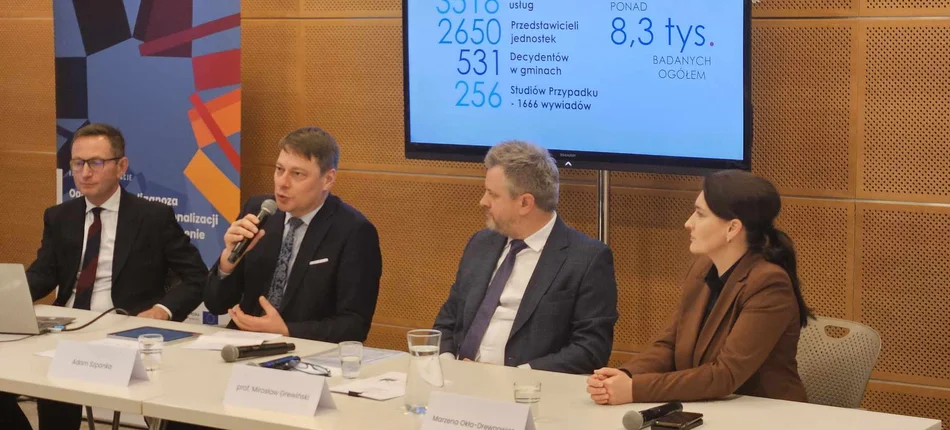
The report "Nationwide Diagnosis of Deinstitutionalization of Social Services in 16 Polish Voivodeships" was created as a result of nearly a year of research commissioned by Regional Social Policy Centers. The diagnosis was attended by more than 3.5 thousand service recipients, more than 2.6 thousand employees of social welfare institutions and more than 500 representatives of municipal governments. 256 providers of inpatient and community-based services were studied in detail. In total, more than 8,300 service recipients and providers participated in the survey.
- The discussion on deinstitutionalization has been going on for a very long time. The first guidelines from the European Commission appeared as early as 2012. This discussion is sweeping through various forums and has different layers. There is a substantive layer, that is, a discussion of arguments, but there is also an ideological layer. We wanted to lay the groundwork for this discussion and stabilize it a bit," says Adam Szponka, director of the Regional Center for Social Policy in Toruń.
Deinstitutionalization is particularly important in the aspect of senior care. This has to do with the aging of the population. Today, the elderly make up 25 percent of the population. In a dozen years or so, however, they will be 40 percent. Today's operating model prevents families from providing care services. Community-based services are already being developed in Poland, but their development is at different speeds.
- Seniors expect the development of community services. Also, the generation that will become seniors in a while would also like to see these services delivered to the home. This is an expected and desired change. For this to be possible, the environment must be prepared, have a full set of services," adds Adam Szponka.
- We are facing a great demographic challenge. There are too few analyses and diagnoses today related to the group of service recipients that are seniors. Diagnosis is the basis. We need to know the facts when it comes to the needs of seniors. We can't guess, we can't rely on intuition. However, the low awareness of senior groups about their needs must also be superimposed on this. Institutions are motivated to work on deinstitutionalization, but without knowledge, resources and support, they won't be able to cope," assesses Prof. Miroslaw Grewinski, rector of Korczak University.
As Marzena Okła-Drewnowicz, Minister of Senior Citizenship Policy, emphasizes, her role is to coordinate activities related to the deinstitutionalization of social services. One important challenge is to coordinate social care with health care.
- There is no way out other than for the Ministers of Family and Social Policy and Health to get along with each other. I am there to make this possible. At the next standing committee of the council of ministers, an order will be considered, which will stand at the council of ministers, to establish an inter-ministerial team to deal with the situation of elderly care and coordination. This is a very big challenge, but if we don't take it up, we will be on the curve in a while. We need to review the entire organization of the long-term care system, see what is not working and how to improve it," the minister points out.
The senior voucher is to be a tool to strengthen support services of a caring nature. In the first instance, it is to be aimed at those families that are active and their loved ones need this care.
- If we add money to the organization of these services, we will give a tool to make it profitable to appoint companies specializing in them. There will be something to hire assistants or caregivers for. Today, the gray market is flourishing," stresses Marzena Okła-Drewnowicz.