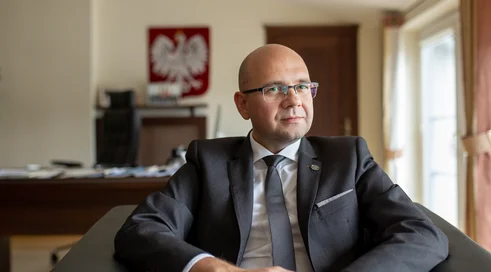
The information and education activities of public authorities in the fight against the phenomenon of "childgrooming" appear to be insufficient, according to the Ombudsman. According to research, gaining a child's trust through the Internet for the purpose of sexual exploitation is becoming a growing problem. Deputy Ombudsman Stanislaw Trociuk requests the director of the Scientific and Academic Computer Network Wojciech Pawlak to consider taking appropriate action on the issue.
RPO: Childgrooming a growing problem. Decisive action is needed

Published Nov. 22, 2023 12:10

Autorstwa Adrian Grycuk - Praca własna, CC BY-SA 3.0 pl, https://commons.wikimedia.org/w/index.php?curid=34910970
The RPO addresses the problem of sharing pathological content online, pointing out the significant risks of this phenomenon to the upbringing of children and young people. Recently, the Minister of Digitization reported that "the results of the 2018-2020 surveys on children's safety on the Internet testify to the declining interest of young people in the phenomenon of pathotreatment and pathostreaming. According to the 2020 Teens 3.0 report, the vast majority of teens (72.8 percent) give a negative answer to the question about viewing patostreams (65.9 percent in 2018), while 17 percent of teens confirm that they are viewers of such content (23.4 percent in 2018)." At the same time, it was stressed that "it is legitimate and even crucial to continue and develop information and education activities that raise awareness not only among children, but also among adults about cyber threats."
However, the RPO continues to receive complaints about patostreaming. Complainants express outrage and helplessness in combating this phenomenon. Information on the subject also appears in the public space. Thus, the problem still seems current and serious.
The Ombudsman sees that with the development of digital technologies, new threats are emerging, including such dangerous phenomena as sexting and childgrooming, among others. Taking into account the NASK report "Not for Show," which is an analysis of the results of a study on the publication of intimate content by young people, the Ombudsman addressed the Ministry of the Interior. He drew attention to the lack of sufficient knowledge and educational measures in the area of cyber-security for children and young people in the context of pathological sexual behavior on the Internet. In response, the ministry described its actions.
In this context, the Ombudsman notes the disturbing information about cases of grooming of children via the Internet, (childgroomig) by popular online influencers, which has been reported recently. The disclosures about child sexual abuse by influencers have highlighted the scale and severity of the problem.
The Ombudsman draws attention to alarming statistics from the reports of the NASK's Internet Watch Team. As indicated in the report for 2022, out of 6737 reported child sexual abuse materials, 2861 of them confirmed such incidents. It was emphasized that there has been an increase in confirmed incidents of child sexual abuse content. It is the highest since 2016, despite a decrease of almost half in the number of reports of such materials.
The reports also confirm the prevalence of the phenomenon. They show that "one in five 12- and 14-year-olds (20.4 percent) confirm that they receive requests or offers to send their own nude or semi-nude photos to others. Among older respondents, that percentage rises to 41.5 percent. One in four (26.6 percent) declaring receiving requests to send self-erotic material indicated that it happened in the last week, which means that the sexting phenomenon is current. Teenagers are most likely to receive messages asking for intimate materials from strangers, and these situations are more likely to affect the youngest Internet users (30.2 percent)."
In addition, compared to previous years, Dyżurnet.pl "has seen a steady increase in the number of incidents involving sexual blackmail. For adults affected by this phenomenon and who chose to report it to Dy¿urnet.pl, the number increased from 69 in 2021 to 100 in 2022. For minors who personally or through their parents sought help, the number increased from 3 to 16."
A significant increase in the scale of online grooming is also being highlighted by the Give Kids Strength Foundation. The 2022 report. "Risks of children and adolescents related to Internet use" indicates that a 2018 survey of a representative sample of children aged 13-17 found that as many as 9 percent of respondents answered affirmatively to the question "Have you ever made an online acquaintance as a result of which an attempt was made to persuade you to behave in a sexual manner?". This was the case for 5.1 percent of teens in 2013, and 3.3 percent the year before the survey."
As highlighted, "percentages may be understated due to the complex nature of the phenomenon. Since perpetrators of online child grooming often use sophisticated strategies of manipulation and deception, including pretending to recruit a modeling agency, a movie, etc., or simulating a deep friendship or romantic relationship (...), such contact may not always and in every phase be perceived by children as 'solicitation of sexual behavior.'"
It was also cited that "more risky behaviors related to meeting strangers were included in the Polish edition of the EU Kids Online 2018 survey (on a sample of children aged 9-17). The highest percentage of respondents admitted to looking for new friends and acquaintances online, while less frequently respondents declared sending online friends their photos, videos or data (...). In the same study, 44 percent of participants admitted to contacting strangers online, and 52 percent of them had met them in person (meaning 23 percent of all young people had met them). For 30 percent of those who met, it was an unpleasant event."
Therefore, in the opinion of the ROP, the information and education measures taken by public authorities in the fight against these threats still seem insufficient. Decisive action is needed for the benefit of children and young people. And the static data presented may not reflect the real scale of the phenomenon, as it is rarely disclosed and any services, including law enforcement agencies, are informed. The recent information about the exploitation of minors by popular influencers is an example of this.
The Deputy RPO therefore asks the Director of the NASK to consider taking appropriate action on this matter.
He also draws attention to the Ombudsman's investigation into the exploitation by patostreamers of vulnerable people. The Ombudsman has already addressed the Chairman of the National Broadcasting Council, the President of UODO and the District Public Prosecutor's Office on this issue, and is monitoring the proceedings in this case.
compiled based on: Office of the Ombudsman